

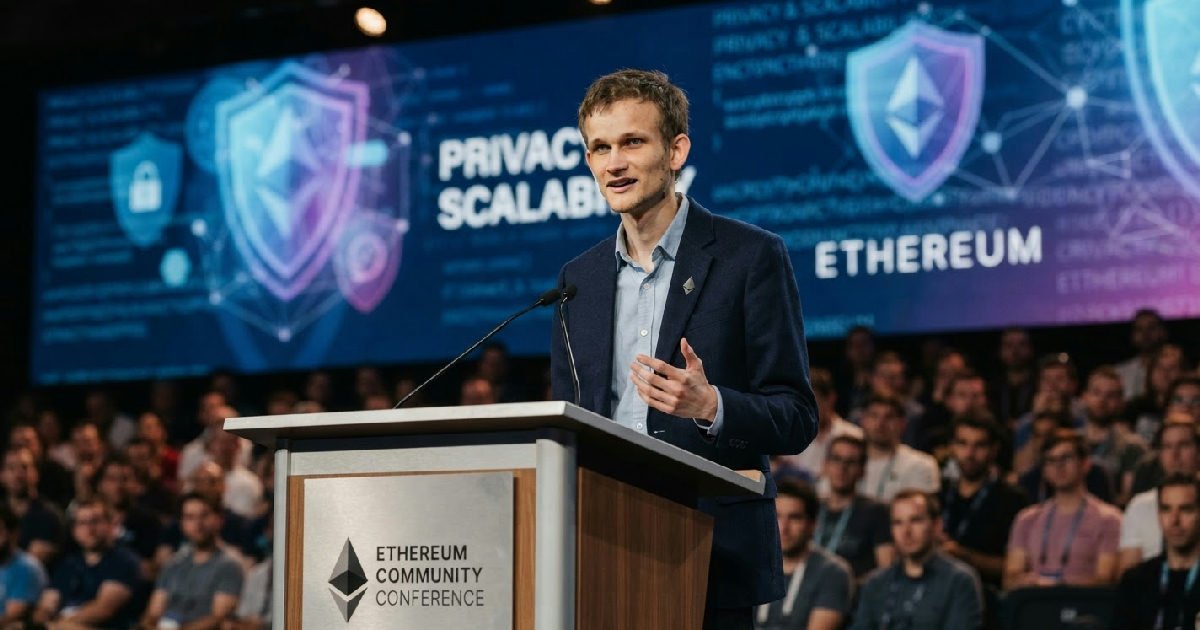
Vitalik Buterin reaffirms commitment to Ethereum privacy
Vitalik Buterin, the co-founder of Ethereum, has publicly reaffirmed his unwavering commitment to enhancing privacy features across the network. His declaration, made on X (formerly Twitter) on September 20, 2026, underscores a significant focus on private reads, shielded transactions, and robust censorship resistance for the world’s second-largest cryptocurrency blockchain.
Buterin’s terse but resolute statement—”I will not give up on privacy; rather, I will strengthen it further”—signals a clear direction for Ethereum’s ongoing technical development. This comes as the crypto industry faces increasing scrutiny and debate over the balance between transparency and individual user anonymity.
Privacy: A Core Tenet for Ethereum Co-founder Vitalik Buterin
Buterin’s recent remarks align directly with an August 2026 update to Ethereum’s roadmap, which identified privacy protection as a paramount priority. This consistent emphasis highlights a philosophical underpinning of the blockchain, aiming to provide users with greater control over their transactional data.
He’s long argued that Ethereum should serve as a hub for “sanctuary technologies,” offering open-source infrastructure where individuals can transact and communicate without facing external pressures. This vision places individual autonomy and privacy at its very core, reflecting the cypherpunk ethos that birthed much of the crypto movement.
Back in March, Buterin argued that Ethereum should envision itself as an ecosystem of “sanctuary technologies,” emphasizing open-source infrastructure for secure transactions and communication. Later, he articulated that Ethereum must not compromise on four core properties: censorship resistance, open source, privacy, and security. He collectively referred to these as “CROPS,” underscoring their foundational importance.
The dedication to these ideals remains strong, even as the regulatory landscape for digital assets evolves globally. Buterin’s public stance provides clarity for developers and the broader community on where key resources should be directed in the coming months and years.
Strategic Priorities for Enhanced Ethereum Privacy
Ethereum’s technical roadmap currently focuses on several key areas to deliver on Buterin’s privacy mandate. These initiatives aim to address the inherent transparency of public blockchains, where addresses, balances, and transactions are easily viewable by anyone.
One primary area involves private reads, designed to prevent infrastructure providers from discerning what specific data a user is accessing. This is crucial for protecting browsing habits and other potentially sensitive information on the blockchain. Furthermore, efforts are underway to implement private writes, controlling the visibility of transaction details when a user initiates a transfer.
A notable proposal in this domain is FOCIL, or “Force-of-Commitment-Inclusion-List,” which seeks to make it exceedingly difficult for powerful block builders to refuse processing transactions from privacy-focused protocols. This aims to bolster censorship resistance directly within the network’s core mechanics.
Researchers are also exploring a protocol-level shielded pool specifically for ETH and ERC-20 token transfers. Such a pool would allow users to conduct transactions with enhanced anonymity, obscuring sender, receiver, and amount from public view. These developments signal a comprehensive approach to embedding privacy deeply within Ethereum’s architecture.
The Role of Zero-Knowledge Proofs in Confidentiality
A significant part of Vitalik Buterin’s strategy for Ethereum privacy relies on zero-knowledge proofs (ZKPs). These cryptographic techniques allow one party to prove they know a piece of information to another party, without revealing the information itself. Buterin has consistently championed ZKPs as a vital tool for both privacy and scalability on the Ethereum network.
In July 2026, he introduced the concept of a “Lean Ethereum” upgrade, which would leverage ZKPs and STARKs to enhance scalability and validator privacy. This proposal aims to re-anonymize validators on a daily basis, making it much harder to link their deposits, staking activity, and withdrawals to a single identity. It’s a move to decentralize and anonymize core network operations.
Buterin’s advocacy for ZKPs extends beyond core blockchain mechanics. In December 2025, he outlined a proposal to use ZK cryptography to increase the transparency of social media algorithms. The idea was to enable verifiable algorithmic decisions without exposing sensitive user data, offering a novel approach to platform accountability.
However, he’s also voiced caution. In June 2025, Buterin warned against the potential for ZK proofs to undermine privacy and decentralization if used for universal digital IDs. He advocates instead for a pluralistic identity approach, acknowledging that while powerful, ZKPs must be applied thoughtfully to preserve individual liberties.
Expanding Transactional Anonymity with Stealth Addresses
Beyond zero-knowledge proofs, Vitalik Buterin has extensively explored the potential of stealth addresses to boost transactional anonymity on Ethereum. This mechanism allows for the generation of a fresh, one-time address for each transaction, effectively obscuring the link between a user’s public wallet and their activity.
His January 2023 blog post detailed a stealth address system designed to provide privacy for various digital assets, including ERC-20 tokens, non-fungible tokens (NFTs), and Ethereum Name Service (ENS) names. He noted that existing privacy solutions, such as Tornado Cash, primarily supported mainstream fungible assets, leaving a significant gap for other token types.
Buterin also expressed his support for implementing stealth addresses specifically for ERC-721 tokens (NFTs). In an August 2022 tweet, he highlighted how this technology could enable anonymous transfers, minting, and burning of NFTs. Such an integration would provide a much-needed layer of confidentiality in a market segment often criticized for its inherent transparency.
These explorations underscore a consistent effort to move beyond rudimentary privacy solutions and integrate sophisticated, native mechanisms directly into the Ethereum protocol. This strategic push aims to make privacy a default, rather than an optional add-on, for a wide array of blockchain interactions.
Challenges and the Path Forward for Ethereum Privacy
While Vitalik Buterin’s renewed emphasis on privacy provides a clear roadmap, implementing these advanced features isn’t without its complexities. Integrating sophisticated cryptographic primitives like zero-knowledge proofs and rolling out network-wide changes to support stealth addresses require careful design, rigorous testing, and broad consensus from the developer community.
The inherent tension between transparency, often seen as a cornerstone of blockchain security, and the demand for user privacy also presents ongoing challenges. Regulators, for instance, often push for greater transparency to combat illicit activities, which could clash with the very technologies Buterin champions. Balancing these competing interests will be crucial for the long-term adoption and acceptance of private transactions.
Buterin’s clear stance, however, reinforces the idea that privacy isn’t merely a feature but a fundamental principle for Ethereum’s evolution. As developers work on account abstraction, keyed nonces, and access-layer improvements, his vocal advocacy serves as a powerful motivator.
It suggests that despite public blockchain transparency, Ethereum is determined to offer its users robust confidentiality options. This continued push will likely solidify Ethereum’s position at the forefront of privacy-preserving blockchain innovation in the coming years, particularly as other networks also explore similar solutions.
It’s a long road, but one Buterin clearly isn’t giving up on.