

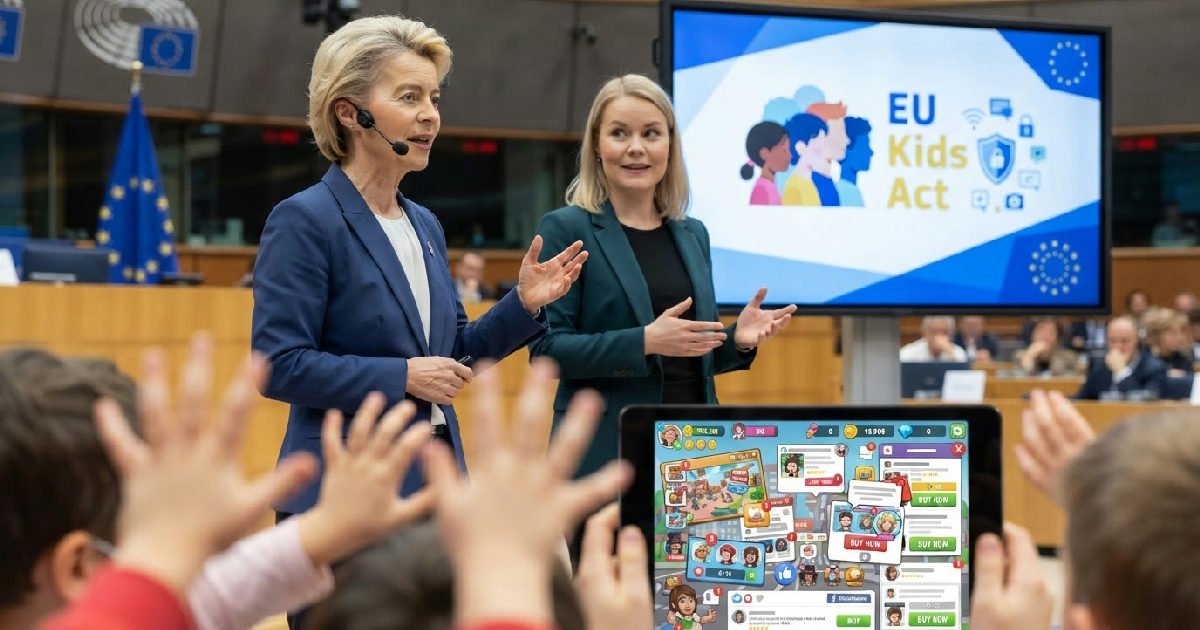
EU Kids Act targets online games and social media
The European Commission officially proposed the “EU Kids Act” on September 17, 2026, a sweeping legislative initiative designed to significantly enhance online safety for young people. This proposal, formally known as “EU Keeping Internet Digital Spaces Accountable and Trustworthy,” aims to impose strict regulations on social media platforms, AI chatbots, and online video games across the EU’s 27 member states.
European Commission President Ursula von der Leyen unveiled the plans on September 16, 2026, during her State of the Union address in Brussels. Executive Vice-President for Tech Sovereignty Henna Virkkunen joined von der Leyen in advocating for the act, which seeks to protect minors from risky digital services and address growing concerns about youth mental health linked to addictive platform designs.
Understanding the EU Kids Act
The core of the EU Kids Act introduces a tiered system for social media access, placing significant obligations on online service providers. Children under 13 would face a direct prohibition from accessing social media platforms altogether. Their online engagement would be limited to specially designed video-sharing services, accessible only through guardian-managed accounts and capped at one hour per day.
Teenagers aged 13 to 15 would be eligible for “mini accounts” on social media. Meanwhile, only individuals over 15 would be granted autonomous accounts, reflecting a graduated approach to online independence. This move directly addresses widespread concerns that current digital environments are not designed with children’s wellbeing in mind, exploiting their attention for commercial gain.
Impact on Gaming and AI Companions
While social media is a primary focus, the EU Kids Act extends its reach to online video games and AI companions. App stores would be mandated to age-rate every application and game using a published, standardised methodology. This requirement could significantly alter how games are developed, marketed, and accessed within the EU.
Online video games are explicitly expected to be impacted, though specific details for some categories remain uncertain. For instance, titles relying on geolocation data, such as Pokémon Go, might face restrictions if young users cannot freely opt into sharing their location. However, the legislation suggests an opt-in mechanism could mitigate some concerns for these types of online video games.
AI Chatbots Face Stricter Scrutiny
AI companions and chatbots are also under the microscope. The act proposes to prohibit these AI systems from simulating interpersonal relationships with young users in ways that could foster emotional dependency. This provision aims to prevent potential psychological harms from children forming unhealthy attachments to artificial intelligences.
The regulation underscores a growing recognition of AI’s pervasive influence on daily life, particularly among younger demographics. Lawmakers are moving to ensure that technological advancements do not inadvertently undermine the developmental and emotional stability of children and adolescents. It represents a proactive step to define ethical boundaries for AI interactions with vulnerable populations.
Age Verification and Default Privacy Settings
Ensuring compliance with age-gated access will rely on robust age assurance tools. The EU Kids Act would require online services and app stores to implement mechanisms like the proposed EU age verification app. For existing accounts, “reasonable proxies” such as account creation date or credit card details could serve as acceptable alternatives for age confirmation.
Beyond age restrictions, the act mandates several default privacy settings for minors’ profiles. These include making profiles private by default, automatically switching off access to microphones and cameras, and disabling geolocation data. These measures aim to curb data collection and reduce the exposure of young users to potential online risks, reflecting a “safety by design” philosophy.
Shifting the Burden of Proof
Notably, the proposal frames the restrictions as prohibiting platforms from “accessing children under the age of 13,” rather than simply preventing children from accessing platforms. This subtle but significant shift places the onus of responsibility squarely on the technology providers. It requires them to prove their services are safe and compliant, rather than asking users to navigate complex safety settings.
This approach aligns with broader EU regulatory trends that prioritize user protection and corporate accountability in the digital sphere. It reflects a growing impatience with self-regulation in the tech industry, especially when it concerns the most vulnerable users. Policymakers are clearly signaling that platforms must actively adapt their designs to protect children.
Precedent and Broader Implications
The EU Kids Act builds upon existing EU legislative frameworks, notably the Digital Services Act (DSA) and the General Data Protection Regulation (GDPR).
The GDPR, enacted in 2016, already recognizes children as a special category requiring specific data protection, with Article 8 mandating parental consent for processing data of minors under varying age limits (13 to 16 by member state). It also requires child-friendly language for privacy terms.
The DSA, which became effective in 2022, also contains provisions for minor protection, including prohibiting targeted advertising based on profiling for known minors. Guidelines published by the European Commission in July 2025 further emphasized “safety by design,” advocating for default private settings and limiting tracking. The EU Kids Act represents a further evolution of these principles, focusing specifically on children’s digital welfare.
Concerns Over Screentime and Mental Health
President von der Leyen highlighted the urgency of the act, citing statistics that show young Europeans spend four to six hours on screens daily. She noted that 92% of Europeans support stronger online protections for children and young people. “Today, our children are engaging with some of the most sophisticated technology ever created.
And it was not created with children’s wellbeing and development in mind,” von der Leyen stated.
Her remarks underscored the detrimental effects of platform design, which often prioritises attention capture and monetisation. Concerns such as sleep deprivation, depression, anxiety, self-harm, and even suicide were explicitly mentioned as issues exacerbated by excessive and unregulated online engagement. The legislation is a direct response to these profound mental health concerns.
Navigating Future Digital Landscapes
The introduction of the EU Kids Act signals a significant shift in the regulatory landscape for technology companies operating within Europe. Developers of online games, social media platforms, and AI companion services will need to re-evaluate their design philosophies and implement robust age verification and privacy-by-default mechanisms. This will likely necessitate substantial investment in new technologies and compliance protocols.
The proposal will now enter negotiations with the European Parliament and EU member states before becoming law. The process could see further amendments and clarifications, particularly regarding the practical implementation of age verification across a diverse range of digital services. Industry stakeholders will be watching closely to understand the full scope of their new obligations, shaping future digital policy.
This legislative push reflects a broader global movement towards greater accountability for tech platforms regarding their impact on youth. The EU, often a trailblazer in digital regulation, is once again setting a precedent that could influence policies far beyond its borders. Companies ignoring these changes do so at their own peril, as compliance failures could lead to significant penalties and reputational damage.
The act’s success will ultimately be measured by its ability to create a safer, healthier digital environment for Europe’s youth without stifling innovation. Balancing these two objectives presents a complex challenge, but the European Commission appears committed to prioritizing child wellbeing in the evolving digital age. It marks a critical juncture for how technology interacts with its youngest users.