

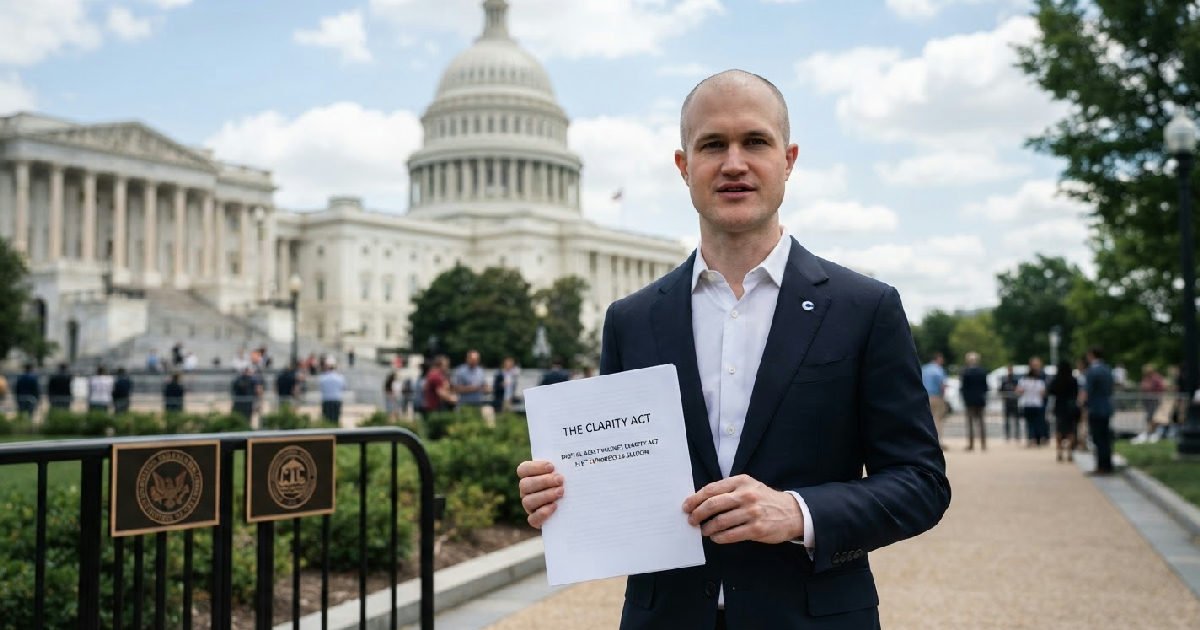
Coinbase CEO Brian Armstrong Foresees US Crypto Rules Regardless of CLARITY Act
Coinbase CEO Brian Armstrong stated today, September 10, 2026, that the United States crypto industry is poised to receive clear federal regulations. This clarity will emerge irrespective of whether the Digital Asset Market Clarity Act clears a crucial Senate test scheduled for September 15.
Armstrong emphasized that even if the legislation fails, federal agencies like the Securities and Exchange Commission (SEC) and the Commodity Futures Trading Commission (CFTC) are prepared to issue their own rules. His remarks suggest a pragmatic outlook, indicating a strong likelihood of regulatory progress in the near future.
Navigating the CLARITY Act’s Senate Vote
The proposed Digital Asset Market Clarity Act, also known as H.R. 3633, aims to establish a comprehensive federal market structure for digital assets. This framework would delineate oversight responsibilities between the SEC and the CFTC.
Under its provisions, tokens classified as securities would fall under the SEC’s jurisdiction. Conversely, decentralized digital commodities like Bitcoin would be regulated by the CFTC, creating a clearer division of supervisory power.
The upcoming September 15 action is a procedural cloture vote, which requires the support of 60 senators to allow the legislation to proceed to further debate. It is not the final vote to pass the bill itself, but a critical hurdle for its progression.
Brian Armstrong noted that negotiations leading up to this point have produced significant bipartisan compromises. He highlighted widespread support for the legislation from various stakeholders, including crypto companies, traditional banks, and law enforcement groups.
Crucially, Armstrong affirmed that Coinbase’s primary concerns with earlier iterations of the proposal have been successfully addressed. This indicates a positive shift in the legislative process, incorporating industry feedback.
However, the vote still faces considerable political obstacles. Persistent disagreements over ethics requirements for elected officials and provisions related to stablecoin rewards have presented challenges.
Reaching the 60-vote threshold demands support from Democrats or independents, which remains a key point of contention. The compressed congressional calendar further pressures lawmakers, with limited time remaining before the November midterm elections.
Regulatory Pathways Beyond Legislation
Even with the legislative uncertainties, Armstrong remains confident that regulatory work will continue. Reports also indicate that SEC Chair Paul Atkins has said the agency is preparing separate crypto rules.
These rules, according to Atkins, could operate effectively with or without the passage of the CLARITY Act. This parallel effort underscores a dual-track approach to establishing a clear framework for digital assets in the U.S.
The potential for federal agencies to act independently suggests a proactive stance from regulators to fill any void left by legislative inaction. This could offer a faster path to regulatory certainty for the crypto industry.
For market participants, this scenario means that clarity is likely on the horizon, regardless of the legislative outcome. It emphasizes that the government is committed to defining the operational landscape for digital assets.
Coinbase CEO Brian Armstrong has been vocal about the future of digital finance, focusing on emerging concepts like agentic finance. Such innovations rely heavily on predictable regulatory environments, highlighting the importance of clear guidelines for the industry. To understand how firms are building out infrastructure, it’s worth noting that some companies are actively seeking regulatory approvals for specialized crypto custody operations.
This approach could prevent prolonged periods of regulatory ambiguity that have historically hampered innovation and investment in the sector. It offers a degree of assurance to businesses operating within the crypto space.
Ethics and Stablecoin Standoffs
Key points of contention in the CLARITY Act negotiations include rules governing elected officials’ digital asset holdings. Armstrong acknowledged that “the details are still being worked out and negotiated” regarding potential conflicts of interest.
He noted that the White House has put forward an offer with what he termed a “very strong ethics provision.” However, Democrats are reportedly seeking more stringent requirements, including outright divestiture of digital assets by officials.
Despite these differences, Armstrong suggested that both sides “appear to be very close to a solution.” This ongoing negotiation highlights the complexity of integrating digital assets into existing ethics frameworks.
Beyond ethics, disagreements over stablecoin rewards have also fueled debate. JPMorgan CEO Jamie Dimon has openly criticized Coinbase on this issue, suggesting the exchange seeks regulatory advantages over traditional banks through the legislation’s stablecoin rules.
Without directly naming Dimon, Armstrong responded by asserting that companies with large payments businesses often have a “competitive issue.” He accused critics of “talking their own book,” implying self-serving motives.
He countered these criticisms by pointing to significant financial institutions such as Goldman Sachs, BNY Mellon, and Fidelity, all of whom support the proposed legislation. This indicates a divergence of opinion within the traditional finance sector regarding crypto regulation.
The debate over regulatory frameworks also touches upon the infrastructure for managing digital assets. Such advancements are closely tied to the clarity offered by new legislation.
Coinbase’s Vision for Agentic Finance
Shifting focus from regulatory battles, Brian Armstrong also outlined what he sees as Coinbase’s next significant market opportunity: agentic finance. This emerging field involves payments made by autonomous software agents.
Armstrong described agentic finance as “still early” but identified it as “the big TAM that’s on the horizon” for Coinbase. This strategic focus highlights the company’s efforts to innovate beyond traditional crypto exchange services.
Coinbase has actively built its agent payment infrastructure around several core components: Base, its blockchain network; the USDC stablecoin; and x402, a payment protocol designed to enable software-driven internet payments. This ongoing development positions Coinbase at the forefront of Coinbase’s AI-driven payments strategy.
He reported impressive early statistics, stating that “well over 90% of the agentic payments that have happened, you know, so far about 165 million of them, they’ve over 90% have happened on Base, the blockchain we created with x402, the protocol we created, and with USDC.” This positions Coinbase as a leader in this nascent sector.
The company has significantly expanded this infrastructure throughout 2026. In July, Coinbase specifically highlighted Base, USDC, and x402 as pivotal to its agentic finance strategy, coinciding with Base payments surpassing 100 million transactions.
These tools empower software agents to execute payments, procure services, and manage wallets according to rules predefined by users or developers. This automation could revolutionize how businesses and individuals interact with financial services.
Coinbase has also extended this technology into business applications. Coinbase Business began supporting USDC payments initiated by AI agents via x402 in July, simultaneously providing developers with tools to integrate this payment standard into their online services.
Bitcoin’s Bullish Outlook Amid Regulatory Developments
During the same CNBC interview, Brian Armstrong reiterated his optimistic long-term price target for Bitcoin. He affirmed that a price of $400,000 by 2030 remains “a reasonable target” in his estimation.
Armstrong went further to comment on the current market cycle, declaring that “the bottom is in on Bitcoin in this most recent cycle.” This strong statement provides a positive outlook for investors following a period of volatility.
His recent comments echo sentiments expressed in August, when he suggested that Bitcoin could be at the beginning of its next bull cycle, particularly as the cryptocurrency traded above $72,000. At that time, he also flagged the September 15 CLARITY Act vote as a major policy event for the market.
Armstrong’s aggressive long-term Bitcoin outlook is rooted in his belief that crypto adoption could reach billions globally by 2030. He anticipates digital assets will increasingly integrate into payments and broader financial services.
For now, attention remains fixed on Washington, where the September 15 cloture vote will determine the immediate fate of the CLARITY Act. Should it fail to clear this procedural hurdle, Armstrong is prepared for the SEC and CFTC to move forward with their own rulemaking initiatives within days.
The digital asset world continues to face evolving regulatory and technological landscapes. This underscores the broader, interconnected challenges and opportunities facing the industry.