

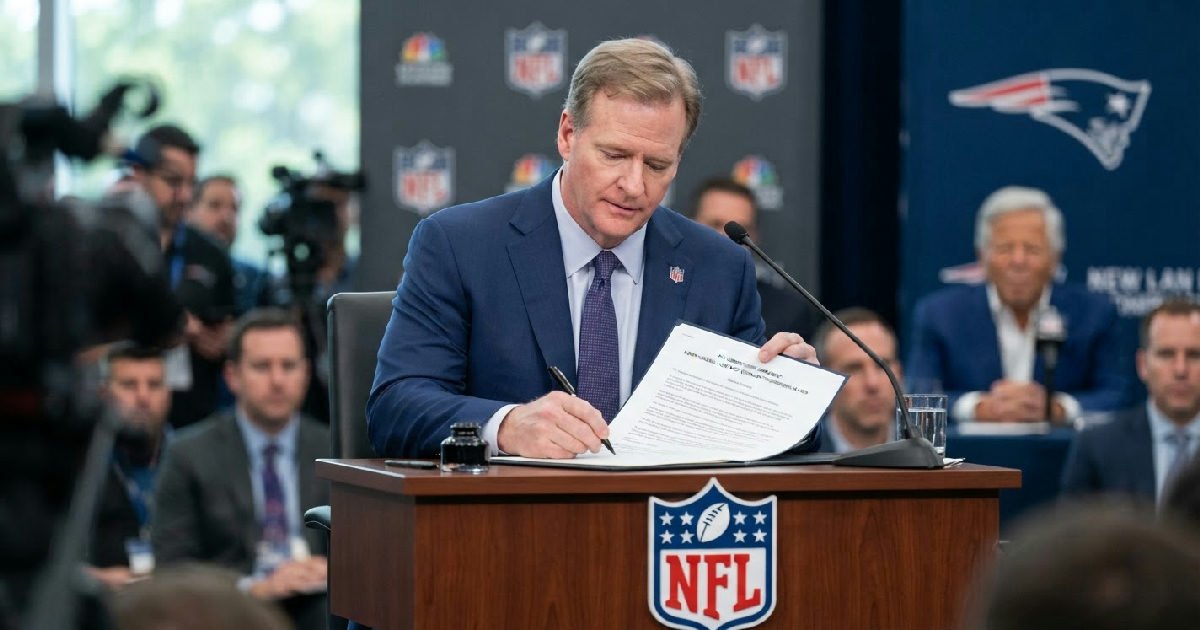
NFL Commissioner Roger Goodell Extends Contract Through 2030 Season
National Football League (NFL) Commissioner Roger Goodell has secured a new four-year contract extension, ensuring his tenure at the helm of the league through the 2030 season. The agreement, announced on Sunday, September 6, 2026, officially extends his leadership until March 31, 2031.
This fifth extension for Goodell, who will be 72 years old when his new deal concludes, positions him to oversee critical upcoming negotiations for the league.
Performance-Based Compensation Drives New Roger Goodell Contract Extension Deal
The deal was meticulously structured by the NFL’s Compensation Committee, chaired by New England Patriots owner Robert Kraft, in collaboration with an independent compensation consultant and outside counsel. This move solidifies continuity for the league, especially as the current collective bargaining agreement (CBA) with the NFL Players Association (NFLPA) also expires after the 2030 season.
The contract extension is heavily weighted towards performance, a key detail emphasized by the Compensation Committee. More than 95% of Roger Goodell’s total compensation is directly linked to his and the NFL’s overall performance. These metrics are evaluated against various benchmarks, with final discretion resting with the Compensation Committee.
Robert Kraft outlined the deal’s framework in a memo distributed to the league’s 32 teams. He stressed that the committee sought an agreement that aligns Goodell’s incentives with the league’s long-term interests and success. This structure reflects a clear mandate for continued growth and strategic management.
The Compensation Committee itself boasts a roster of influential owners, including representatives from the New York Giants, Jacksonville Jaguars, Cleveland Browns, Arizona Cardinals, and Denver Broncos. Their collective oversight underscores the significance of this contract and the expectations placed on Goodell’s continued leadership.
Goodell’s Enduring Tenure and League Growth
Roger Goodell’s journey with the NFL began in 1982, and he officially assumed the role of Commissioner on September 1, 2006, succeeding Paul Tagliabue. This latest extension marks his fifth since taking office, with previous agreements signed in 2009, 2012, 2017, and 2023. His previous contract was set to expire in March 2027.
Under Goodell’s leadership, the NFL has seen remarkable financial expansion and global reach. The league generated approximately $23 billion in revenue during the fiscal year ending March 2025, marking an 8% increase from the prior year. Current projections suggest the league is on track to surpass $25 billion by 2027, highlighting robust financial health.
The Commissioner has also been instrumental in expanding the league’s media rights value. The NFL secured 11-year broadcast and streaming agreements valued at over $110 billion, a testament to its enduring appeal and strategic media partnerships. The league continues to push its global footprint, with a record nine international games scheduled for 2026 across four continents, seven countries, and eight stadiums.
Strategic Alignment with Collective Bargaining
A crucial aspect of this extension is its strategic timing, aligning Goodell’s term with the expiration of the current Collective Bargaining Agreement. The existing CBA with the NFL Players Association (NFLPA) is also set to run through the 2030 season, officially expiring in March 2031. This synchronicity suggests a deliberate move by owners to maintain stability during what will be complex and pivotal negotiations.
Owners have indicated a strong desire for continuity through these upcoming discussions, which will shape the league’s operational and financial landscape for years to come. Having a seasoned Commissioner like Roger Goodell at the table, with deep institutional knowledge, is seen as a key advantage.
One major item expected to surface in these future negotiations is the potential for an 18-game regular season. Such a significant change would require player approval, making the upcoming CBA talks particularly sensitive. The continuity provided by Goodell’s extended contract offers a steady hand in navigating these intricate discussions.
Implications for League Stability and Future Direction
The extension of Roger Goodell’s contract sends a clear message about the NFL owners’ satisfaction with his stewardship. Despite past controversies and challenges, the league has enjoyed unprecedented financial success and increased global visibility during his tenure. The owners clearly value his ability to navigate complex issues and drive revenue growth.
For players and fans, this extension means continued leadership from a figure who has both championed and been criticized for his policy decisions. His longevity in the role provides a consistent framework for the league’s operations, but also suggests that fundamental changes to the league’s power structure are unlikely in the near future. This reflects a clear strategic decision to maintain the current trajectory.
This commitment also highlights the league’s long-term vision, particularly concerning labor relations and market expansion. The stability offered by Goodell remaining in his position can help the NFL execute its ambitious international growth plans and ensure a smooth transition into new media landscapes.
It allows for sustained focus on strategic objectives, from fan engagement to competition rules. Professional sports leagues often aim for leadership stability when facing significant upcoming negotiations or strategic pivots.
The Road Ahead: Challenges and Opportunities
Goodell will lead the league through several significant challenges and opportunities over the next few years. Beyond the CBA negotiations, the NFL continues to grapple with player safety concerns, particularly regarding head injuries, and evolving social justice initiatives. Public perception and fan engagement remain critical areas of focus, demanding adaptable leadership.
But there are also immense opportunities, particularly in technological innovation and expanding global markets. The league’s success in securing massive broadcast and streaming deals underscores its capacity to adapt to changing media consumption habits. Further international expansion, potentially into new territories, will also be a major undertaking that Goodell is now tasked with overseeing.
His deep experience and established relationships within the league and with broadcast partners will be invaluable as the NFL seeks to consolidate its position as a dominant global sports entertainment property. The decision to secure Goodell for another four years reflects a strategic investment in maintaining this momentum. High-stakes negotiations are common across major sports, often requiring experienced figures to lead the discussions.