

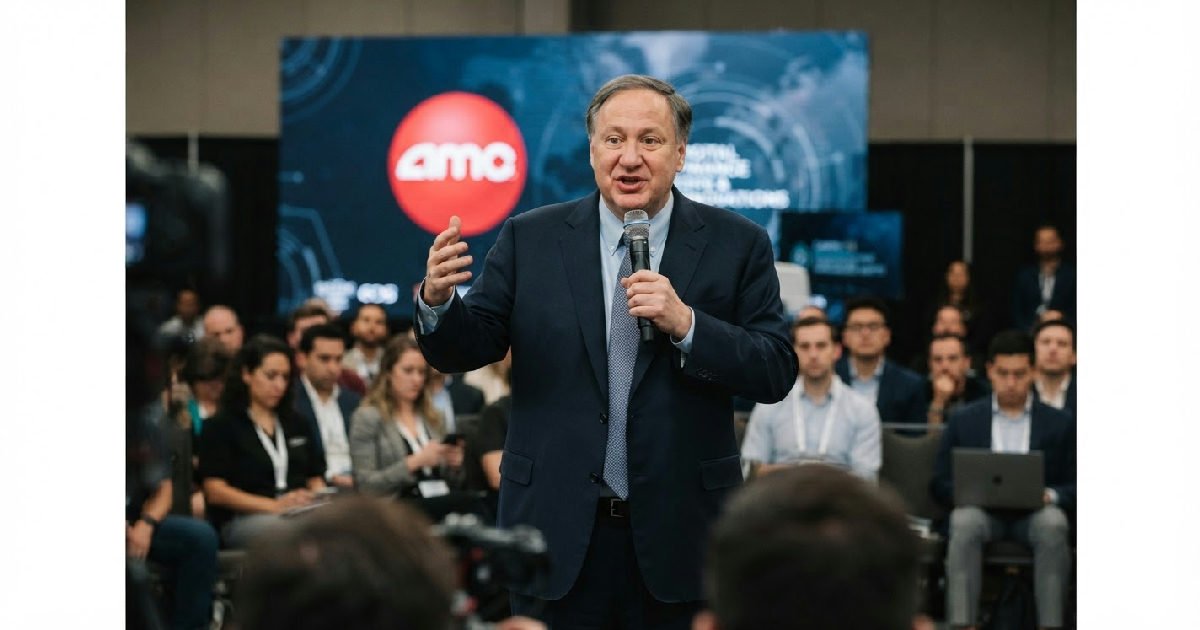
AMC Entertainment’s Adam Aron sparks tokenized stock model debate
AMC Entertainment Chief Executive Adam Aron’s public dispute with Robinhood on Friday, September 5, 2026, ignited a broader industry argument over tokenized stock models.
The core of the conflict centers on which of three distinct approaches to tokenizing equities should become the market standard, a question with significant ramifications for investor rights and market integrity.
Entertainments Adam Aron and tokenized stock
With tokenized equities now totaling $2.91 billion, up 14.4% in the last 30 days across 2.67 million holders, the stakes in this debate are increasingly high.
The catalyst for the intensified debate was Adam Aron’s vocal criticism of Robinhood’s tokenized AMC shares, which he initiated on Friday, September 4, 2026, publicly threatening legal action and demanding a cease and desist. This led to swift responses from key figures in the crypto and traditional finance sectors.
Gabriel Otte, co-founder of Dinari, characterized some tokenized instruments as “indisputably worse for the end investors than even common stocks.” Conversely, Uniswap founder Hayden Adams argued for the benefits of programmability and 24/7 trading that such innovations provide.
The Securities and Exchange Commission (SEC) has already identified three distinct legal categories for tokenized stocks, each with varying implications for ownership, rights, and regulatory oversight. These models fundamentally differ in what a token holder truly owns, ranging from direct ownership of shares on-chain to synthetic exposure through debt instruments.
Robinhood’s approach involves what the SEC categorizes as “linked securities.” These are debt securities issued by an unregulated entity, Robinhood Assets (Jersey) Limited, which are sold exclusively to non-U.S. persons. These tokens provide economic exposure to the referenced company but confer no direct claim or rights on the underlying shares.
This structure has drawn considerable scrutiny for its potential to create investor confusion and bypass traditional securities laws.
Synthetic Instruments Under Scrutiny
Critics, including AMC Entertainment Chief Executive Adam Aron, argue that Robinhood’s tokenized shares could mislead investors by blurring the line between economic exposure and actual share ownership. Aron articulated his concerns about these instruments potentially operating outside of U.S. securities laws, describing the practice as “contemptible, outrageous, disgusting, detestable, inexcusable, vile.”
He highlighted that token holders are denied traditional shareholder rights, such as voting rights, and the trading activity remains separate from AMC’s capital-raising processes.
Ariel Givner, a corporate and intellectual property lawyer and founder of Givner Law, echoed these sentiments. She bluntly stated that buying economic exposure from an offshore affiliate that simply applies a company’s ticker to a derivative “is NOT tokenization.”
This perspective underscores a fundamental disagreement within the industry about what truly constitutes a legitimate tokenized security. Robinhood’s Chief Legal Officer Dan Gallagher, an SEC commissioner from 2011 to 2015, reportedly responded to Aron by telling him to “send your lawyers and we’ll educate them,” signaling the firm’s readiness to defend its model.
Custodial and Issuer-Backed Tokenization
In contrast to Robinhood’s model, companies like Dinari, Ondo, and xStocks employ a “third-party custodial” model. Here, the underlying shares are held through regulated intermediaries, with the economic benefits passed on to the token holders. Dinari distinguishes itself by being the only one of these three platforms to actively sell to U.S.
investors, utilizing an SEC-registered broker-dealer to hold its dShares with FINRA-member Alpaca Securities in segregated custodial accounts. These dShares pay cash dividends in stablecoins and allow for redemption at market value.
A third model, championed by Securitize and Superstate, involves “issuer-sponsored tokens,” where a company’s own registered shares are directly placed on-chain. This means the issuer and its transfer agent are integral to the transaction, effectively putting the security itself on the blockchain.
Securitize, for instance, operates multiple regulated affiliates, allowing it to act as the official record-keeper for tokenized securities rather than a counterparty. The company has tokenized over $4 billion of assets, including its own shares, which went public on the NYSE as SECZ on July 2 following a merger with Cantor Equity Partners II.
Similarly, Superstate’s Opening Bell program acts as a digital transfer agent, issuing registered shares directly onto Ethereum and Solana for listed companies like Galaxy Digital and Forward Industries.
Market Dynamics and Trading Venue Concerns
The total market for tokenized equities currently stands at $2.91 billion, demonstrating significant growth with a 14.4% increase in the last 30 days. This expanding market is distributed among various platforms, with Ondo leading at $869.6 million.
Other notable players include bStocks ($659.4 million), xStocks ($633.7 million), Securitize ($274.1 million), Bitget ($170.5 million), and Robinhood ($133.2 million). The consistent growth across these platforms highlights a robust and expanding interest in digital asset investment models.
Robinhood Chain, for example, recorded $1.56 billion in decentralized exchange (DEX) volume within 24 hours, more than double its previous week’s figures. This surge, partly driven by memecoin pairs, even saw Robinhood Chain surpass Solana in tokenized stock volume in late July.
However, this high trading volume on DEXs introduces concerns about best execution for investors, a point raised by Brian Huang, co-founder of onchain portfolio manager Glider and a former XTX Markets equities trader.
Execution Quality Versus Price Slippage
Brian Huang articulated on a recent livestream that the trading venue itself often matters more than the specific wrapper of a tokenized asset. He pointed out a critical difference for U.S.
investors: “In the US, we have protections around what’s called the national best bid offer or best execution rules, where whether you’re trading on Robinhood, Coinbase or any of the major apps or brokers in the US, you are guaranteed to get best execution. Now, that is not true via AMMs.”
This suggests that while decentralized exchanges offer accessibility, they may not provide the same level of price assurance that traditional regulated markets do.
Huang also addressed concerns about shareholder rights, arguing that “You do get the voting rights through particular issuers.” He cited Ondo’s collaboration with Broadridge, which added proxy voting capabilities to over 250 Ondo tokenized stocks and ETFs in April, though not yet available in the U.S.
He posited that the market will eventually converge on a request-for-quote design, where market makers source shares off-chain and tokens are minted, ultimately eliminating current price dislocations within a year. However, the pairing of memecoins with stocks also presents issues of “impermanent loss” due to their uncorrelated nature.
Regulatory Landscape and Industry Demands for Clarity
The intensifying debate highlights the urgent need for clear regulatory frameworks governing tokenized securities. The SEC’s Division of Corporation Finance has already outlined the three categories of tokenized stocks, acknowledging their distinct legal characteristics. However, industry stakeholders are pushing for more explicit rules to protect investors and ensure market integrity.
Transfer agents, critical to maintaining shareholder records, have actively petitioned the SEC to establish clearer distinctions. Continental Stock Transfer & Trust, for example, submitted input to the SEC’s crypto task force on July 21, asserting that third-party tokens “do not establish a legal relationship between the token holder and the issuer.”
The firm argued these tokens could “confuse investors, impair issuer governance, create disclosure and market-integrity risks, and bypass the shareholder-record and corporate-action infrastructure,” advocating for their exclusion from regulatory relief without proper safeguards.
A week later, Computershare asked for neutral treatment across all book-entry forms instead, emphasizing the desire for consistent regulation across different digital asset structures. These appeals underscore the industry’s desire for consistent and well-defined regulatory guidelines for tokenized assets.
The Future of Tokenized Equities
The “AMC Fight” has underscored a foundational tension in the nascent tokenized stock market: the balance between innovation, accessibility, and investor protection.
Hayden Adams of Uniswap drew a parallel between tokenized stocks and early stablecoins, noting that while they may not be identical to their traditional counterparts, they fulfill a critical user demand for programmability, 24/7 trading, and global access, especially for those outside the traditional banking system.
However, Gabriel Otte countered that these demands could be met without resorting to synthetic, “inferior product[s] with price dislocation.”
Binji Pande, a founding member of Ethereum R&D lab Ethlabs, suggested the current blowouts are a “supply problem rather than a design flaw,” noting that the industry has “figured out how to program demand before we figured out how to program supply.”
This perspective suggests that addressing the underlying infrastructure for consistent on-chain supply and redemption could mitigate many of the current issues.
As the market for tokenized equities continues to grow, with major players like Ondo and Securitize leading the charge, the resolution of this industry debate will be critical.
The direction taken by regulators, particularly the SEC, in defining and enforcing rules for these diverse models will profoundly impact investor confidence, the types of products offered, and the overall trajectory of crypto-native financial instruments.
The discussion now shifts from whether stocks can be tokenized to how they should be, ensuring a robust and equitable market for all participants.