

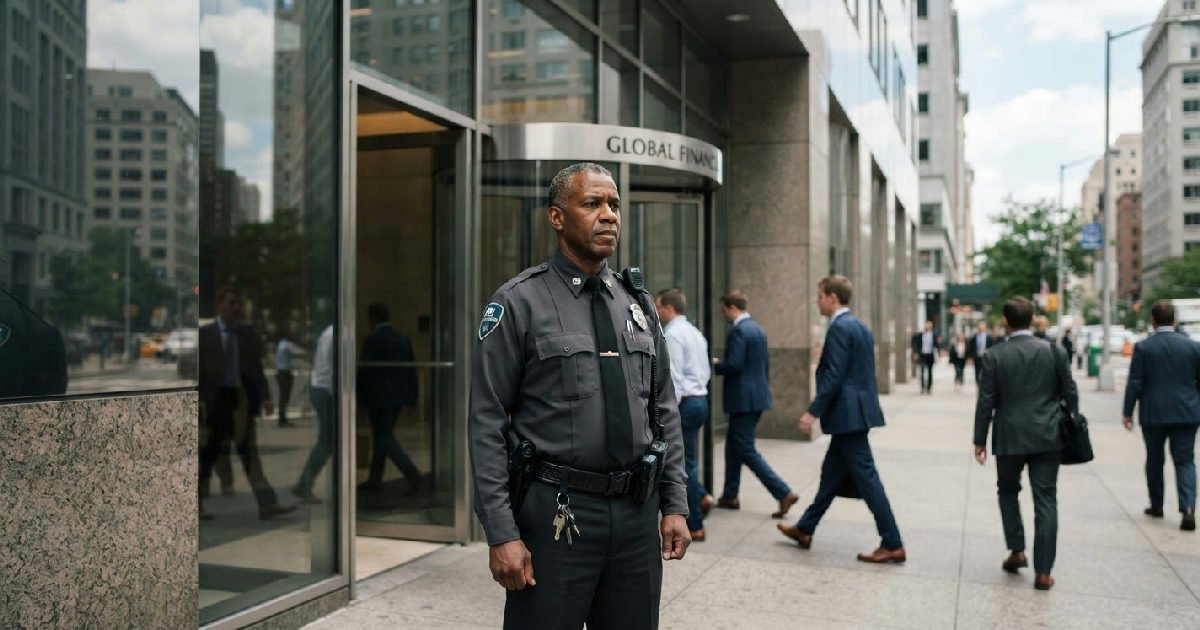
Private Security Market Exceeds $50 Billion Amid Rising Demand for Personal
The private security industry in the United States has exploded into a more than $50 billion market, fueled by a societal shift toward personal protection that persists despite a national decline in violent crime. This substantial growth highlights a stark divergence between actual crime statistics and public perception of safety, propelling companies like Allied Universal into unprecedented expansion.
Business associations, corporations, and even local governments are increasingly turning to private solutions, demonstrating a profound change in how security is perceived and managed. This trend has created a booming sector, generating significant revenue for firms that offer everything from manned guarding to advanced electronic surveillance systems.
Private security billion amid rising demand
In San Diego’s Hillcrest neighborhood, for instance, the Hillcrest Business Association began allocating approximately $400,000 annually in 2024 for unarmed security patrols. This budget is set to increase by another $150,000 next year to fund a second shift, underscoring a growing reliance on private security to “set a tone in the neighborhood,” as Benjamin Nicholls, the association’s executive director, noted.
The overall U.S. private security market saw its revenue climb 17% over the past decade, reaching over $50 billion in 2025. Outsourced services alone accounted for more than $35 billion of this total, encompassing both electronic security systems and traditional manned guarding.
This significant financial commitment reflects a broader societal unease, even as official government data indicates a sharp decrease in violent crime. This global market expansion also underscores changing financial landscapes worldwide.
Globally, the market paints an even more expansive picture. Valued at $241.4 billion in 2022, the global private security market is projected to skyrocket to $531.5 billion by 2032, growing at a compound annual growth rate (CAGR) of 7.8% from 2023. This projection reveals a consistent, strong upward trajectory in demand across continents, with North America leading this growth.
Allied Universal’s Dominance and Global Reach
At the forefront of this burgeoning industry stands Allied Universal, a privately held giant with annual revenues approaching $23 billion. The company operates in over 100 countries, providing a wide array of protection services, from screening individuals at major sporting events and music festivals to securing corporate offices for more than 80% of Fortune 500 companies. This scale contributes to its significant revenue.
Allied Universal claims to be the world’s seventh-largest private employer, boasting a workforce of roughly 800,000 individuals. This colossal figure nearly doubles the employee count of Target and more than triples that of Disney. The company’s hiring pace is formidable, processing approximately 65,000 applications and hiring about 3,500 new personnel for its North American operations each week.
Glen Kucera, president of Allied Universal’s enhanced protection services division, emphasizes the company’s ubiquitous presence, stating, “We’re everywhere.” In locales like Lower Manhattan, Allied teams, including human-and-canine units, guard high-profile landmarks such as the Staten Island Ferry and the World Trade Center, inspecting bags for explosives and providing assistance.
Beyond the visible patrols, Allied Universal employs covert security measures. Plainclothes workers monitor areas for potential threats, while command centers remotely track cameras, ready to alert on-site staff to any detected dangers. Justin Kelley, an Allied vice president and former Connecticut State Police officer, highlighted the crucial balance between overt physical security and vital covert operations.
Drivers Behind Surging Demand
Industry leaders point to a confluence of factors fueling the soaring demand for private security services. Increased corporate spending and evolving insurance requirements are playing significant roles. An Equilar analysis revealed that around 40% of S&P 500-listed firms provided security services to executives in 2025, a notable jump from just under 19% in 2019, with median costs surging by 178%.
Companies like Walmart have recently begun providing executive security, while others, such as Cracker Barrel, continue to cover protective service expenses for former leaders like Julie Masino, as noted in a July regulatory filing. This demonstrates a sustained commitment to executive protection that extends beyond immediate employment.
The threat of workplace violence has consistently ranked as the top concern for security leaders since 2021, according to the trade publication Security. This ongoing worry, combined with pressure from insurers who now view robust security plans as integral to “duty of care,” as explained by Steve Amitay, executive director of the National Association of Security Companies, further drives market expansion.
Local governments are also contributing to this demand. Louisville, Kentucky, city lawmakers mandated in July that certain late-night businesses hire private security. Meanwhile, Santa Fe, New Mexico’s Public Works Department allocated nearly $1 million for contract security in its current fiscal year. These measures highlight a growing reliance on third-party guarding to supplement or even replace traditional police forces.
An Essential but Underpaid Workforce
The growth of the private security industry has created a massive workforce. Federal data from May 2025 indicated that nearly 1.3 million Americans were employed as security guards, marking a 16% increase since 2016. In contrast, the national police force grew by only about 2% over the same period, illustrating the widening gap between private and public sector security employment.
Despite their critical role, security guards often face challenging conditions. The mean wage for a security guard in May 2025 was $20.42 per hour, or $42,470 annually. This figure stands significantly below the average income for police and sheriff’s patrol officers, who earned $38.08 per hour or $79,200 annually, and even falls short of the $33.54 hourly average across all occupations.
High turnover plagues the industry, with annual churn rates reaching 89% in 2024, far exceeding the 66% average across other private sectors. Enrique Lopezlira, director of the UC Berkeley Labor Center’s Low-Wage Work Program, highlighted that this “essential workforce” is increasingly asked to do more, yet their pay, training, and labor standards have not kept pace with their expanding responsibilities and inherent risks.
Tragically, security guards face heightened dangers on the job. The UC Berkeley Labor Center reported that over two out of five guards lack employer-provided health insurance, and they are significantly more likely to die while working than typical employees in other industries.
A May shooting at the Islamic Center of San Diego, which claimed the life of an on-site security guard credited with mitigating the attack, tragically underscores these risks.
Public Perception Versus Reality of Crime
A striking paradox underpins the rise of the private security industry: Americans’ perception of crime often diverges sharply from statistical reality. Government data shows violent victimizations have plummeted 71% from 1994 to 2024, and the FBI estimated a further 9% drop in violent crime in 2025 alone. Yet, public sentiment remains largely pessimistic.
An October 2025 Gallup poll indicated that nearly half of Americans believe crime is increasing. Furthermore, a March survey from the same organization found that roughly two out of three adults worried either a “great deal” or a “fair amount” about crime and violence.
This discrepancy suggests that media coverage, specific high-profile incidents, or general societal anxieties may be influencing public opinion more than official crime figures.
David Kennedy, director of the National Network for Safe Communities and a professor at the John Jay College of Criminal Justice, points out this disconnect. He notes that while homicide rates have fallen, they remain higher than in comparable developed countries, a difference he attributes partly to less restrictive firearms regulations in the U.S.
Many Americans, paradoxically, have turned to gun ownership for a sense of increased safety.
A study by Harvard and Northeastern researchers revealed that over 11 million Americans became first-time gun owners between 2021 and 2024. Annual non-military gun production in the U.S. also roughly tripled in 2023 compared to two decades prior.
This surge in personal firearm acquisition reflects a fundamental human response: “The less secure people feel, the more likely they are to take steps to protect themselves and their loved ones,” Kennedy explained.
The proactive measures taken by organizations like Temple Israel in metro Detroit further illustrate this trend. In March, when an attacker drove into the synagogue during an event filled with children, its in-house security staff quickly mobilized, preventing fatalities. Andy Bocknek, the temple’s past president, hailed the guards as heroes, underscoring the tangible value placed on immediate, on-site protection in an unpredictable world.
The Rise of Private Bodyguard Services
A specialized segment within the broader security market, private bodyguard services have also seen substantial growth. Valued at $6.39 billion in 2024, this market is projected to expand significantly, reaching an estimated $12 billion by 2035 with a CAGR of approximately 5.9%. This expansion underscores a demand for personalized, high-level protection for individuals facing unique or elevated risks.
North America currently dominates the global private bodyguard service market, with Asia-Pacific predicted to experience the most rapid growth by 2025. This geographical spread indicates a worldwide recognition of the need for bespoke security solutions. The emphasis on individual safety extends from high-net-worth individuals to public figures, reflecting a global concern for personal protection.
Future Outlook for Private Security
The trajectory for the private security industry remains robust. With growing global market projections, the sector is poised for continued expansion, driven by both commercial and residential demand. Commercial applications currently represent the largest segment, accounting for 61% of the U.S. market share and 70% globally. However, residential demand, increasing by 19% in 2024 due to urban crime concerns, suggests a broadening client base.
As threats evolve and public perception of safety continues to be a driving force, the industry will likely see further integration of electronic security systems, which accounted for 59% of the market in 2024.
Manned security, still dominating with over 50% of total market revenue, is projected to reach $211.9 billion by 2031, affirming the enduring value of human presence in security operations. This growth parallels trends in evolving financial services.