

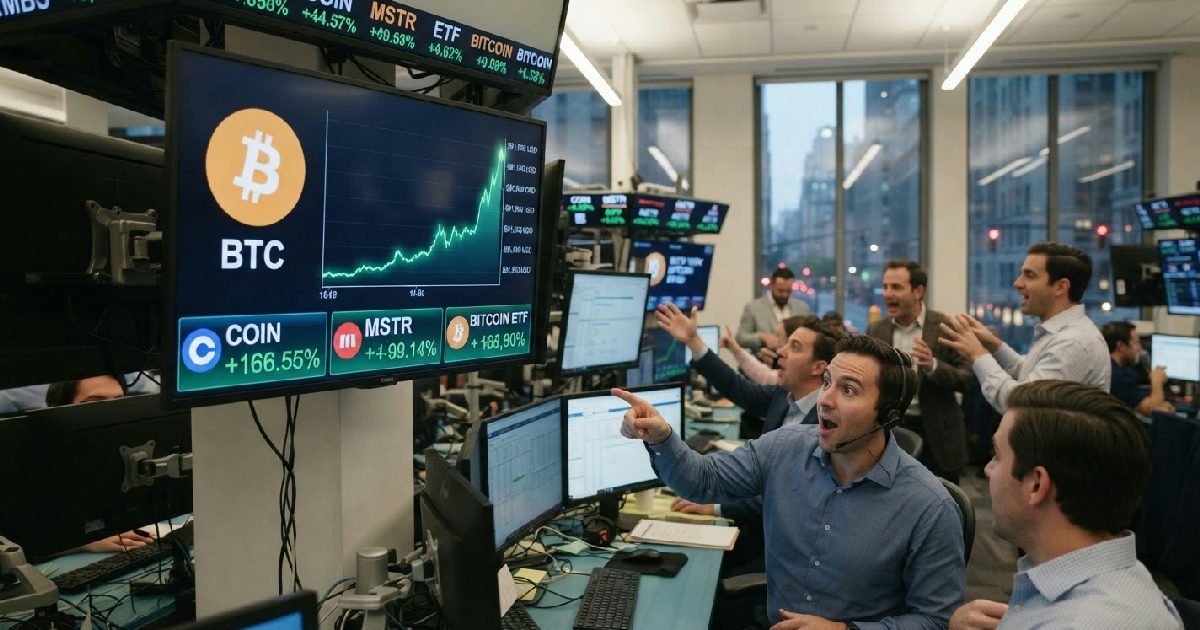
Bitcoin price surges past $81,000 as crypto stocks post double-digit gains
Bitcoin (BTC) decisively broke through a key resistance level on Thursday, surging past $81,000 and triggering a wider market rally that sent crypto-related equities soaring. The leading cryptocurrency reached a high of $81,282 in New York trading on September 3, a nearly 3% gain in 24 hours that builds on a monthly increase of over 23%.
The bullish momentum, which follows a period of consolidation, appears driven by a confluence of favorable macroeconomic news, renewed institutional interest, and positive political signals from Washington. The rally wasn’t confined to Bitcoin; stocks with significant exposure to the digital asset industry saw even more dramatic gains, with some posting double-digit increases.
Bitcoin price surges past crypto stocks
While Bitcoin set the pace, crypto-proxy stocks enjoyed an even stronger updraft, reflecting their nature as a higher-beta bet on the underlying asset’s performance. Investors piling into these equities are wagering on continued upside for the crypto market, and the results on Thursday were stark.
MicroStrategy (NASDAQ: MSTR), the software company with the world’s largest corporate Bitcoin treasury, saw its shares jump by more than 13%.
The move in MicroStrategy’s stock followed the company’s announcement on Monday that it had resumed its bitcoin purchasing strategy after a 10-week pause used to reorganize its cash balance sheet. This commitment to expanding its corporate Bitcoin treasury has made MSTR a go-to vehicle for traditional investors seeking exposure to the asset. Similarly, Coinbase (NASDAQ: COIN), America’s largest crypto exchange, saw its stock climb 11%.
The rally extended deep into the bitcoin mining sector, a group of companies whose profitability is directly tied to the price of BTC. HIVE Digital led the pack with a 13% surge, while MARA Holdings (MARA) was not far behind, gaining over 10%.
Other notable miners also posted strong results, with CleanSpark jumping 9% and IREN, which is transitioning away from mining toward AI computing, rising 4%. Elsewhere, Circle (CRCL) and Galaxy Digital (GLXY) surged 13% and 11% respectively.
Macroeconomic winds and policy shifts fuel the surge
This week’s price action isn’t happening in a vacuum. It’s rooted in significant shifts in the broader economic and political landscape that have made assets like Bitcoin more attractive. A combination of U.S. fiscal policy, changing expectations around interest rates, and potential regulatory clarity has created a powerful tailwind for the digital asset market.
US Treasury actions and a weaker dollar
A primary catalyst was the U.S. Treasury Department’s announcement that it would more than double its repurchases of government debt. This move is designed to control surging bond yields, which had reached levels not seen in nearly two decades. While stabilizing the bond market, this action effectively increases liquidity and puts downward pressure on the U.S. dollar, leading to renewed concerns about currency debasement.
In this environment, non-yielding, finite assets like Bitcoin and gold become more appealing stores of value. The market’s reaction suggests that investors are interpreting the Treasury’s move as a long-term inflationary signal, hedging their portfolios by moving into assets outside the traditional fiat system. Bitcoin’s phenomenal run in August, its third-best ever, was largely kicked off by this development.
Political tailwinds and regulatory clarity
Adding fuel to the fire, President Donald Trump recently urged lawmakers to pass the long-awaited Crypto Clarity Act. The digital asset industry has been calling for comprehensive federal legislation for years, arguing that the current patchwork of regulations creates uncertainty and stifles innovation in the United States. The lack of clear rules has been a persistent headwind for the market.
President Trump’s public backing for the bill provides a significant political boost, increasing the odds that a framework for digital assets could soon become law. The prospect of regulatory clarity is highly bullish for the industry, as it would provide clear guidelines for businesses and could unlock a new wave of investment from more cautious institutional players who have remained on the sidelines.
The anatomy of the rally: Short squeezes and institutional demand
The speed and ferocity of Bitcoin’s move above $81,000 was amplified by market mechanics, specifically a classic short squeeze. As the price began to climb, leveraged traders who had bet on a price decline were forced to buy back into the market to cover their positions, adding further upward pressure. This dynamic was a key feature of the recent surge.
On September 3 alone, approximately $140 million in short positions were liquidated across the crypto market within just 60 minutes as Bitcoin jumped 5%. This followed a similar event on August 25, when a move through the $80,000 level wiped out a reported $260 million in shorts within four hours.
These squeezes demonstrate how pessimistic positioning can quickly become fuel for a rally, allowing firms to profit from Bitcoin’s rally without taking directional risk.
But this rally is more than just a short squeeze; there is substantial evidence of renewed institutional buying. U.S.-based spot Bitcoin exchange-traded funds (ETFs) have seen massive inflows, with investors pouring over $2.8 billion into the vehicles—the most since the previous market peak in October.
At one point, these funds recorded a multi-session inflow streak topping $3 billion. The Coinbase Premium Index, which tracks the price difference between Coinbase’s USD pair and other exchanges, has also flipped into positive territory, suggesting strong demand from U.S. institutions.
Market context and the road ahead
After spending much of June and July trading below $65,000, Bitcoin’s recent performance marks a significant change in character. However, it’s important to view the rally in context. The asset remains nearly 40% below its all-time high of $126,080, which was set in October of last year. The key question is whether this is a sustainable move or merely a temporary bounce.
Market analysis firm Fundstrat has suggested the rally may be “more durable than a tactical bounce,” citing the strong ETF inflows and increased trading activity as signs of genuine demand. However, others, like the advisory firm BTIG, are more cautious, noting that a similar market pattern was observed in January 2023 before a subsequent downturn.
The market’s strength has also been reflected in other major assets on the Nasdaq CME Crypto Index, with Ethereum (ETH) climbing 2.8% to around $2,460 and XRP posting a sharp gain of 7.76% to trade near $1.47.
Looking ahead, investors are closely watching for several key signals. Economic data, particularly August inflation figures, will be critical.
Fed Governor Christopher Waller has indicated he would support holding interest rates steady if inflation cools, and traders have already scaled back their bets on a rate hike at the Federal Open Market Committee’s meeting on September 15-16.
Any confirmation of a pause from the Fed would likely be another positive catalyst for risk assets like Bitcoin.