

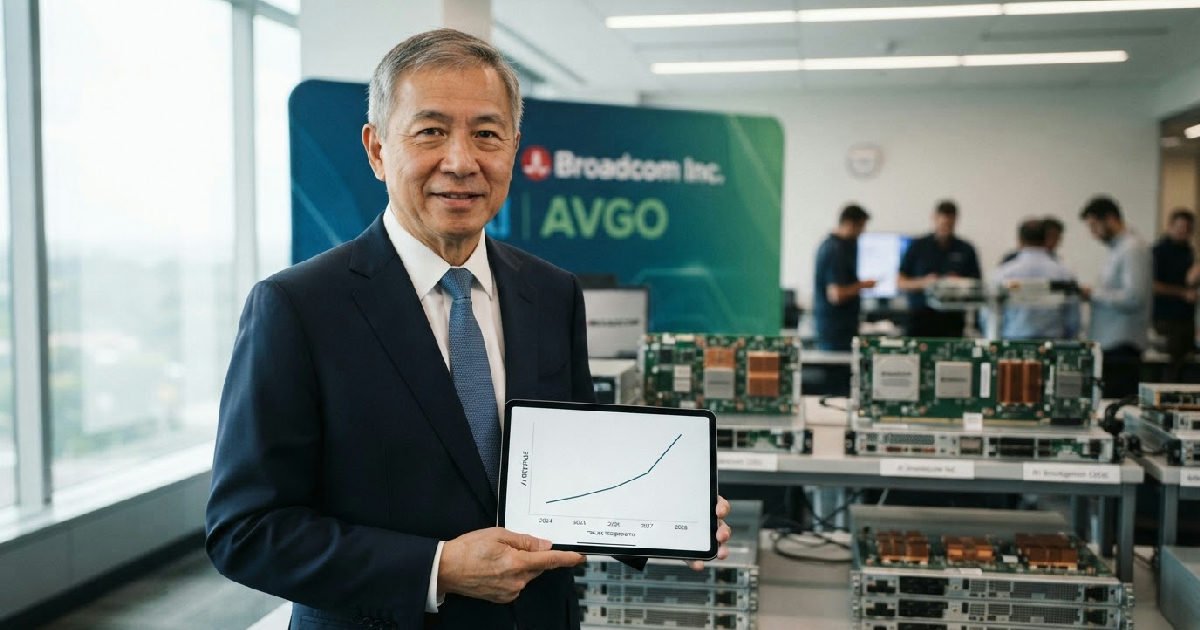
Broadcom CEO Hock Tan projects $230B in AI revenue by 2028 after record quarter
Broadcom Inc. President and CEO Hock Tan announced record-breaking third-quarter financial results on 2026-09-02, driven by AI semiconductor demand. on 2026-09-02 announced record-breaking third-quarter financial results, powered by an astounding surge in demand for its artificial intelligence (AI) semiconductors. President and CEO Hock Tan signaled even more aggressive growth ahead, projecting the company’s AI-related revenue could hit approximately $230 billion by fiscal 2028.
The Palo Alto, California-based firm reported total revenue of $29.6 billion for the quarter ending August 2, an 86% increase year-over-year that surpassed Wall Street estimates of $29.25 billion. The driving force was its AI semiconductor business, which rocketed 221% from the previous year to reach $16.7 billion, now accounting for 56% of the company’s total sales.
Hock Tan on Broadcom’s AI revenue surge
The stellar third-quarter performance underscores Broadcom’s central role in the global AI infrastructure buildout. The company posted a non-GAAP diluted earnings per share of $3.32, a 96% jump from the prior year and comfortably ahead of analysts’ forecasts of $3.21. This profitability was backed by a record free cash flow of $13.7 billion, representing 46% of revenue, demonstrating remarkable financial health.
“We delivered an exceptional quarter with revenue, operating income and free cash flow all exceeding prior records,” Tan stated in the earnings call. The CEO pointed directly to the source of this explosive growth. “Driving this was our Q3 AI semiconductor revenue, which grew 221% year-on-year and up 54% sequentially.”
This success highlights a focused corporate strategy that is paying massive dividends. While other parts of the technology sector have seen volatility, including some companies undertaking a major workforce reduction to recalibrate, Broadcom has doubled down on the AI boom. Tan captured the mood of relentless optimism, telling analysts, “Q3 demand was simply hot and we’re just getting started.”
The company’s non-GAAP operating margin reached a robust 68% of revenue, indicating that it is not just growing sales but doing so very profitably. This combination of top-line growth and bottom-line efficiency has investors taking close notice, positioning Broadcom as a key barometer for the entire AI industry.
An ambitious roadmap projects exponential growth
While the Q3 results were historic, it was Hock Tan’s forward-looking statements that captured the market’s imagination. Broadcom issued an audacious multi-year forecast that suggests the current AI boom is still in its early innings. The company is now on track for a fiscal year that will set a new standard for growth in the semiconductor industry.
For the full fiscal year of 2026, Broadcom raised its AI revenue forecast from $56 billion to $58 billion, which would represent a 186% increase over the previous year. But the projections didn’t stop there. Tan laid out a roadmap that sees AI revenue nearly doubling to approximately $115 billion in fiscal 2027, and then doubling again to a staggering $230 billion in fiscal 2028.
Tan also projected that the company would exceed $30 in earnings per share by fiscal 2028. This outlook for earnings per share is a bold statement about Broadcom’s expected profitability, emphasizing the company’s strong confidence in its future performance.
This confident forecast overshadowed a slightly cautious guide for the upcoming fourth quarter. Broadcom expects consolidated revenue of $34.8 billion, a 93% increase year-over-year, which was slightly below analysts’ expectations of $35.03 billion. However, investors largely shrugged this off, focusing instead on the colossal long-term opportunity the company is pursuing.
The strategy behind custom chip dominance
Broadcom’s success isn’t accidental; it’s the result of a deliberate strategy to become the premier partner for a select group of hyperscale companies and AI labs that are building the world’s most powerful AI systems. Instead of competing directly with general-purpose GPUs, Broadcom specializes in creating custom accelerators, known as XPUs, and the networking hardware to connect them.
Deep partnerships with AI leaders
The company’s earnings call read like a who’s who of artificial intelligence. Tan detailed extensive collaborations with Google, Anthropic, OpenAI, and Meta. He stated that Broadcom expects to speed up shipments of Google Ironwood tensor processing units to Anthropic and TPU 8i chips to Google.
He added that Broadcom will deliver tens of billions of dollars of processors to Google each year for the next several years.
For Anthropic, Tan said Broadcom is looking for them to deploy 5 gigawatts of TPU 8i chips in 2027, with a line of sight to deliver another 10 gigawatts. For Meta, production shipments of their custom MTIA accelerator optimized for inference and recommendation at scale are expected to continue.
And for OpenAI, shipments of the custom Jalapeno chip are ongoing, with Tan noting the lab is getting ready to tape out its second-generation chip and putting together plans for a third version.
He also mentioned a 1.3 gigawatt deployment of Jalapeno in 2027, with line of sight for over 5 gigawatts for Jalapeno and the second generation. New game development often relies on advanced chip architecture for performance.
Amie Thuener, Broadcom’s finance chief, indicated that the company might provide residual value guarantees that are contingent liabilities to the labs. She noted that it makes economic sense for Broadcom to invest and enable these key customers, who are the leading AI labs, to bridge the gap between their current cash flow and the significant upfront investments required for their businesses.
A different path from competitors
The company’s strategy hinges on providing bespoke silicon and networking solutions that are hyper-optimized for its customers’ specific workloads.
This is reflected in the numbers: shipments of its custom processors (XPUs) rose more than 3.5 times from a year ago, representing 73% of AI revenue in Q3, while its AI networking revenue increased more than 2.5 times year-over-year. This proves there is more than one way to win in the AI hardware market.
The commitment to rapid, iterative development with partners like OpenAI is a core part of this strategy. Tan confirmed OpenAI is already preparing to “tape out” its second-generation chip with Broadcom, with a third version in the planning stages. This continuous innovation is crucial for staying competitive in the rapidly evolving AI hardware space.
Investor reaction and market context
Following the earnings announcement, Broadcom’s shares (trading under the ticker AVGO) saw a modest rise in after-hours trading. The positive long-term forecast appeared to outweigh the slightly soft consolidated revenue guidance for the fourth quarter, signaling that investors are buying into Hock Tan’s vision for the future.
The earnings beat and the extraordinary long-range forecast could serve as a catalyst for future investment. The semiconductor giant continues to attract considerable attention as the AI sector matures and demands more specialized hardware solutions. Key player performance in any industry can drive significant market movement.
The company also reaffirmed its commitment to shareholder returns, announcing a quarterly common stock dividend of $0.65 per share, payable September 30 to shareholders of record as of September 21. This demonstrates confidence in its ability to generate substantial and sustained cash flow, even as it invests heavily to meet the insatiable demand for AI hardware.
What this means for the semiconductor industry
Broadcom’s results send a clear signal: the AI infrastructure build-out is not a fleeting trend but a durable, multi-year cycle that is reshaping the entire technology landscape. The sheer scale of Broadcom’s revenue and forecasts indicates that the capital investment from AI labs and cloud providers is reaching unprecedented levels.
The success of its custom chip strategy also highlights the growing importance of specialization. While one company has dominated the headlines with its general-purpose AI chips, Broadcom is proving there is a massive, parallel market for bespoke solutions tailored to the unique needs of the largest players. This dual-track market structure is likely to define the semiconductor industry for years to come.
Ultimately, Broadcom has tied its fate to the continued expansion of frontier AI. By becoming the essential engineering partner for companies like Google, OpenAI, and Anthropic, it has secured a critical position at the heart of the AI revolution. As long as these labs continue to push the boundaries of what’s possible, Broadcom is poised to keep breaking records.