

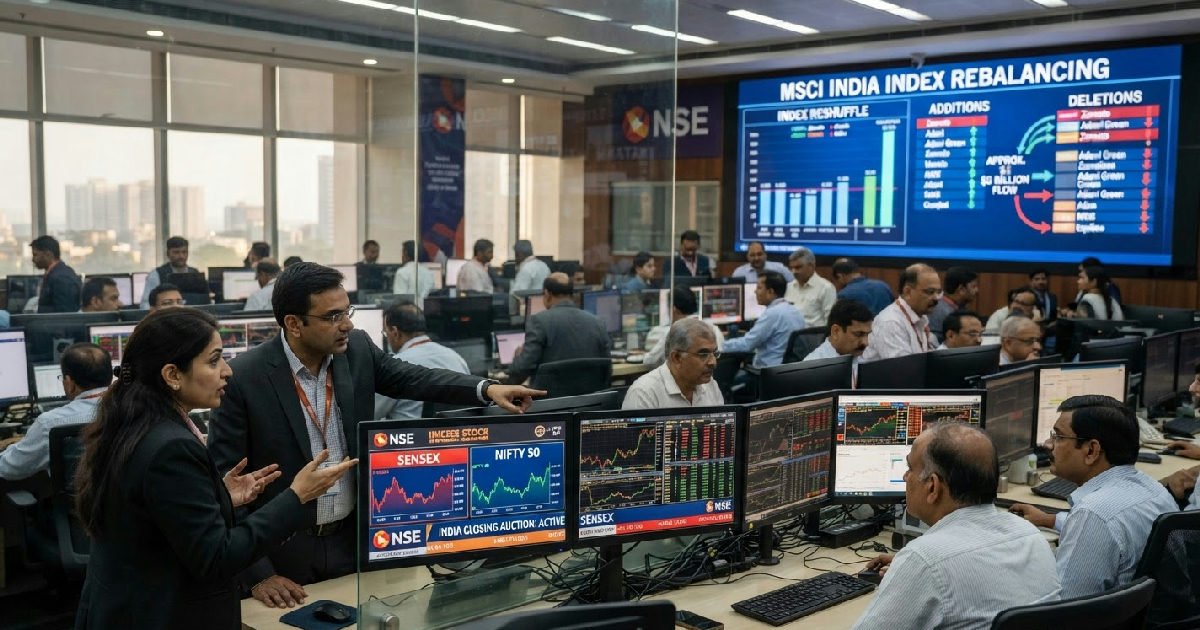
India’s new closing auction faces crucial $5 billion MSCI rebalance test
India’s newly implemented closing auction system is confronting a significant live test today, August 31, 2026. This pivotal moment arrives as approximately $5 billion in passive fund trades are expected to flow through Indian equity markets due to the quarterly rebalancing of the MSCI India Index.
The global index provider’s latest reshuffle sees four Indian stocks added and three removed from the benchmark. This rebalancing event directly coincides with the relatively new auction mechanism, placing its efficiency and robustness under intense scrutiny from market participants.
MSCI reshuffle challenges new Indian auction
The August 2026 MSCI rebalance, the results of which were announced on August 12, 2026, necessitates that passive funds tracking MSCI indexes adjust their portfolios. These funds must execute trades at the official closing price to maintain alignment with the revised benchmark.
This mandate directs a substantial volume of transactions towards India’s closing auction. The system, introduced on August 3, 2026, was designed to enhance price discovery and curb potential market manipulation. It aims to bring India’s market structure closer to global standards seen in major exchanges like the NYSE and London Stock Exchange.
Market observers view this confluence as a critical challenge for the Indian market infrastructure. Stakeholders are keenly watching how the system handles the anticipated surge in trading volume, particularly given its recent operational launch. This situation creates a unique examination of the auction’s operational integrity.
The Securities and Exchange Board of India (SEBI) initially proposed this framework in 2024. Requests from index-tracking passive funds, seeking to minimize tracking errors, were a primary driver behind its implementation. The ambition is to align India’s market structure with practices in major global markets, reflecting a broader trend towards standardization in international financial operations.
This push for harmonisation parallels various major international economic agreements seen globally.
Index adjustments and capital flows
The MSCI India Index will now feature 166 constituents, a marginal increase from its previous 165. This change stems from the addition of four new securities and the removal of three others, reflecting shifts in market capitalization and liquidity.
Consequently, India’s weight within the broader MSCI Index will nudge up slightly, from 11.8% to 11.9%. This marginal rise indicates the growing prominence of Indian equities on the global stage, attracting increased international investment.
Nuvama Alternative & Quantitative Research anticipates significant inflows for the newly added stocks. Laurus Labs is projected to attract the highest, approximately $598 million, followed by Lenskart Solutions with about $352 million. Adani Energy Solutions is set to receive around $310 million, and Billionbrains Garage Ventures, the parent company of Groww, is expected to see inflows of about $256 million.
Conversely, some stocks are bracing for outflows. Reuters estimates Balkrishna Industries could experience around $169 million in outflows, with SBI Cards and Payment Services facing approximately $143 million. Astral is also predicted to see outflows amounting to roughly $138 million.
Beyond these direct index changes, other companies will also experience shifts in capital. Eternal is projected to attract the largest incremental passive inflow at approximately $674 million. Adani Enterprises and Adani Ports are expected to see inflows of around $22 million and $77 million, respectively.
However, some heavyweights face potential outflows. Reliance Industries is estimated to confront roughly $523 million in outflows, while Jio Financial Services may see $61 million departing. Other companies that could attract inflows include JSW Energy, Adani Power, GMR Airport, and Swiggy. Conversely, Indian Hotels, Aditabella Capital, and Colgate India might experience outflows.
The MSCI India Domestic Small Cap Index also undergoes a reshuffle, adding 12 securities and removing 19. This results in a net reduction of seven constituents within the small-cap segment, reflecting ongoing adjustments across market caps.
How India’s closing auction operates
The new closing auction system applies to over 200 stocks with listed derivatives, representing a significant portion of the market. Shares without derivatives continue their normal trading until 3:30 p.m. IST, operating under the previous closing-price mechanism.
Under the new system, continuous trading ceases at 3:15 p.m. IST. A reference price is then calculated using trades executed between 3:00 p.m. and 3:15 p.m. IST. This calculated price serves as a benchmark for the subsequent auction period.
Investors can place, modify, or cancel auction orders within a defined window that opens after 3:15 p.m. This concentrated period allows market participants to finalize their positions, aiming to create a fair and transparent closing price. This unique situation places the new system under considerable pressure, making it a crucial test for its operational stability.
The volume handled by this auction has already shown its capacity. On August 28, 2026, the BSE’s closing auction processed approximately ₹446 crore, equivalent to about $46.7 million. The National Stock Exchange, during its monthly derivatives expiry, saw an even higher turnover, reaching around ₹1,377 crore, or $144 million.
The Sensex provided a glimpse into potential volatility on August 28. After continuous trading ended at 3:15 p.m. IST at 77,182.91, its indicative level during the auction dipped to 74,983.19. This nearly 3% fall below its pre-auction level highlighted the system’s sensitivity, though it eventually recovered to close at 76,933.59.
Regulatory scrutiny and market integrity
The introduction of the new closing auction system by SEBI was largely driven by a desire to enhance market integrity. The goal is to improve price discovery while simultaneously curbing manipulative practices that could distort closing prices. This aligns with global efforts to foster fair and transparent trading environments.
Evidence of such concerns surfaced recently when SEBI ordered the impounding of ₹3.68 crore, or about $384,000. This action was linked to estimated gains from alleged manipulation during the August 13 Sensex closing auction. Such incidents underscore the importance of robust mechanisms to protect investors and maintain market confidence.
The current $5 billion MSCI reshuffle offers a critical assessment of these new regulatory tools. The market is watching closely to see if the system can prevent similar issues with a much larger volume of passive trades. Ensuring fair play in such significant events is paramount for India’s financial reputation.
Successful navigation of this rebalancing event will bolster confidence in India’s regulatory framework and its ability to manage large-scale market activity. Any hiccups, however, could prompt further adjustments and increase scrutiny on the market’s operational efficiency.
Global alignment and future outlook
India’s push for a more sophisticated closing auction system is part of a broader strategy to align its financial markets with leading global counterparts. By adopting practices prevalent in the NYSE, Nasdaq, London Stock Exchange, and Australian Securities Exchange, India aims to attract more international capital and enhance its market’s liquidity.
The primary beneficiaries of this system are passive funds, which can now minimize tracking errors more effectively. By ensuring trades are executed at a transparent and non-manipulated closing price, these funds can more accurately reflect the performance of the underlying index, thereby benefiting their investors.
Today’s test is more than just an operational exercise; it’s a statement about India’s commitment to financial market modernization. A smooth execution of the $5 billion MSCI reshuffle would solidify India’s standing as a mature and reliable investment destination, encouraging further foreign portfolio investment.
The implications extend beyond just passive funds; improved market integrity benefits all participants by fostering greater trust. While the Nifty 50 closed at 24,175.65 on August 30, 2026, and GIFT Nifty Futures stood at 24,222.5 points this morning, the real test of market resilience happens today.
Successful handling of this event will send a clear signal to global investors about the Indian market’s capacity and regulatory strength.
It’s a crucial step in its journey to become an even more integrated and influential player in the global financial ecosystem.