

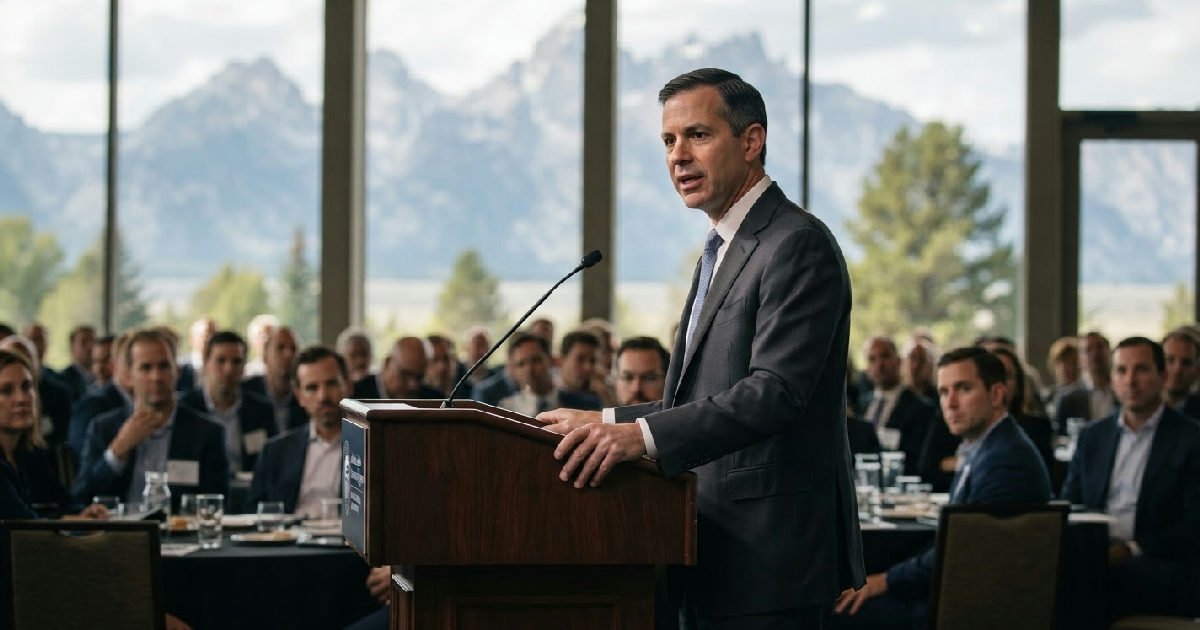
Fed Chair Kevin Warsh faces high-stakes test at Jackson Hole symposium
All eyes will be on Federal Reserve Chair Kevin Warsh this week as he prepares for his first keynote address at the Jackson Hole Economic Policy Symposium.
The annual gathering in Wyoming presents a critical test for Warsh, who confronts persistent inflation, recent market volatility, and complex questions about the traditional boundaries between fiscal and monetary policy. Investors will be watching closely for clues on how Warsh plans to address these challenges and the broader economic outlook.
A high-wire act for the new Fed chair
The summit, hosted by the Federal Reserve Bank of Kansas City, runs from Thursday, August 27, to Saturday, August 29, 2026. Warsh is scheduled to deliver his much-anticipated remarks on Friday, August 28, 2026, at 10:00 a.m.
While this year’s official theme is “Financial Innovation: Implications for Payments and Policy,” global markets are focused on a more urgent question: what clues will Warsh reveal about the future of U.S. monetary policy?
The stakes for Warsh’s speech are exceptionally high. Investors and policymakers are desperately seeking clarity in an uncertain economic environment. This demand for guidance runs directly counter to Warsh’s stated intention to move away from the detailed forward guidance that markets had grown accustomed to under his predecessors.
Warsh has reportedly “spooked investors” by signaling he will no longer be “spoon-feeding” markets with hints about the Fed’s next moves. He has been “pretty clear he doesn’t want to show his hand,” preferring to maintain flexibility. But this approach creates a communication vacuum that his Jackson Hole address will be expected to fill, making every word and inflection carry immense weight.
This tightrope walk isn’t new for a Fed Chair, but the current context feels particularly fraught. As Tom Keene of Bloomberg noted, the tension heading into this year’s symposium is palpable. He drew comparisons to only a few other times in the last 25 years, like the dawn of the financial crisis in 2007.
The pressure is on Warsh to strike the right balance between providing clarity and preserving his policy options.
Blurring lines between treasury and the Federal Reserve
Complicating Warsh’s task is the recent and direct intervention by the U.S. Treasury in the bond market. This move has raised fundamental questions about the traditional boundaries between fiscal policy, set by the government, and monetary policy, the domain of the independent central bank. The Fed now finds itself navigating a landscape where its actions are intertwined with those of the Treasury in unprecedented ways.
Henrietta Treyz, director of economic policy at Veda Partners, described this as a “fascinating dynamic.” She noted that Treasury Secretary Bessent is simultaneously managing geopolitical and market crises. This forces the Fed to react to another powerful government entity’s actions, potentially compromising its independence and complicating its primary mission.
This dynamic presents a central challenge for Warsh. His speech will be meticulously analyzed for how the Fed views this new relationship and how it plans to assert its independence while coordinating with the Treasury. The perception of Fed autonomy is crucial for the U.S. financial system’s credibility. Any erosion could have long-term consequences.
The $40 trillion question for policymakers
Looming over the entire discussion is the U.S. national debt, which recently surpassed the $40 trillion threshold. This staggering figure amplifies the challenges for both the Fed and the Treasury. High debt levels can constrain the Fed’s ability to raise interest rates to fight inflation without dramatically increasing the government’s borrowing costs.
While there has been considerable hand-wringing in Washington over the nation’s fiscal house, little substantive action has been taken on Capitol Hill. This political paralysis places an even greater burden on the Federal Reserve to manage the economic fallout. Warsh’s speech will be listened to for any acknowledgement of these fiscal realities and how they factor into the Fed’s policy calculus moving forward.
Global inflation concerns cast a long shadow
While the symposium takes place in Wyoming, the economic pressures are global. Soaring energy prices have hit consumers and businesses worldwide. European diesel prices have jumped more than 70% since the outbreak of war in February. U.S. gasoline prices are also up 60%.
These cost increases ripple through the entire economy, fueling broader inflation. For American voters, inflation has become the number one issue, according to recent polling. The tangible impact of rising costs on household budgets creates a powerful political headwind and places immense pressure on the Fed to bring prices under control.
The political dimension of the economic situation is becoming increasingly apparent. Treyz pointed out that voters often respond more to a general sense of ‘chaos’ than to specific economic data points. With a President facing a 33% approval rating and the Republican party losing recent special elections, the feeling of economic instability is having clear political ramifications.
This adds another layer of complexity to the Fed’s decisions. Its actions are viewed through an intensely political lens.
The world watches Jackson Hole for policy direction
The Jackson Hole symposium has been held in Jackson Hole, Wyoming, since 1982. Its location was chosen in part to entice then-Fed Chair Paul Volcker, a keen fly-fisherman. It has since evolved into what The New York Times calls “the world’s most exclusive economic get-together.”
In a typical year, just 120 central bankers, finance ministers, academics, and officials from around 70 countries attend. The meetings themselves are closed to the press, adding to the mystique. However, officials often speak with reporters throughout the event, and a choreographed “beauty walk” for photo opportunities provides a glimpse into the proceedings.
The academic papers presented are often dense, but the discussions can be pointed and influential, shaping economic policy for years to come.
For those not on the exclusive invite list, the key event is the Fed Chair’s speech. This address has been live-streamed since 2020 via the Federal Reserve Bank of Kansas City’s YouTube channel. This allows global market participants to watch in real-time, parsing every nuance for clues about future policy.
All asset classes, from equities to bonds, are poised for volatility as investors await Warsh’s pronouncements.
What to expect from Warsh’s speech and beyond
Market reactions to Jackson Hole speeches have been dramatic in the past. In 2022, a hawkish speech from the Fed Chair caused the S&P 500 index to drop 3.37% in a single day. Conversely, a more dovish tone in 2025 sent the Russell 2000 index jumping 3.92%. Investors will be on high alert for any similar market-moving signals this Friday.
Heading into the symposium, markets are pricing in a 61.9% probability of a quarter-point interest rate hike at the Federal Open Market Committee (FOMC) meeting on September 16. Warsh’s comments could either solidify those expectations or send traders scrambling to re-evaluate their positions. The event occurs 19 days before the September 16 FOMC decision.
Ultimately, the speech may be a work in progress until the very last minute. Given the market turmoil and fast-moving geopolitical events, Warsh is likely waiting to absorb as much information as possible before committing his thoughts to paper.
As one analyst put it, it would be “folly for him to start writing this now.” The world will simply have to wait until 10:00 a.m. Friday to find out what he has to say.