

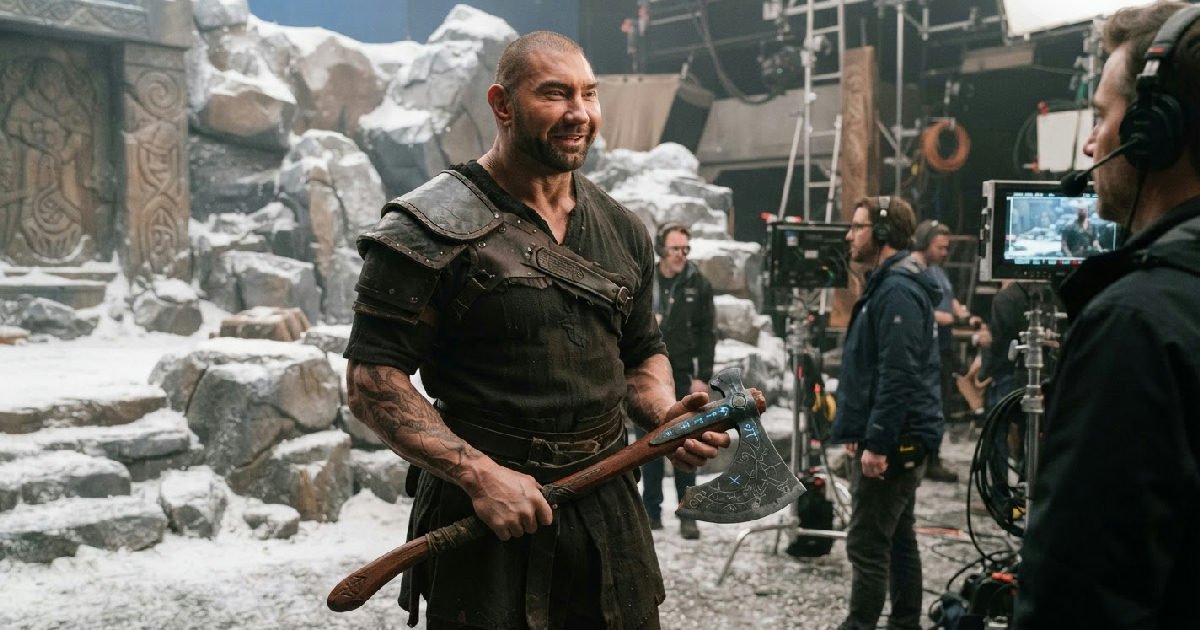
Dave Bautista replaces injured Ryan Hurst as K
The inevitable recasting after Ryan Hurst’s injury
The sudden and necessary shift in casting was triggered by a severe physical setback involving the original actor, Ryan Hurst. Hurst, who had been officially cast as Kratos in January 2026, suffered a torn bicep while performing a stunt on set in Vancouver in late June 2026. This devastating injury immediately halted production on the highly anticipated live-action series.
Hurst’s recovery timeline proved incompatible with Amazon and Sony Pictures Television’s production schedule. The injury required immediate surgery, and medical estimates suggested a recovery period of at least four to six months before he could return to action. Full strength recovery could potentially take up to a year, pushing the show’s timeline deep into 2027.
Producers faced a difficult decision: delay the entire first season by several months, risking millions in sunk costs and holding up the two-season order, or move forward with a new actor. Ultimately, the financial and logistical demands of a major streaming project meant the studio opted for the painful but swift solution of recasting the lead role.
This decision means every scene already filmed featuring Hurst as Kratos—filming began in February 2026—will need to be reshot once Bautista steps into the role. This massive undertaking adds significant time and expense to a production already under intense scrutiny. It underscores the challenges faced when adapting physically demanding properties like the God of War saga.
The recasting announcement came barely two weeks after reports surfaced that Bautista was in negotiations for the part. This rapid turnaround suggests that Amazon MGM Studios had already lined up its preferred replacement candidate immediately after the severity of Hurst’s injury became clear.
Hurst is a major talent, known for roles in Sons of Anarchy and The Walking Dead, and his sudden exit shocked many fans concerned about recovering from a serious injury.
Dave Bautista’s physical transformation and fan expectation
For many fans of the video game franchise, Dave Bautista represents a long-desired choice for the role of the Ghost of Sparta. His imposing physique and established career playing emotionally guarded but explosive characters make him a natural fit for Kratos, who must balance brutal violence with his complicated relationship with his son, Atreus.
Bautista’s professional background as a decorated former WWE wrestler, known under the ring name “Batista,” provides him with the necessary screen presence to carry the role. Beyond wrestling, he has built a strong acting résumé, including critically acclaimed turns in Blade Runner 2049 and Dune, cementing his credibility as more than just an action star.
His most recognized role, however, remains Drax the Destroyer in the Marvel Cinematic Universe’s Guardians of the Galaxy franchise. This history with major franchise properties, coupled with previous collaborations with Amazon MGM Studios on projects like the My Spy films, smoothed the transition process. He’s a known quantity for a project facing sudden, high-stakes turbulence.
There is a specific physical requirement for the character, though, that Bautista must address. The actor famously underwent a significant weight loss in late 2024, reportedly dropping 75 pounds.
While this change was praised for its health benefits, playing the imposing Kratos will require him to bulk up once more to match the character’s mountainous appearance, reminiscent of the 40 pounds of muscle Ryan Hurst had initially gained for the role.
While the studio cited Hurst’s recovery timeline as the reason for the exit, rumors surfaced that Amazon and Sony Pictures Television may have seized an opportunity to cast the actor many fans had initially petitioned for. This controversy puts extra pressure on Bautista to deliver a performance that justifies the logistical upheaval and any perceived unfairness toward his predecessor.
Disruptions and the future of the God of War TV series
The recasting forces a recalibration of the production timeline for the God of War TV series. Filming, which began in Vancouver in February 2026, had been paused since Hurst’s injury in June. The plan now is to restart production relatively soon, with reports suggesting filming is set to resume in mid-October 2026.
The series is a huge bet for Prime Video, which ordered two full seasons to be shot back-to-back. This aggressive schedule increases the pressure to keep the train moving, explaining why a long delay until 2027 was deemed unacceptable. Every day the cameras aren’t rolling adds millions to the budget, especially when shooting on location in Vancouver.
The creative team, led by showrunner and executive producer Ronald D. Moore (known for *Battlestar Galactica*), must now work closely with Bautista to ensure a seamless integration into the world they’ve already established. Moore’s background in complex, narrative-driven science fiction and fantasy bodes well for handling the Norse mythology themes, but the lead actor change is an undeniable obstacle.
Furthermore, the entire cast, including Mandy Patinkin as Odin and Callum Vinson as Atreus, must now repeat scenes and rebuild the on-screen relationship dynamics with Bautista.
The subtle chemistry between Kratos and his 10-year-old son Atreus is central to the modern saga, making Vinson’s transition to working with a new Kratos critical to the show’s success. While the game world continues to evolve, as seen with new installments, the appetite for game adaptations remains high.
For Amazon, the stakes are exceptionally high. This production, a collaboration between Sony Pictures Television, Amazon MGM Studios, and PlayStation Productions, represents one of the most significant efforts yet to translate a flagship gaming property into prestige television. They need the casting change to be viewed as an upgrade, or at least a necessary evil, rather than a disruption.
Key members of the extensive Norse cast
While the focus is firmly on the replacement of Kratos, the surrounding cast remains a powerful ensemble that should anchor the production. The series will follow the narrative established in Santa Monica Studio’s 2018 game, focusing on Kratos and Atreus traveling to scatter the ashes of Faye, Kratos’ wife and Atreus’ mother, navigating the treacherous world of Norse gods.
The ensemble includes veteran actor Mandy Patinkin, who brings significant gravitas to the role of Odin, the manipulative Allfather. Ed Skrein is set to play Baldur, and Ólafur Darri Ólafsson takes on the mantle of Thor. Max Parker is cast as Heimdall and Teresa Palmer as Sif, building out the Norse pantheon that Kratos and Atreus must inevitably confront.
Perhaps one of the most welcome returning figures for fans of the source material is Alastair Duncan, who will reprise his role as Mimir, the quick-witted Head, whom Kratos carries on his belt. His vocal performance was iconic in the games, and Duncan’s continued involvement adds a crucial layer of authenticity to the adaptation.
The dwarven brothers Brok and Sindri, who serve as integral weapon smiths for Kratos and Atreus, will be played by Danny Woodburn and Jeff Gulka, respectively. The depth of the cast list signals Amazon’s commitment to fully exploring the rich, complex mythology created by the game developers, ensuring that Kratos’ journey is supported by a robust narrative framework and supporting characters.
The show’s success relies heavily on the chemistry between the Spartan warrior and his son. Callum Vinson, playing Atreus, must carry the weight of this central relationship. Kratos’ evolution from the vengeful murderer of the Greek gods to a protective, though emotionally stunted, father is the core emotional arc of the Norse saga, and that requires Vinson and Bautista to click on screen.
Anticipating season two changes and game precedents
Even as the first season production struggles to get back on track, attention has already turned to the future, specifically Season 2. Reports suggest that Amazon is exploring options to recast both Atreus and the character Thrud for the second run of episodes. This decision is reportedly based on the need to reflect character growth and the aging process inherent in the source material.
In the *God of War* games, the passage of time between the first and second Norse titles saw Atreus grow from a child into an older teenager, reflecting a significant physical change. If the series adheres closely to this chronology, recasting the actors to reflect that developmental jump would be necessary.
A casting call, reportedly discovered by MP1st, indicated Amazon is looking for older versions of both Atreus and Thrud, who is played by Island Austin.
This potential recasting for Season 2 adds another layer of complexity to an already complex show, suggesting that continuity might be sacrificed for narrative fidelity to the source material. It’s an interesting parallel to decisions other major studios face when adapting long-running intellectual property, such as those tackling major sports events like a 2026 playoff run.
The commitment to two seasons, filmed consecutively, also puts pressure on the creative team to ensure that the material flows logically, even if the faces change.
For instance, the transition from one Kratos actor to another in the first season will need careful writing and directing to maintain narrative immersion, though the studio will likely rely on the immediate restart of filming to minimize the noticeable shift.
Ultimately, the casting of Dave Bautista is a high-profile move designed to stabilize the production after a serious accident. While the delays and reshoots will undoubtedly impact the budget and timeline, Bautista’s established star power and physical suitability for Kratos provide a clear path forward for the ambitious adaptation. Fans are now eagerly awaiting a release date, which remains unconfirmed as of now.
The broader implications for video game adaptations
The dramatic recasting in the Amazon God of War series highlights the unique logistical challenges inherent in producing large-scale video game adaptations. These projects often require specialized stunt work, demanding physically intense performances that carry high risks of injury, as Ryan Hurst’s exit painfully proved.
Unlike traditional film franchises, video game adaptations are often judged against decades of established visual and behavioral lore. This makes creative choices—especially casting the protagonist—incredibly high-stakes. Studios like Amazon must balance physical authenticity with acting capability and name recognition, a trifecta that Bautista arguably satisfies more completely than most candidates.
The financial commitment demonstrated by Amazon, evidenced by the dual season order and the decision to absorb the cost of reshooting an entire season’s worth of scenes, speaks to the perceived value of the *God of War* property.
The success of recent adaptations, such as HBO’s *The Last of Us* and Amazon’s own efforts in the genre, has clearly raised the floor for investment in gaming IP.
However, the rapid nature of the recast—with rumors leading directly to confirmation within a few weeks—also signals a greater willingness by production companies to prioritize efficiency over sentiment. When a delay threatens a tight schedule and budget, major streaming platforms are prepared to make swift, ruthless decisions to protect their multi-million dollar investments.
For Bautista, this role represents a step further into the realm of action-fantasy lead roles, distinguishing him from his ensemble work as Drax. He is taking on one of gaming’s most iconic, physically demanding characters at a crucial time for the video game adaptation market.
His performance will be a definitive factor in determining the critical and commercial success of Amazon’s most ambitious gaming project to date.