

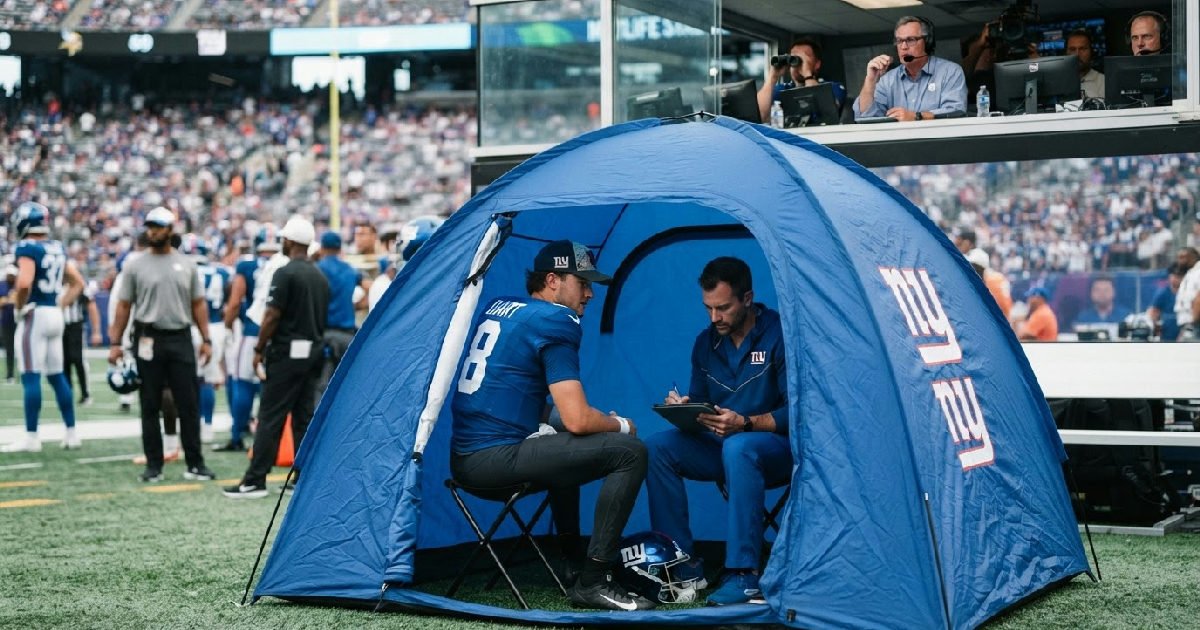
Jaxson Dart’s ‘puzzling’ blue tent complaint draws sharp rebuke from NFL analysts
New York Giants quarterback Jaxson Dart has found himself at the center of a debate pitting player frustration against league-mandated safety measures. After being sent to the Jaxson Dart blue tent for a concussion evaluation during a preseason game, Dart called the frequent checks “puzzling,” a comment that drew swift criticism from NFL analysts and a pointed clarification from the league itself.
The incident occurred on Saturday, August 15, during the Giants’ 13-10 preseason loss to the Minnesota Vikings at MetLife Stadium. Dart was sacked by Vikings safety Jay Ward and subsequently escorted to the blue medical tent, sparking his post-game remarks on August 16. The response underscores the NFL’s rigid stance on head trauma, a position fortified by years of evolving science and policy.
Dart questions trips to the Jaxson Dart blue tent
Following the game, Jaxson Dart expressed a growing frustration with what he perceives as constant monitoring. “I really respect the rules and the thought behind the NFL’s efforts to keep players healthy and reviewing things,” he stated. “But at the same time, I’m still puzzled by it just feeling like every time that I get hit, I find my way in there.”
The hit that prompted the evaluation was jarring. A missed assignment left Ward with a clear path to the quarterback. The impact caused a whiplash effect, and video showed Dart’s helmet striking the artificial turf. He remained on the ground for several seconds before getting up, a key trigger for independent medical spotters.
Despite the interruption, Dart played efficiently in his limited appearance. He completed 3 of 4 passes for 26 yards and a touchdown over two drives, though he was sacked twice. His annoyance seemed directed not at the single event, but at a recurring pattern that began in his rookie season.
When pressed further on the situation, Dart became more reserved. “I’m not gonna talk too much about the tent,” he said, later adding, “Which, at times, I still try to wrap my head around. That’s all that I’m going to say about that situation.” This sentiment echoes a player’s natural desire to stay on the field, even when protocols dictate otherwise.
The NFL’s official stance
The league office was quick to frame the evaluation as standard procedure. On Monday, August 17, chief NFL spokesman Brian McCarthy confirmed to Pro Football Talk via email that the incident prompted a “standard medical timeout.” The statement reinforces that such decisions are often out of the team’s hands, initiated by independent officials.
Analysts and NFL defend concussion protocol
Prominent NFL media figures were less diplomatic. They characterized Dart’s comments as naive at best and dangerous at worst. Mike Florio of Pro Football Talk issued a stern on-air rebuke, suggesting the Giants’ leadership needed to intervene. “This mechanism is there for your safety, Jaxson,” Florio said. “It’s not there to hassle you.”
Florio argued that Dart’s public complaints could backfire. He advised that the organization, from head coach John Harbaugh to the front office, should counsel the young quarterback on the purpose of the protocols. “I don’t think that complaining about it is gonna make it any better,” Florio warned. “I think if anything, it’s going to make the spotters more sensitive.”
Connor Orr of Sports Illustrated echoed this sentiment, pointing to Dart’s own on-field actions. “On many of Dart’s trips to the medical tent, there’s been a moment where he’s gripped his helmet, rolled over in obvious pain or laid on the field,” Orr wrote on social media. “While getting pulled for a few plays may be annoying, what should head trauma officials do?”
A history of head injuries and protocol scrutiny
This isn’t a new issue for Dart or the Giants. During his 2025 rookie season, the quarterback was evaluated for a concussion five separate times. One of those instances led to a formal diagnosis, forcing him to miss two games. This history has inevitably placed him under a microscope whenever he takes a significant hit.
The organization itself has a checkered past with the league’s rules. In 2025, the New York Giants were hit with a $200,000 fine for violating the concussion protocol. The team’s former head coach, Brian Daboll, was personally fined $100,000 for his role in the violation. This expensive lesson likely contributes to the team’s current abundance of caution.
That sensitivity extends to other players as well. During one of Dart’s previous tent visits, running back Cam Skattebo was fined $15,000 simply for entering the tent while the quarterback was being checked. The league’s message is clear: the medical evaluation space is sacrosanct, and the process will be protected from outside interference.
The mechanics of the NFL’s spotter system
Dart’s feeling of being singled out stems from a system designed to be impartial and proactive. At every NFL game, a team of unaffiliated neurotrauma consultants (UNCs) and independent certified athletic trainers (CATs) are tasked with monitoring players for potential head injuries. This system was a major development after years of debate over how the tourists chasing history in American sports would be protected.
Crucially, one UNC and two CATs are stationed in a booth with access to broadcast video and replay. They have the authority to call a medical timeout and halt the game if they see signs of impact or injury behavior that the on-field staff might miss.
This includes a player clutching their head, struggling to stand, or remaining motionless after a play, all of which applied to Dart’s situation.
This ‘eye in the sky’ approach removes the decision from the player, who may be compromised by the injury itself, and from team coaches, who are focused on winning the game. The protocol is triggered by visual evidence, not by a player’s request or a coach’s permission.
For a player like Dart, with a documented history and a playing style that invites contact, these triggers are likely to occur more often.
Player style and risk
Even before his pro career, Dart garnered a reputation for a reckless, all-out style of play at Ole Miss. While this endears him to fans and teammates, it also exposes him to high-risk situations. Analysts have long expressed concern that his propensity to take on defenders rather than slide or go out of bounds could jeopardize his availability and, by extension, hurt the team.
Pro Football Talk’s Florio offered simple advice for quarterbacks who want to avoid the tent. “Avoid taking big hits like that,” he said. “Fall in a way that doesn’t result in the helmet striking the turf. And move quickly (if possible) to get up after the play ends.”
While easier said than done in the heat of the moment, it’s the reality of today’s game. This reality is part of a wider trend in sports, where even in gaming, updates are made to ensure fair play, as seen in the Valorant 13.04 update.
What this means for Dart and the Giants
As the Giants prepare for their season opener against the Dallas Cowboys on September 13, the focus on Dart’s health and his attitude toward it will only intensify. His comments, however mild, have put both him and the team in an awkward position. They are now on notice that the league and its independent spotters are watching closely.
The quarterback’s frustration is understandable from a competitive standpoint. No player wants to be pulled from a game, especially when they feel fine. However, the NFL’s concussion protocol isn’t about how a player feels in the moment; it’s about protecting them from the severe, long-term consequences of brain trauma that may not be immediately apparent.
Similar concerns about future risk are being debated with the rise of analyst AI concerns in other industries.
For Jaxson Dart, the path forward is clear: adapt or face continued interruptions. He must either adjust his playing style to minimize violent collisions or accept that the blue tent will be a regular part of his career.
In the modern NFL, the league has decided that a few ‘puzzling’ minutes in a medical tent is a small price to pay for a player’s long-term health. The onus is now on the player to accept it.