

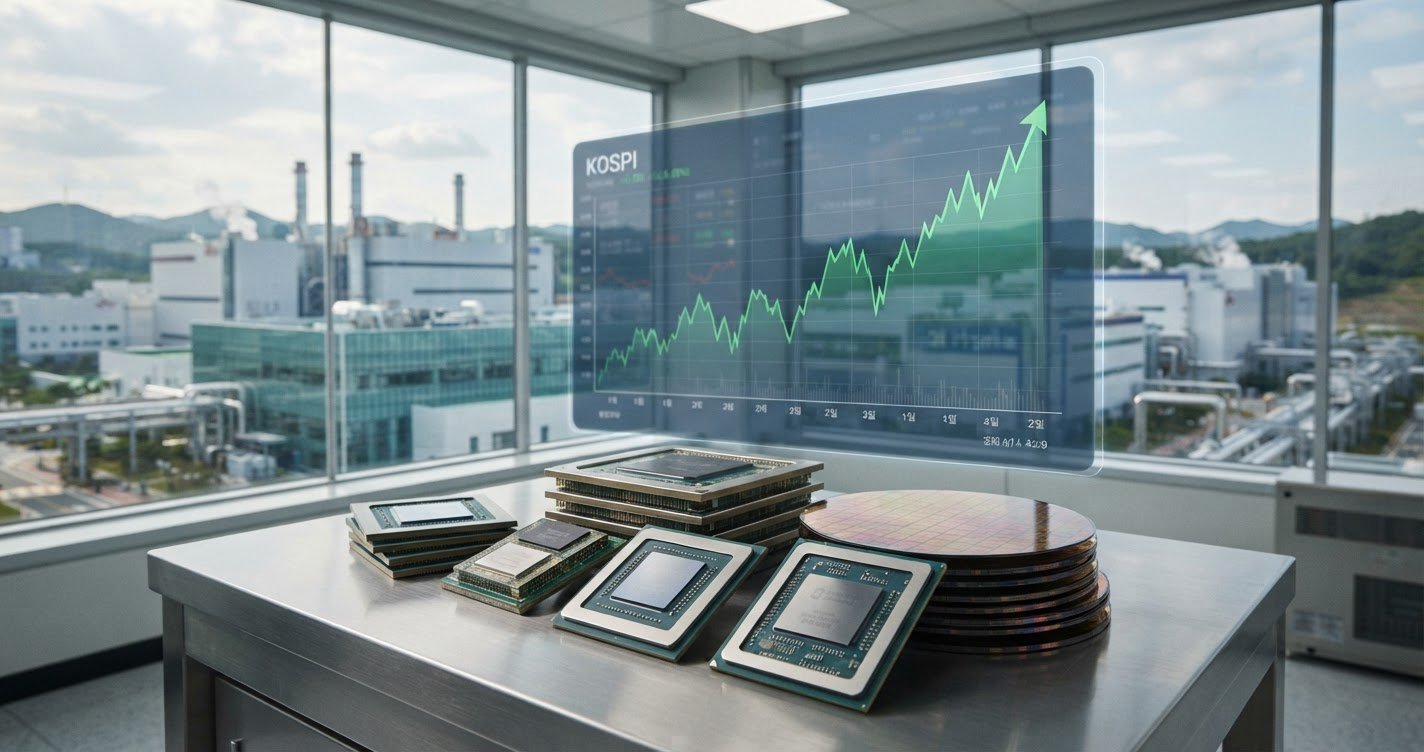
South Koreas KOSPI enters bull market on AI chip demand
The KOSPI, South Korea’s benchmark stock market index, officially entered a technical bull market today, August 13, 2026. This rapid turnaround follows a period of significant decline and is primarily fueled by explosive global demand for AI semiconductor chips, coupled with comprehensive corporate governance reforms and the increasing influence of leveraged Exchange Traded Funds (ETFs).
The index surged over 31% from its low point in July 2026, culminating in a 4% rise today. This dramatic shift marks a critical moment for the nation’s economy, which has grappled with volatility over the past year.
AI semiconductor boom propels KOSPI rally
The primary engine behind the KOSPI’s remarkable ascent has been the insatiable global demand for AI semiconductor chips. This surge has directly benefited South Korea, home to some of the world’s leading memory chip producers.
These companies are experiencing record-breaking orders as the world races to build out its AI infrastructure. The resulting sharp upward revisions in earnings projections have transformed market sentiment.
Chipmakers’ dominance and earnings revisions
The impact of this boom is most evident in the fortunes of Samsung Electronics and SK Hynix. These two industrial giants, key players in the global semiconductor landscape, now command an outsized influence on the KOSPI.
As of July 22, 2026, they accounted for 55.5% of the KOSPI’s total market capitalization, a substantial leap from just 22% at the close of 2023. SK Hynix’s share price has seen an astonishing 1,000% increase over the past year, while Samsung’s shares soared by 500%.
This stellar performance underscores the critical role these firms play in the global technology supply chain. The broader market’s earnings picture also shifted dramatically, with earnings per share projections for listed companies, excluding these two titans, revised upward by 48% in May 2026. Including Samsung Electronics and SK Hynix, the total market projection jumped by 261%.
SK Hynix made headlines recently, raising USD 26.5 billion in what became the biggest U.S. initial public offering ever by a foreign company on July 10, 2026. Prior to this, as of June 24, 2026, SK Hynix had been preparing a U.S. IPO with a reported target of around $30 billion.
Sweeping corporate governance reforms tackle “Korea Discount”
Beyond the tech sector, a concerted effort to address the long-standing “Korea Discount” has played a crucial role in improving investor confidence. This term refers to the historical undervaluation of South Korean stocks compared to their international peers.
The government and financial authorities have made corporate governance reform a top national priority. They’re pushing for greater transparency, better capital efficiency, and enhanced shareholder returns.
The Corporate Value-Up Program and its goals
A cornerstone of these efforts is the Corporate Value-Up Program, launched in February 2024 by the Financial Services Commission. This initiative actively encourages listed companies to boost their capital efficiency, modernize their governance structures, and, critically, increase returns for shareholders.
The program aims to foster a more investor-friendly environment, a significant departure from past practices often criticized for favoring controlling shareholders over minority investors. This shift is a key part of the government’s strategy to enhance shareholder value strategies.
Key Commercial Act revisions bolster shareholder rights
Several pivotal revisions to the Commercial Act demonstrate this commitment. In July 2025, the act was updated to explicitly include shareholders within the scope of a director’s duty of loyalty, a move designed to better protect investor interests.
Further changes saw outside directors officially renamed “independent directors” to emphasize their autonomy from management and controlling shareholders. Their mandatory representation on boards also increased from one-quarter to one-third of the total number of directors in July 2026.
August 2025 brought additional revisions, including a prohibition against firms opting out of cumulative voting. This change, alongside an increase in the minimum number of audit committee members elected separately from one to two, empowers minority shareholders.
Tax adjustments and market infrastructure upgrades
Tax reforms have also played a part. January 2026 saw a major change in how dividend income is taxed for both firms and investors. This was a deliberate policy choice to incentivize higher dividend payouts and encourage companies to distribute more of their profits to shareholders.
Authorities also introduced the Korea Value-Up Index and related ETFs. These new tools are designed to broaden the investor base and promote stable, long-term capital inflows into the market, echoing broader regional efforts in stablecoin network development.
In a significant move to enhance market liquidity and efficiency, South Korea fully lifted its stock short-selling ban in March 2025. This decision, long awaited by institutional investors, has been seen as a step towards aligning the Korean market with global standards.
Domestic investor surge and ETF influence
While institutional reforms set the stage, the actual buying power driving the KOSPI’s recent rally has come largely from domestic investors. Their renewed enthusiasm for the market has been amplified by the rapid growth of leveraged Exchange Traded Funds.
These financial products allow investors to amplify their exposure to market movements, both up and down. They’ve become increasingly popular, particularly among retail investors seeking higher returns in a dynamic market environment.
The rise of leveraged ETFs and trading volumes
The sheer scale of ETF growth in South Korea is striking. Total net assets of Korean ETFs have quadrupled over the past three years. This explosion in popularity has had a direct impact on trading volumes.
Average daily trading turnover soared from KRW 6.6 trillion (approximately USD 4.5 billion) in December 2025 to a staggering KRW 34 trillion (USD 23 billion) by June 2026. This surge in trading activity reflects a significant shift in how domestic capital is being deployed.
Shifting investor landscape and foreign capital
It’s worth noting that this domestic-led rally contrasts with earlier trends. In the first half of 2026, foreign investors offloaded a record net KRW 148.3 trillion (USD 96.7 billion) of Korean equities. This outflow suggests a divergence in sentiment between local and international market participants.
The growing popularity of ETFs among domestic investors has effectively compensated for some of this foreign capital withdrawal. It shows a strong belief among Korean individuals and institutions in their own market’s potential, particularly given the recent reforms and the AI boom.
Government’s long-term economic vision and reforms
The market’s current trajectory is also underpinned by a broader government strategy aimed at long-term economic growth and structural improvements. These initiatives extend beyond just corporate governance to touch various aspects of the financial ecosystem.
The goal is to create a more resilient and attractive market for both domestic and international investors. Policymakers are looking at every angle to sustain this positive momentum.
2026 Second Half Economic Growth Strategy details
On July 14, 2026, South Korea unveiled its “2026 Second Half Economic Growth Strategy,” a comprehensive plan to drive economic vitality. This strategy includes further reforms targeting tax valuation, corporate transparency, and the overall financial market structure.
Specifically, there are plans to revise inheritance tax stock valuation rules to prevent price suppression, which can deter long-term investment. The government will also begin publishing lists of companies with persistently low Price-to-Book Ratios (PBR) starting November 2026. This measure aims to publicly pressure underperforming firms to improve capital efficiency, thereby impacting their corporate market performance.
Another significant, albeit less dramatic, move is the planned reduction of the stock settlement cycle from two days to one. A detailed roadmap for this change is expected by October 2026, promising faster transactions and increased market efficiency.
MSCI inclusion ambitions to attract foreign capital
A key strategic objective for the South Korean government is securing inclusion in the MSCI Developed Markets Index. This would be a significant milestone, as it would likely trigger substantial inflows of foreign capital from passive funds that track the index.
Achieving developed market status is seen as a stamp of approval from the international investment community, validating the country’s reform efforts and its economic maturity. It’s a long-term goal that underscores the government’s commitment to global integration.
Market volatility and future outlook
Despite the current bullish momentum, the South Korean market has demonstrated extreme volatility over the past year. This underscores the inherent risks and rapid shifts that characterize global markets in the current era.
The dramatic swings highlight the need for continued vigilance and thoughtful policy decisions to ensure sustained growth rather than just fleeting surges. The journey from bear to bull has been anything but smooth.
Unprecedented market swings and circuit breakers
The KOSPI Volatility Index actually surpassed its 2008 global financial crisis peak in 2026. This statistic alone illustrates the extraordinary levels of market uncertainty that investors have navigated. The Korea Exchange also triggered market-wide circuit breakers seven times this year, an unprecedented number.
To put this into perspective, the mechanism designed to halt trading during extreme drops was activated more times in 2026 than in its entire history prior to this year. This highlights the fragility beneath the surface of the recent gains.
Balancing growth with stability
Looking ahead, the challenge for South Korea will be to maintain the momentum driven by AI chip demand and corporate reforms while mitigating future volatility. The government’s economic strategy, with its focus on transparency and market efficiency, aims to build a more stable foundation.
The reliance on two semiconductor giants, while currently a boon, also presents a concentration risk that policymakers will need to manage. Continued reforms and a broadening of economic drivers will be crucial for the sustained health of the South Korean stock market.