

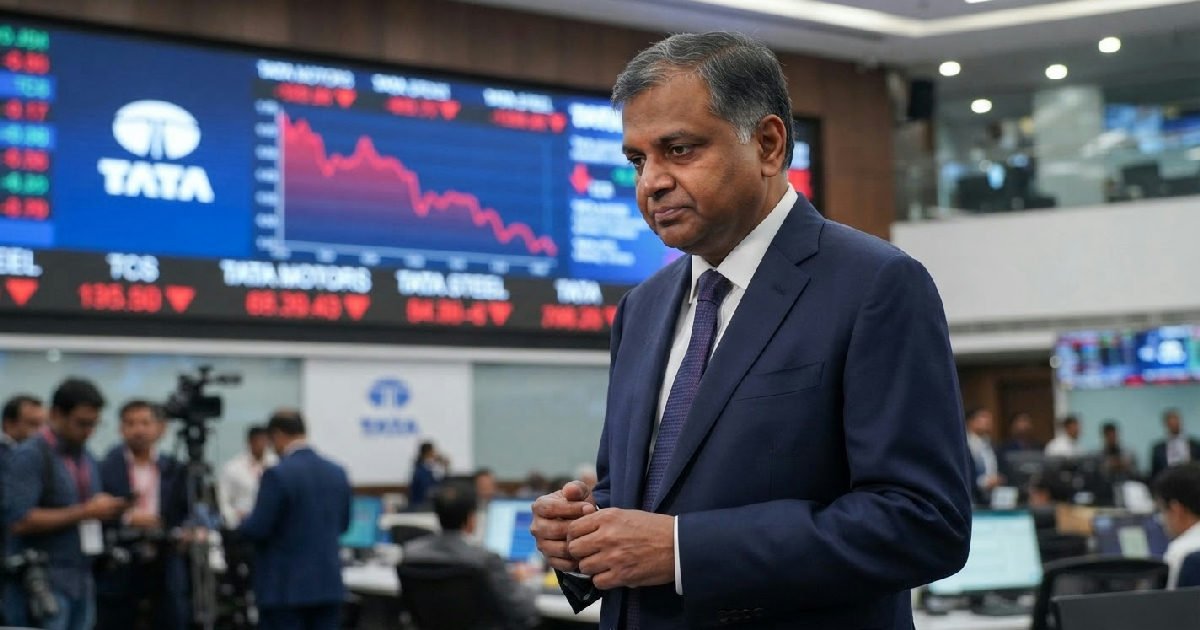
Tata Group market capitalization dips $3.22 billion as Chairman N. Chandrasekaran plans exit
Tata Group Chairman exit: Market capitalization dipped $3.22 billion as Chairman N. Chandrasekaran announced he won’t seek reappointment. 22 billion following the announcement that Chairman N. Chandrasekaran will exit his position. Chandrasekaran, the influential Chairman of Tata Sons, has decided not to seek reappointment when his current term ends on February 20, 2027.
This pivotal announcement, made on Wednesday, August 12, 2026, sent ripples through the Indian stock market.
The news prompted a swift and sharp reaction from investors. Shares in Tata Group entities saw their total market value on the BSE erode by over Rs 2 lakh crore (more than 268 billion rupees), approximately $3.22 billion USD, as markets digested the implications of the leadership transition.
Market reacts to leadership change
The immediate aftermath of Chandrasekaran’s decision saw a substantial reduction in the combined market value of Tata Group companies listed on the BSE. This more than 268 billion rupees (approximately $3.22 billion USD) decline underscores the immense influence of the chairman’s role within the sprawling conglomerate.
Investors often view leadership stability as a critical factor, especially in large, diversified groups like Tata. The unexpected nature of the announcement, coming well in advance of his term’s expiry, appears to have unsettled market sentiment in India.
Behind the Tata Group Chairman exit
N. Chandrasekaran, who is 63 years old, informed the Tata Sons board of his decision to step down after his current tenure. He cited a lack of unanimous backing for his reappointment from the board as the primary reason for his departure.
This move aims to provide clarity on leadership for a vast network of employees, investors, partners, and other stakeholders across the globe. Tata Sons, as a large institution, has numerous strategic projects currently at critical stages, necessitating clear direction.
Boardroom battles and strategic disagreements
Reports suggest that disagreements had been simmering for several months between Chandrasekaran and Tata Trusts, the charity arm that holds a 66% stake in Tata Sons. Noel Tata, Chairman of Tata Trusts and a board member of Tata Sons, reportedly opposed Chandrasekaran’s reappointment.
Points of contention reportedly included the potential listing of Tata Sons, mounting losses at Air India, and the strategy for handling the planned exit of a minority shareholder. Questions around capital deployment and financial discipline also played a role in the internal discord.
Tata Trusts’ influence and legal challenges
The internal rifts came to a head during a Tata Sons board meeting on February 24, 2026, where a proposal to extend Chandrasekaran’s tenure failed to gain unanimous support. This meeting proved to be a turning point, solidifying the chairman’s decision not to seek another term.
Adding another layer of complexity, the Sir Ratan Tata Trust (SRTT) has faced suspension from decision-making by the Maharashtra Charity Commissioner. This situation raises questions about its capacity to participate in crucial voting at the upcoming Tata Sons Annual General Meeting (AGM) scheduled for August 18, 2026, potentially impacting future leadership decisions.
N. Chandrasekaran’s tenure and legacy
During his time as Chairman, N. Chandrasekaran oversaw a period of significant strategic shifts and challenges for the conglomerate. His leadership encompassed a wide range of industries, from technology giants like Tata Consultancy Services (TCS) to automotive leader Tata Motors and Tata Consumer Products.
One notable acquisition during his tenure was Air India, which has subsequently faced considerable financial challenges. Managing this turnaround has been a complex undertaking, contributing to some of the internal discussions regarding capital allocation and performance.
His departure marks the end of an era for Tata Group’s broad portfolio, which touches nearly every aspect of the Indian economy. The group, under his guidance, continued its expansion and diversification, even while grappling with various sector-specific headwinds and competitive pressures.
What next for Tata Sons? Leadership search begins
With Chandrasekaran’s term concluding in early 2027, the focus now shifts to the succession planning at the helm of Tata Sons. The group will need to identify a new leader capable of navigating its diverse business interests and resolving ongoing internal strategic debates.
The search for a successor will be closely watched by domestic and international investors alike. Ensuring a smooth transition is crucial for maintaining confidence and stability across the vast Tata Group ecosystem and its many stakeholders.
The upcoming AGM on August 18, 2026, may provide further indications regarding the immediate future direction and composition of the board. The decisions made in the coming months will shape Tata Sons’ strategic trajectory for years to come, particularly concerning its investment priorities and operational efficiencies.
Analysts are now assessing the potential impact on various group companies, speculating on whether a new chairman might alter existing strategies for loss-making ventures or accelerate divestitures. The market will be keen to see how the new leadership approaches critical decisions, such as the future of Air India.
This leadership change at one of India’s most revered conglomerates highlights the intricate balance between corporate governance and shareholder influence. It also reflects broader trends in global business, where even established titans must constantly adapt to evolving market demands and internal dynamics.
The situation underscores the importance of clear communication and alignment within the top echelons of a company, especially one with the scale and complexity of Tata Group. The ensuing months promise to be a period of significant observation for the Indian financial markets.