

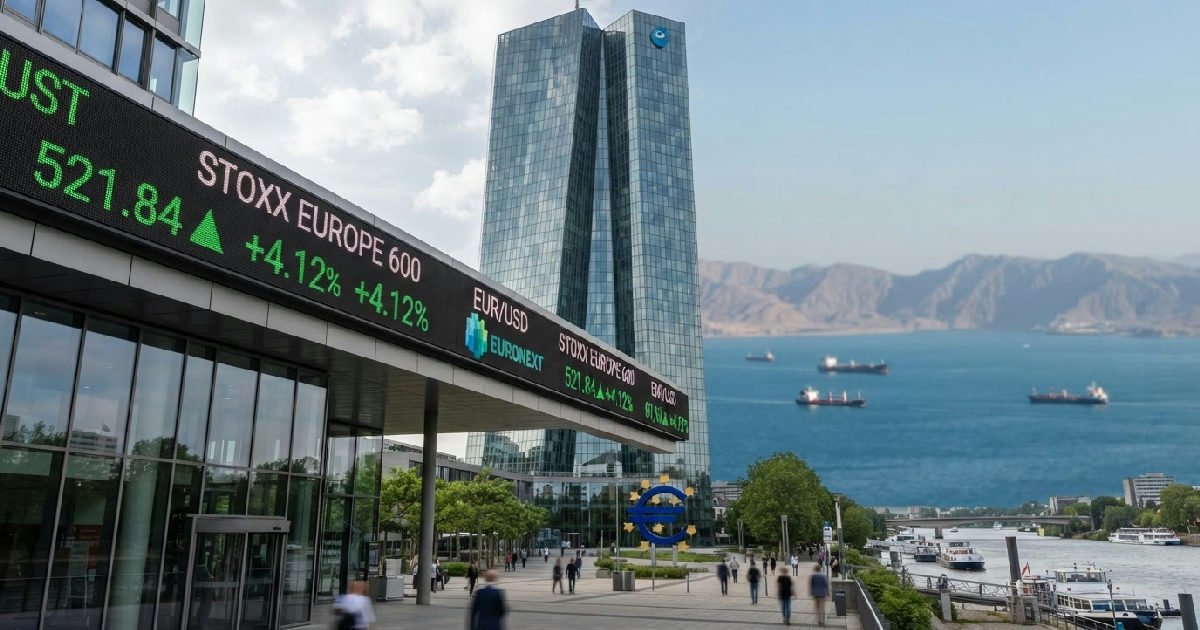
European stocks gain traction amid strong earnings, eased Iran tensions
Investors are redirecting significant capital back into European equities, a move underpinned by a robust second-quarter earnings season and an apparent easing of tensions in the US-Iran conflict. This pivot has not only propelled major European indices to record highs but also positioned the region’s stocks as a strategic buffer against the volatility gripping global technology shares.
The influx marks a notable shift in sentiment, arriving as hopes for renewed diplomacy between the US, under President Donald Trump, and Iranian officials, potentially leading to the reopening of the Strait of Hormuz, have sent oil prices tumbling. This combination of strong corporate performance and geopolitical de-escalation is reshaping investment strategies across the continent.
Corporate earnings power European market rally
European companies have delivered their strongest earnings performance since 2022, with second-quarter results on track to show a remarkable 22% year-on-year growth. This figure represents a significant leap from the 12.5% forecast in early May, demonstrating a powerful corporate rebound across nearly all sectors.
Even when excluding the often-volatile energy sector, earnings growth still stands at an impressive 11.5%, more than double initial expectations. This widespread strength suggests a fundamental health in European businesses that many investors may have previously overlooked amidst broader global anxieties.
Divergent company results underscore sector dynamics
The earnings season wasn’t a uniform story of success, but strong performers largely outweighed those that stumbled. WPP, the advertising giant, saw its shares surge by 28.6% on August 7, building on a 26% jump from August 6 after reporting first-half results that handily beat market forecasts for organic growth.
Similarly, Deutsche Telekom climbed 6.3% on August 7. This came after the telecommunications titan announced an expansion of its 2026 share buyback plan by €3 billion, bringing the total to as much as €5 billion, following an 11.1% rise in adjusted net profit to €2.8 billion for the second quarter.
In the financial sector, lenders like BNP Paribas and UBS reported substantial profit jumps, with BNP Paribas seeing its quarterly profits surge by a third. Shell also showcased its robust performance, more than doubling its second-quarter adjusted profit to $9.8 billion.
However, not all companies enjoyed the same upward trajectory. German industrial conglomerate Siemens fell 4.5% on August 7 after its Digital Industries business failed to meet expectations. Defense contractor Rheinmetall also lost 3.5% after cutting its 2026 sales outlook, indicating that even in a generally positive environment, sector-specific challenges persist.
Looking at year-to-date standouts, materials technology company Soitec has skyrocketed 414.5% since the start of 2026 through August 5, making it the best-performing constituent of the STOXX Europe 600 index. Austrian semiconductor and printed circuit board manufacturer AT&S also saw shares soar by 343.5% over the same period, highlighting the strong demand in certain high-growth niches.
Geopolitical calm steadies energy markets
A crucial factor in the renewed investor confidence in European stocks is the perceived de-escalation of the US-Iran conflict. This tension, which began in late February, had initially pushed Brent crude prices above $90 a barrel, creating significant headwinds for global economies reliant on stable energy costs.
Now, optimism surrounding diplomatic efforts to resolve the conflict and reopen the critical Strait of Hormuz has dramatically impacted oil prices. Brent crude was trading 5% lower at $83.47 a barrel by lunchtime on August 3, having previously fallen as much as 7.3% to $81.55 a barrel. US West Texas Intermediate saw a similar drop, falling more than 5% to $79.47 a barrel.
Lower oil prices alleviate inflationary pressures and reduce operational costs for European businesses, contributing directly to improved corporate profitability. This shift away from geopolitical uncertainty offers a much-needed breath of fresh air for market participants.
Europe as a hedge against tech volatility
Investors are increasingly eyeing European stocks not just for their inherent value but also for their potential as a diversification strategy. The market has been dominated by a tech stock surge, particularly in global technology and artificial intelligence companies, which while offering high returns, also carry significant volatility.
European markets, with their diverse industrial base and comparatively lower exposure to the most speculative ends of the tech sector, offer a more stable alternative. This “diversification interest” is tangible: European stock exchange-traded funds (ETFs) recorded positive net flows in July for the first time since the US-Iran conflict began, attracting substantial capital.
BlackRock, one of the world’s largest asset managers, reported an impressive $4.4 billion in inflows into its European equities products during July alone. This strong uptake signals a deliberate move by institutional and retail investors alike to balance their portfolios.
Economic indicators bolster investor confidence
Beyond earnings and geopolitics, several underlying economic fundamentals are reinforcing the bullish outlook for European equities. Corporate balance sheets across the continent remain resilient, providing a solid foundation for future growth and mitigating some of the downside risks that have plagued other regions.
Furthermore, Europe is experiencing steady disinflation, a welcome sign for central banks considering future monetary policy adjustments. This trend, combined with robust Eurozone growth data, paints a picture of an economy gaining momentum.
The banking sector, in particular, has benefited from higher interest rates and the more volatile market environments of recent months. These conditions have allowed banks to improve their margins and profitability, further contributing to the overall positive earnings landscape.
Outlook: continued momentum or looming headwinds?
While the current trajectory for European stocks appears promising, analysts remain cautiously optimistic. The confluence of strong corporate earnings, easing geopolitical tensions, and favorable macroeconomic conditions has created a powerful tailwind.
However, the sustainability of these factors is always subject to change. Any renewed escalation in the US-Iran conflict or a significant shift in global monetary policy could quickly alter the market’s direction. Investors will be closely watching for continued diplomatic progress and future earnings reports to gauge the durability of this European equity renaissance.
Moreover, the performance of individual sectors and companies continues to vary significantly, meaning selective investment remains paramount. While the broader indices are hitting record highs, a deeper dive reveals nuanced stories of success and struggle within the European market. Investors are also weighing broader global developments such as geopolitical shifts and macroeconomic trends, which are explicitly supported by the research.