

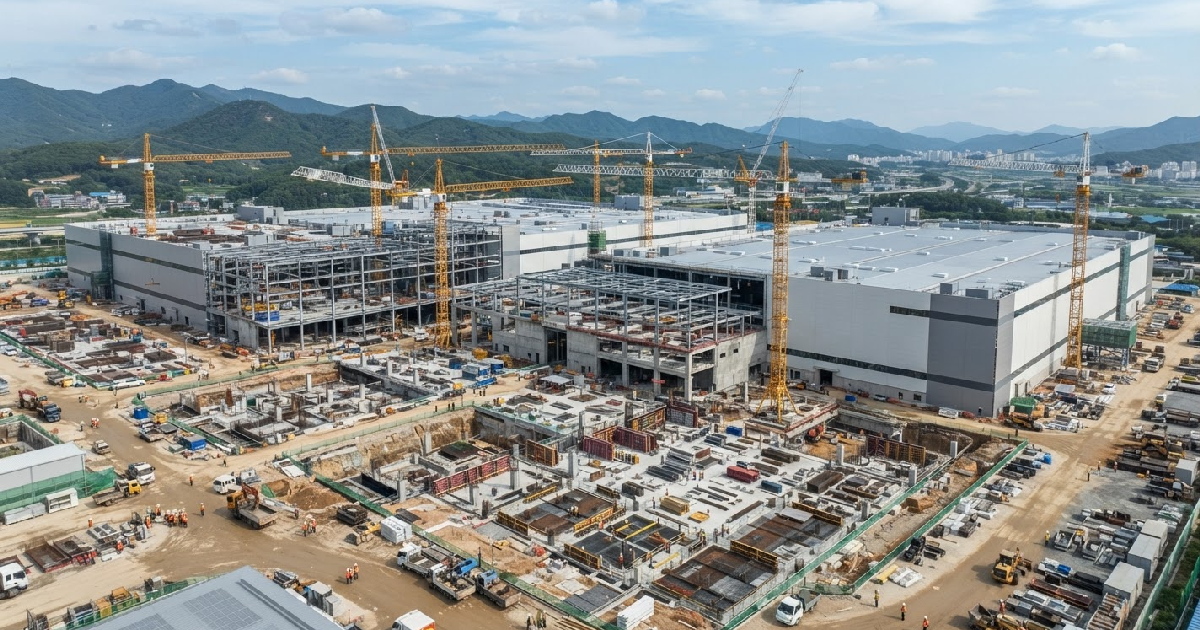
SK Hynix to invest $38 billion building new memory chip plants amid surging AI demand
SK Hynix, a global leader in memory semiconductors, has approved a significant investment of 54 trillion Korean won, approximately $38 billion USD, to construct two new state-of-the-art memory chip manufacturing plants in South Korea. The decision, made by the company’s board of directors on Friday, reflects a direct response to the explosive global demand for components critical to artificial intelligence applications.
This strategic move comes as the memory chip sector faces its most severe shortage ever, according to CEO Kwak Noh-jung. The new facilities are crucial for the company to meet projected demand, which is expected to outstrip supply well into the next decade.
New SK Hynix memory chip plants to meet AI demand
The substantial investment will be split between two key locations within South Korea. SK Hynix plans to channel 35.2 trillion won into a new fabrication plant, or fab, designated “Y2” in Yongin. The remaining 19.1 trillion won is earmarked for a new facility in Cheongju, known as “M17.”
The Yongin Y2 plant is the second of four fabs envisioned within the ambitious Yongin Semiconductor Cluster. Its primary focus will be dynamic random access memory (DRAM), a vital component for computing. Crucially, it will also produce High-Bandwidth Memory (HBM), which is indispensable for powering advanced AI data centers.
Construction on Yongin Y2 is slated to begin in July 2027, with the first cleanroom becoming operational by June 2029. This will enable the production of HBM and other next-generation DRAM products. The Cheongju M17 fab, conversely, will break ground in February 2027 and open its first cleanroom in December 2028, specializing in NAND flash memory.
Strategic locations for future chip supply
These new data center demand and AI growth. Cheongju is quickly evolving into a comprehensive manufacturing hub, encompassing NAND, HBM, and advanced packaging facilities. The strategic placement of these new fabs aims to solidify South Korea’s position as a global semiconductor powerhouse.
They’re integral to SK Hynix’s broader “master plan,” announced last year, which outlines colossal investments across its domestic operations. The Yongin Semiconductor Cluster alone is set to receive 600 trillion won. An additional 100 trillion won is dedicated to expanding the Cheongju production base.
Broader investment vision beyond immediate plans
The 54 trillion won investment approved today forms part of an even grander strategy by SK Hynix. Its mid-to-long-term investment plan totals an enormous 1,100 trillion won, equivalent to roughly $700 billion USD.
This colossal sum also includes a proposed 400 trillion won for a new semiconductor cluster in the southwestern region of South Korea. SK Hynix is also making strategic international investments, including approximately $4 billion for an advanced chip packaging factory in Indiana, USA.
The company is actively exploring other regions, such as the US, Japan, and Southeast Asia, for potential future wafer fabrication investments. They prioritize locations with sufficient land, electricity, water, and a skilled workforce at competitive costs.
Global demand fuels chip price surge
The unprecedented scale of this semiconductor investment directly reflects the intense pressure on the global memory chip market. The widespread adoption of AI technologies, from large language models to complex data analytics, has created a voracious appetite for specialized memory. This includes companies building AI infrastructure and major chip firms like Nvidia.
The overall global demand for artificial intelligence applications has caused a severe shortage of all types of memory chips. This market dynamic has driven prices for both NAND flash memory and DRAM to historical highs.
Investors have closely watched this supply-demand imbalance, leading to significant rallies in the share prices of top memory producers like SK Hynix, Samsung, and Micron. Many expect this tight market to persist for the foreseeable future, fueling further investment.
South Korea’s national ambition in semiconductors
These massive capital injections from SK Hynix are not just corporate decisions; they align with a broader national agenda for semiconductor leadership. South Korean President Lee Jae Myung recently attended an event related to these plans, highlighting the government’s commitment.
The investments are a key component of a nationwide initiative to capitalize on the AI boom, aiming to double South Korea’s memory chip production capacity within five years. This coordinated effort seeks to ensure the economic benefits of AI are widely distributed across the country.
Samsung Electronics is also part of this broader South Korean investment drive in semiconductors. The continued expansion reinforces the nation’s strategic position in the global tech ecosystem.
Implications for the international tech ecosystem
The expansion by SK Hynix signals a period of intense competition and rapid development across the semiconductor industry. As AI models grow more sophisticated, the demand for specialized memory will only continue to surge.
These investments, alongside those from other major players, will largely determine the pace of AI advancement across various sectors. The expanding AI software sector also underscores the need for continuous hardware innovation. But the sheer scale of the investment also highlights the long lead times and enormous capital required to meet future technological needs.
Ultimately, these new facilities could help alleviate some of the acute memory shortages that have plagued the industry. However, the continuous evolution of AI applications means that demand could continue to push the limits of even this expanded capacity. Investors are also watching for broader market shifts as capital flows into promising tech areas.
The race to build the next generation of AI hardware is just beginning, and South Korea is firmly positioning itself at the forefront. Ensuring a robust and reliable supply chain for critical components has become a matter of national security and economic resilience.