

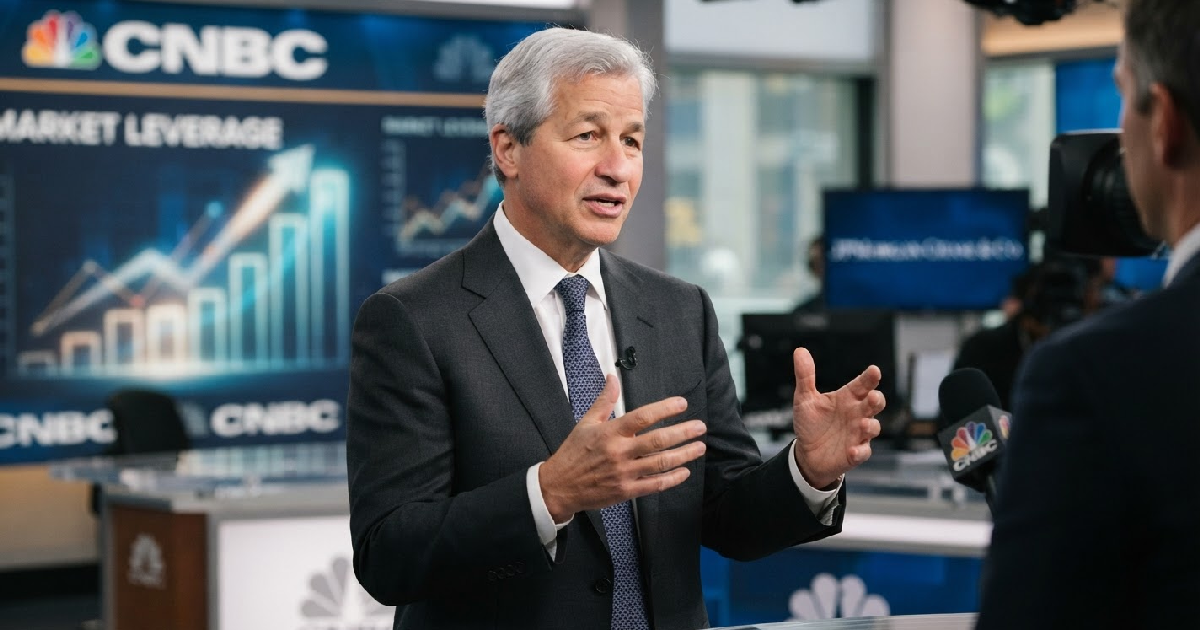
JPMorgan CEO Jamie Dimon warns of escalating market leverage risks
Jamie Dimon, the Chairman and Chief Executive Officer of JPMorgan Chase & Co., has issued a stark warning about significantly elevated market leverage, predicting that its unchecked growth could trigger swift disruptions. Speaking on Wednesday, August 5, 2026, during an interview with CNBC, Dimon articulated his concerns that hidden borrowing and unprecedented margin debt levels are making financial markets increasingly vulnerable.
His latest comments highlight a persistent theme from the influential banking chief, who has consistently flagged potential fragilities in the financial system. These remarks underscore how current market dynamics carry risks that investors and regulators might be underestimating, despite generally robust performance.
Dimon flags hidden dangers of elevated market leverage
Dimon’s primary concern centres on the sheer volume of leverage currently present in financial markets, much of which he argues is not readily apparent. He stated unequivocally that margin debt, the borrowing used by investors to purchase securities, has reached its highest point ever.
But the problem extends beyond just traditional margin accounts. Dimon pointed out that a significant portion of this borrowing remains out of sight, “not called margin debt,” but rather disguised within various financial instruments and strategies. This invisible leverage makes it harder to assess the true scale of potential risk.
The invisible hand of borrowing
The JPMorgan CEO specifically identified several key sources contributing to this elevated market leverage. He cited borrowing through prime brokerages, hedge funds, leveraged exchange-traded funds (ETFs), and complex Treasury arbitrage strategies.
“The market leverage is pretty high,” Dimon stressed, indicating that this widespread, often obscured, borrowing creates a precarious environment. This means a single, unexpected event could reverberate more widely than many anticipate.
When discussing the recent unwind of AI-focused hedge fund Situational Awareness, Dimon noted that JPMorgan was one of its prime brokers. While the markets absorbed that specific failure without broader disruption, it served as a vivid example of how quickly leveraged bets can turn sour.
Learning from past crises
Dimon drew a critical distinction between the current situation and the 2008 financial crisis, where actual losses on mortgages were the primary driver of systemic stress. He acknowledged that while leverage alone isn’t always the sole cause of disaster, it amplifies any losses that do occur.
“The worst thing is if you have actual losses in the marketplace,” he explained, noting that significant leverage increases the chance that “somebody will disrupt the market in a quick way, and people get rattled over it.” This perspective highlights the fragility introduced by interconnected borrowing.
JPMorgan Chase has a history of navigating turbulent financial periods, partly due to Dimon’s conservative approach. In 2006, for instance, he proactively ordered the offloading of $12 billion in subprime mortgages, a move that proved prescient ahead of the housing market collapse.
During the 2008 crisis, the bank acquired Bear Stearns for $260 million and Washington Mutual for $1.9 billion, bolstering its position while others faltered. This strategic foresight has seen JPMorgan’s balance sheet grow to over $3.8 trillion in assets under Dimon’s leadership, managing $3.9 trillion in client assets.
Geopolitical tremors and inflationary pressures
Dimon’s warnings aren’t limited to market mechanics; he also points to significant geopolitical and macroeconomic headwinds. He highlighted ongoing wars in Ukraine and Iran, alongside heightened tensions between the United States and China, as major global risks.
Mounting government deficits globally and persistent inflationary pressures are also factors he views as destabilising. These elements, combined with high leverage, create a cocktail of potential market vulnerability.
Costs of global rearmament
Another significant factor Dimon raised is the structural demand for capital driven by global rearmament efforts. This push for increased military spending worldwide could reignite inflationary pressures, keeping long-term interest rates higher than many expect.
“The remilitarization of the world would be inflationary,” he cautioned, reiterating a previous sentiment that these dynamics could act as “the skunk of the party” for investors seeking returns on long-dated bonds. Such forces make the global economic outlook less predictable, and could affect sectors like energy markets.
These confluence of geopolitical instability and inflationary pressures suggests a more volatile investment climate. Policymakers are navigating complex terrain, with implications stretching across international markets. This complex environment requires careful consideration from global financial institutions.
Markets too comfortable amid high valuations?
Dimon also expressed unease regarding what he perceives as growing complacency in financial markets. Investors and lenders might be underestimating risks despite soaring asset prices and high transaction volumes.
“My own view is people are getting a little comfortable that this is real, these high asset prices and high volumes – that we won’t have any kind of problem whatsoever,” he stated. This sentiment suggests a dangerous detachment from underlying economic realities.
This “everyone’s coining money” environment, as Dimon put it, can breed overconfidence and excessive risk-taking. He cautioned against believing that the “sky was the limit” in a market characterised by rising tides lifting all boats.
Indeed, recent market performance has shown some volatility. As of July 30, 2026, the S&P 500 had dipped by 0.87% over the previous month, while the tech-heavy Nasdaq Composite was down by 1.43%. Such movements affect various asset classes, including digital currency markets.
Dimon’s consistent warnings extend to specific investment advice, too. He confirmed on July 22, 2026, that he personally wouldn’t buy stocks or long-dated Treasuries at their current valuations. This reflects his cautious outlook on present asset prices.
JPMorgan’s cautious stance and resilience
JPMorgan’s internal strategy reflects Dimon’s deep-seated caution. The bank continues to operate with a “Fortress” strategy, focusing on capital preservation and robust risk management, a principle he discussed as early as January 5, 2026.
He emphasised that the bank would continue adjusting collateral requirements as market conditions change. “When volatility goes up, clearing houses and banks generally ask for more collateral,” Dimon explained, implying that a tightening of lending standards is likely.
This conservative approach means JPMorgan is prepared to cede business if it involves excessive risk. “If the bank loses business because we don’t want to underwrite a leveraged loan, so be it. We’re not chasing anything,” he affirmed.
Dimon also highlighted the critical lesson from history: “too much leverage too much risk.” He recalled how many banks relying heavily on leverage for high returns often faced bankruptcy during past financial crises, unlike JPMorgan.
What’s next for global financial stability?
The repeated warnings from Jamie Dimon serve as a crucial reminder for investors and regulators alike. The prevalence of high market leverage, both visible and hidden, creates a landscape ripe for unexpected volatility.
While Dimon stopped short of calling it a systemic threat, he maintained that the risk of sudden disruption is considerable. The key takeaway here is that individual market events, even those not directly systemic, can still have pronounced effects.
Policymakers and financial institutions must remain vigilant, particularly as geopolitical tensions mount and inflationary pressures persist. The market’s perceived comfort could be its greatest vulnerability, as more “straws” could break the camel’s back.
Dimon expects increased volatility to lead to higher collateral demands from banks, forcing a deleveraging process. This proactive adjustment by financial institutions is crucial to maintaining overall financial system stability.