

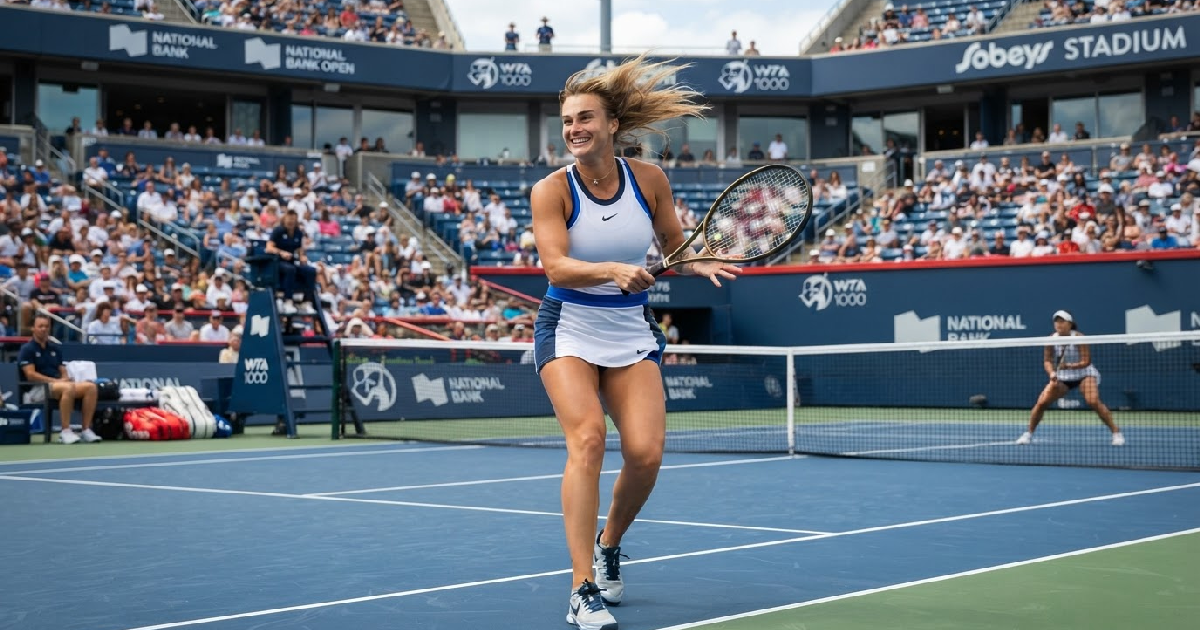
Aryna Sabalenka embraces challenging Canadian Open conditions after dominant victory
World No. 1 Aryna Sabalenka found the Canadian Open conditions in Toronto to be unusually favorable despite notorious winds during her 2026 tournament debut on Tuesday. 1 Aryna Sabalenka kicked off her 2026 Canadian Open campaign on Tuesday afternoon with a commanding win, but it was her unusual positive take on the notoriously windy conditions in Toronto that truly stood out. The Belarusian swiftly defeated Japan’s Moyuka Uchijima 6-3, 6-3 on Canadian Open Centre Court, securing her spot in the next round.
This victory marks a strong start for Sabalenka, who views the challenging weather as a unique training opportunity rather than a hindrance. Her perspective contrasts sharply with the frustrations many other top players often express regarding unpredictable elements.
Sabalenka’s strategic embrace of Canadian Open conditions
Sabalenka’s dominant performance included four aces and a solid 74% success rate on her first-serve attempts against Moyuka Uchijima. Her post-match comments revealed a distinctive approach to the persistent gusts at the WTA 1000 event, a factor that often frustrates other top players.
“I’m happy with the performance. I’m happy with the fight,” Aryna Sabalenka stated during her press conference. She acknowledged that returning to competition after a break can be difficult, but she confirmed her readiness both mentally and physically.
The reigning world No. 1 elaborated on her appreciation for the tricky playing environment. She sees it as essential practice for developing her recovery after extended rallies and improving her handling of difficult positions on court.
“Oh, I love it. For me it’s a great practice,” she explained. “I need to work on those tricky positions just so in the bigger matches I can perform at my best.”
Refining tactics through challenging play
This positive outlook on the wind isn’t just psychological; it also informs Sabalenka’s tactical development. She disclosed that she’s been focusing on specific elements like the serve-and-volley and drop shots in recent training sessions.
“We do it a lot. We do it a lot in practice,” she said, emphasizing her current focus on returning to basic skills and simplifying her game. She aims to build the confidence needed to execute these sophisticated shots spontaneously during matches.
She added, “I just felt it today, and I trusted myself and I went for it.” This reflects a deliberate strategy to integrate advanced techniques under varied conditions, preparing her for any scenario on the tour.
Canadian Open’s historical battle with wind
The Canadian Open, officially known as the National Bank Open presented by Rogers, has a long-standing reputation for challenging weather. Wind has consistently been a key discussion point among players competing in Toronto over recent years.
Its impact on elite tennis performance is significant, altering a ball’s flight, speed, and trajectory. Even a moderate breeze can cause substantial deviations, making precise control exceptionally difficult.
Players recount struggles against the elements
Crosswinds are particularly troublesome, constantly pushing the ball sideways and forcing players to adjust their aim considerably. A 15 mph crosswind, for example, can shift a flat groundstroke by 20-40 cm, while a high looping shot might move over a meter.
Headwinds tend to slow the ball down and increase topspin, often leading to longer rallies and more margin over the net. Moreover, wind can severely disrupt the ball toss during serves, resulting in aborted motions, multiple tosses, and a higher likelihood of double faults.
Several high-profile players have shared their struggles. Three-time major champion Andy Murray described the conditions at the 2023 event as “really wasn’t pleasant to play in” after his victory against Lorenzo Sonego. He noted the wind changing direction mid-point, which made play uncomfortable.
Alex de Minaur echoed similar sentiments in 2023 following his win against Cameron Norrie. He remarked that the “blowing a gale” didn’t make for “pretty tennis,” acknowledging that both competitors found it tough but he was pleased to secure the win.
More recently, Felix Auger-Aliassime openly struggled with the wind after his 2025 defeat to Fabian Marozsan. The Canadian admitted the blustery conditions hampered his serve and led to getting broken frequently.
Auger-Aliassime had even arrived early in Toronto to adapt. Despite his frustration, he conceded, “The wind is something you can’t control, but it’s the same for everyone. There’s no point complaining now about the conditions in Toronto.”
World No. 1 Aryna Sabalenka’s impressive career
Aryna Siarhiejeŭna Sabalenka, 28 years old, has established an impressive career defined by aggressive play and powerful groundstrokes. As of July 27, 2026, she holds the world No. 1 ranking in women’s singles by the WTA.
Her career highlights include four Grand Slam singles titles, with two Australian Opens (2023, 2024) and two US Opens (2024, 2025). She also reached the French Open final in 2025 and the Australian Open final in 2026, cementing her status as a formidable competitor.
Beyond the majors, Sabalenka has won eleven WTA 1000 events, the highest tier of tournaments below the Grand Slams. Her powerful serve and devastating forehand are central to her game, enabling her to dictate rallies with an aggressive, baseline-oriented style. These significant wins often involve intense competition and a need for mental fortitude, much like the unverified claims among basketball players.
The prestige of the Canadian Open WTA 1000 event
The National Bank Open is one of the world’s oldest tennis tournaments, founded in 1881, placing it behind only Wimbledon and the US Open in longevity. It moved permanently to hard courts in 1979 and is a key WTA 1000 event.
This category represents elite events on the WTA Tour, offering champions 1,000 ranking points. Since 2024, all WTA 1000 tournaments have become mandatory for top players, ensuring strong fields.
In even-numbered years like 2026, the women’s tournament is held in Toronto at Sobeys Stadium, which boasts a capacity of 12,500 fans. Both the men’s and women’s events take place during the same week in August.
Sabalenka’s next challenge and tournament outlook
With her initial victory secured, Sabalenka now prepares to face China’s Shuai Zhang in the third round. Zhang, world No. 73 as of May 4, 2026, is a three-time Grand Slam women’s doubles champion with three WTA Tour singles titles.
Sabalenka’s projected path to the final includes potential matches against Ekaterina Alexandrova or Talia Gibson in the fourth round, followed by Elina Svitolina or Amanda Anisimova in the quarter-finals. The semi-finals could see her face Iga Świątek or Marta Kostyk, with a final potentially against Elena Rybakina or Coco Gauff.
Her unique positive attitude towards the challenging Canadian Open conditions provides a crucial mental edge, especially in a draw stacked with top talent. This approach could prove vital as she navigates through tough matches, contrasting with how other athletes might reflect on their current performance levels in highly competitive sports.