

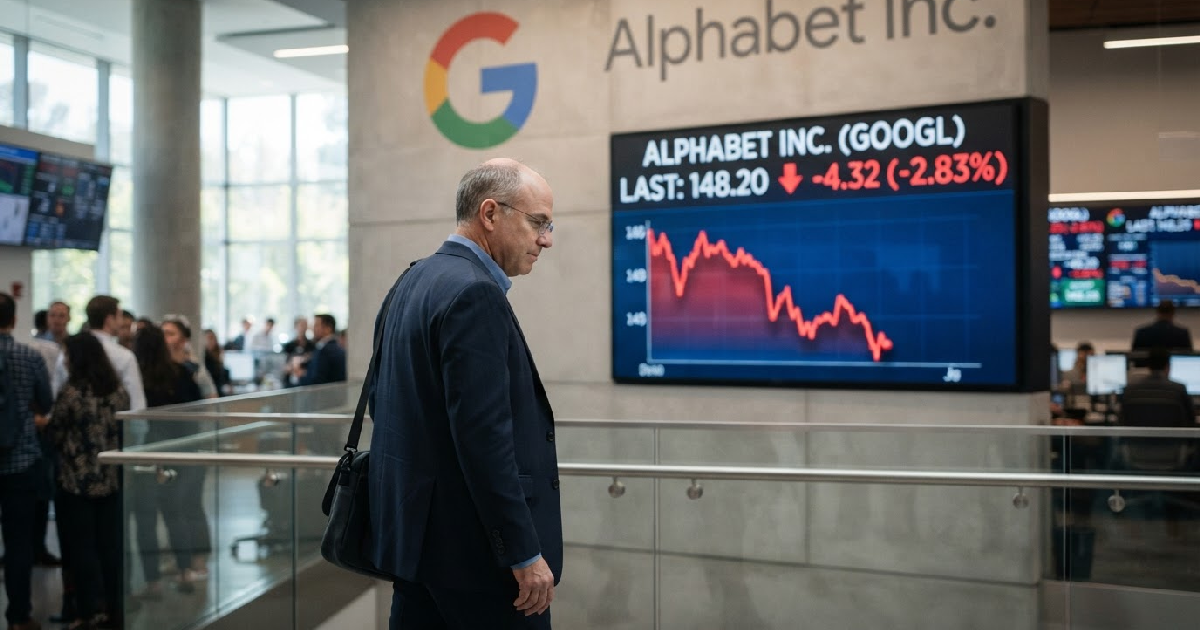
Alphabet shares plunge 4% as chief scientist Jeff Dean exits for AI venture
Alphabet’s stock plummeted on Wednesday, August 5, 2026, dropping as much as 5.4% intraday, after Google confirmed the departure of its long-serving chief scientist, Jeffrey Adgate Dean, and several other top artificial intelligence executives.
Dean, a foundational figure in Google’s AI strategy and co-founder of Google Brain, is leaving after 27 years to launch a new public-benefit corporation called Discovery Loop, alongside fellow AI veterans Sanjay Ghemawat, Oriol Vinyals, and Quoc Le.
Senior AI talent exodus hits Alphabet shares
The exodus has triggered a significant leadership reshuffle within Google DeepMind and sent ripples through the tech giant’s valuation.
The announcement immediately impacted Alphabet’s market performance, with shares falling approximately 4% shortly after the news broke and closing down 3.93%. This recent dip follows an earlier 7% decline in the wake of the company’s late-July earnings report, which highlighted a surge in AI spending.
The departures underscore a growing concern among investors regarding Google’s ability to retain its top AI talent amidst an increasingly cutthroat competition in the artificial intelligence sector.
The market’s reaction to the news was swift and unforgiving. Alphabet (GOOGL) shares experienced a notable drop, declining 3.45% intraday, pushing the stock to a session low that saw it down as much as 5.4%.
These movements reflect persistent investor anxiety over Google’s competitive standing in the rapidly evolving AI landscape, especially given recent delays in the flagship Gemini models which missed their planned June launch.
Jeffrey Dean’s exit is particularly impactful. He joined Google as its 30th employee in 1999 and held the esteemed position of Senior Fellow, the company’s highest technical rank. As Google’s Chief Scientist and a co-technical lead for the Gemini project, his influence on the company’s AI trajectory over nearly three decades has been immense.
His departure, along with other key researchers, represents a significant brain drain for the tech giant.
Google’s AI leadership reshuffles
In response to the shifting landscape and Dean’s departure, Alphabet is undertaking a significant restructuring of its AI leadership. Demis Hassabis, previously CEO of Google DeepMind, will now assume the newly created title of Alphabet’s Chief Scientist. He will also become Chair of Google DeepMind, with a stated focus on the “big picture” surrounding artificial intelligence and artificial general intelligence (AGI).
Alphabet CEO Sundar Pichai indicated that he and Hassabis had been in discussions for a while about creating a role that would allow him to fully concentrate on shaping the future of AGI.
This strategic move aims to elevate Hassabis’s influence across the entire Alphabet ecosystem, while also providing him more time at Isomorphic Labs, the drug discovery company he founded.
Meanwhile, Koray Kavukcuoglu, Google DeepMind’s Chief Technology Officer and Alphabet’s Chief AI Architect, will step up to oversee the day-to-day operations of Google DeepMind as Senior Vice President, reporting directly to Pichai.
The allure of Discovery Loop for former Google leaders
Jeffrey Dean’s new venture, Discovery Loop, aims to be a public-benefit corporation focused on advancing machine learning and scientific research. He’ll be joined by Sanjay Ghemawat, Oriol Vinyals, and Quoc Le, all highly respected figures in the AI community.
The startup plans to automate complex, multi-step science and engineering experiments, beginning with an internal technology stack for machine learning research. From there, it aims to expand into critical areas like hardware design, drug discovery, and clean energy.
Dean reportedly began planning the startup about five weeks before the public announcement, driven by a desire to build specialized infrastructure outside Google’s traditional ecosystem. Sanjay Ghemawat underscored this point, noting that Google’s existing framework is primarily tailored for massive consumer applications, search functionalities, and advertising systems.
This structure, he implied, isn’t ideally suited for the kind of specialized, foundational research Discovery Loop intends to pursue.
The formation of Discovery Loop highlights a fundamental challenge for large tech companies: how to foster groundbreaking, often experimental, research within a corporate structure optimized for product delivery. This kind of innovative thinking around creating new entities to pursue market shifts and technological advancements isn’t unique to the AI sector, as various industries grapple with maintaining their competitive edge.
Intensifying AI talent war shakes tech giants
The departure of Dean and his colleagues isn’t an isolated incident for Alphabet; it’s part of a broader, intensifying battle for top AI talent across the tech industry. Throughout June 2026, Google saw a series of high-profile defections. Noam Shazeer, who co-led the Gemini project and previously served as Vice President of Engineering at Google, made headlines when he moved to OpenAI.
Shazeer has a history of leaving and returning to Google, having previously departed in 2021 to co-found Character.AI, a company valued at $2.5 billion in a licensing deal, before returning in 2024. Also in June, John Jumper, a Nobel Prize winner in Chemistry, left for Anthropic.
Reports from the same month indicated that Jonas Adler and Alexander Pritzel, both key contributors to Google’s Gemini AI model, were planning to join Anthropic, with Adler focusing on AI coding and Pritzel on training AI systems.
This steady stream of departures illustrates the fierce competition among tech giants and well-funded startups for the brightest minds in artificial intelligence. Companies like OpenAI and Anthropic are aggressively recruiting, offering compelling opportunities for researchers to work on cutting-edge projects, often with greater autonomy. The strategic importance of retaining industry veterans and cultivating new talent has never been more critical for long-term success.
Investor concerns and market reaction
Investors are increasingly scrutinizing Alphabet’s ability to translate its vast resources into a clear competitive advantage in AI. The stock drop reflects a growing sentiment that Google might be trailing rivals in key areas, despite its pioneering work in the field. Delays in the release of foundational models like Gemini, coupled with heightened spending on AI initiatives, have amplified these concerns.
The market expects tangible results and clear pathways to monetisation from AI investments. When high-profile engineers and scientists—who are central to those advancements—choose to leave, it signals potential instability or dissatisfaction within the company’s core AI divisions. This perception can directly impact a company’s valuation, as seen with Alphabet’s recent share performance.
Google’s strategy amid defections
Despite the high-profile departures, Alphabet isn’t entirely cutting ties with its former talent. Google is backing Discovery Loop as a founding investor and cloud computing partner. This arrangement allows Google to maintain a connection with Dean’s groundbreaking work, potentially benefitting from future innovations without housing them directly within its complex corporate structure.
Furthermore, the elevation of Demis Hassabis to Alphabet’s Chief Scientist and Koray Kavukcuoglu’s expanded role within Google DeepMind indicates a deliberate strategy to consolidate and refocus leadership. Pichai’s emphasis on Hassabis’s attention to AGI suggests a push to reassert Google’s long-term vision in advanced AI research. These internal adjustments aim to reassure stakeholders that Google remains committed to its AI leadership goals.
Future implications for AI innovation
The current landscape of AI development is dynamic, marked by intense competition and rapid innovation. The decision by prominent figures like Jeffrey Dean to venture out and form new companies such as Discovery Loop could lead to exciting new breakthroughs. These independent entities, unencumbered by the internal politics and product cycles of larger corporations, may have the agility to explore more radical research avenues.
For Alphabet, the challenge now lies in demonstrating that its restructured AI division under Demis Hassabis and Koray Kavukcuoglu can still lead the charge in AGI and practical applications.
The ongoing “AI talent war” means that tech giants must not only innovate internally but also adapt their strategies to either retain their best minds or strategically partner with those who choose to forge their own paths.
The future of AI innovation may increasingly depend on a vibrant ecosystem of both established powerhouses and nimble, specialized startups.