

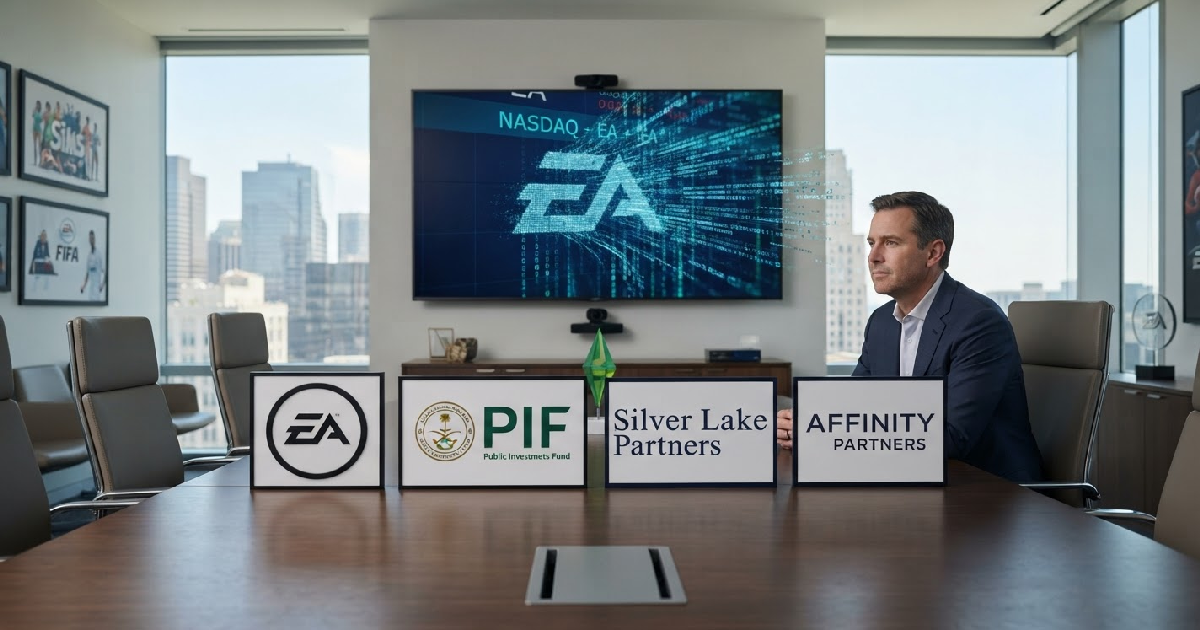
Electronic Arts acquisition completed in historic $55 billion Saudi-led buyout
Electronic Arts (EA), one of the world’s most prominent video game publishers, has officially transitioned to private ownership in a monumental $55 billion acquisition. The deal, finalized on August 4, 2026, sees a consortium spearheaded by Saudi Arabia’s Public Investment Fund (PIF), alongside Silver Lake Partners and Jared Kushner’s Affinity Partners, assume control.
This all-cash transaction removes EA’s stock from NASDAQ, ushering in an uncertain but transformative era for the gaming behemoth. First announced in September 2025 and receiving regulatory approval in December of the same year, this acquisition now stands as the largest leveraged buyout (LBO) in history.
Historic $55 billion Electronic Arts acquisition finalized
The $55 billion acquisition of Electronic Arts represents a seismic shift within the entertainment sector. It marks a significant moment not just for EA and its vast portfolio of franchises, but for the broader global investment community, demonstrating an increasing appetite for major players in digital entertainment.
This deal’s sheer scale is unprecedented in the history of leveraged buyouts. It also ranks as the second-largest deal ever in the video game industry, only surpassed by Microsoft’s staggering $75.4 billion purchase of Activision Blizzard. The consortium paid shareholders $210 per share for their stakes.
The transaction, however, also saddles EA with a substantial debt load. This includes $20 billion financed through arrangements organized by JP Morgan. The ownership structure gives PIF 93.4% of EA, with Silver Lake holding 5.5% and Affinity Partners owning 1.1%.
Key players in the ownership consortium
Saudi Arabia’s Public Investment Fund (PIF) leads the consortium, rolling over its existing 9.9% stake in EA into the new deal. This controlling stake aligns squarely with the PIF’s stated ambition to diversify Saudi Arabia’s economy beyond oil, with entertainment and video games identified as key growth sectors.
The PIF hasn’t been shy about its gaming investments in recent years. It has previously acquired other significant entities in the space, such as mobile game developer Scopely, known for hits like Monopoly Go. This kind of strategic investment highlights a growing trend where non-traditional tech investors see immense value in digital media.
Jared Kushner’s Affinity Partners, which now holds a 1.1% stake, remains under investigation by the House Judiciary Committee. The inquiry concerns potential conflicts of interest during Kushner’s time as “Special Envoy for Peace” in the Middle East. Silver Lake, a technology investment firm, secured a 5.5% ownership in the newly private company.
Leadership outlines vision for a new EA chapter
Despite the change in ownership, Electronic Arts will maintain its headquarters in California. Andrew Wilson will also continue in his role as CEO. Wilson expressed optimism about the new chapter, emphasizing shared vision and ambition with the new partners.
“We’re entering this next chapter from a position of strength with partners who share our vision and ambition,” Wilson stated in a press release. He added that the collaboration would enable bold investment, accelerated innovation, and the development of next-generation games and experiences for millions of players globally.
Investor voices on EA’s future trajectory
Other key figures in the consortium also weighed in on the acquisition. Jared Kushner highlighted EA’s cultural impact, noting its creation of “stories, characters, and communities that have become part of everyday life for hundreds of millions of people.” He signaled support for continued growth and creativity within the company.
Turqi Alnowaiser, the PIF Deputy Governor and Head of International Investments, underscored the strategic importance of the deal. He noted that entertainment and sports are rapidly evolving sectors crucial to the PIF’s investment philosophy. Egon Durban, CEO of Silver Lake, praised EA’s beloved franchises and its focus on players, promising heavy investment in growth and AI enhancements.
Unease and uncertainty for EA’s gaming future
While executives project a positive outlook, the Electronic Arts acquisition has sparked considerable unease. Critics worry that the change could lead to significant shifts in content, corporate culture, and employment. This has led to protests outside EA’s California headquarters.
Many fans of reliable franchises like Madden NFL and EA Sports FC anticipate little change, expecting these titles to continue their established trajectories. Live-service giants such as Apex Legends are also largely seen as safe bets, likely to maintain their current operational models.
Cultural clashes and creative freedom questions
The future appears shakier for other studios and their iconic series. Maxis, the developer known for The Sims franchise, suffered intense community backlash when news of the deal first broke last year. The studio’s long-standing commitment to representing LGBTQ+ communities has raised questions among players.
These players fear new ownership values might not align with this inclusive stance, potentially putting future Maxis projects in jeopardy. Similarly, BioWare, the studio behind acclaimed series like Mass Effect and Dragon Age, finds its future under scrutiny.
Former BioWare lead writer Trick Weekes voiced concern, stating EA is “a hedge fund with a videogame hobby” and that the deal could spell the end for such narrative-driven franchises. Concerns for creative teams are growing across the industry.
Financial pressures and workforce implications
The transition to a private company also means an end to transparent shareholder calls. This will make it harder for outsiders to track EA’s internal dealings. More concretely, there’s widespread speculation about potential layoffs and studio closures, fueled by the substantial debt incurred in the acquisition.
Piers Harding-Rolls of Ampere Analysis suggested that EA’s new owners may look to “cut excess spending and rationalize the company’s workforce.” This sentiment is echoed by reports from the Financial Times, which indicate the consortium is banking on artificial intelligence to significantly reduce costs. This is a prospect met with contention within the video game development community.
Unionized workers express apprehension
The United Videogame Workers CWA, representing unionized workers at EA, has publicly voiced its apprehension. They issued a statement warning that any job losses or studio closures resulting from the deal would be a deliberate choice, not a necessity. Such actions, they say, would aim “to pad investors’ pockets.”
The union specifically highlighted concerns for studios arbitrarily deemed “less profitable,” whose contributions are nevertheless vital to EA’s creative reputation. Such internal dynamics are critical to monitor as the industry grapples with evolving business models. This reflects broader anxieties within the gaming sector as consolidation continues to reshape its landscape.