

SBF appeal mandate issued: final blow to FTX founder’s legal fight
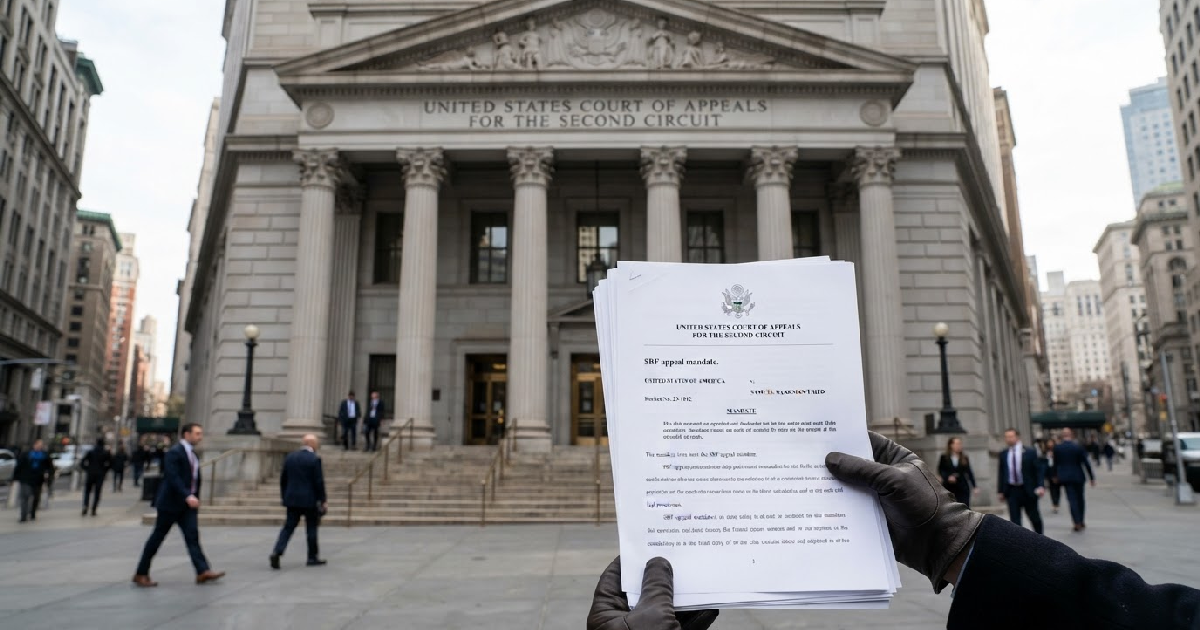
Sam Bankman-Fried (SBF), the disgraced founder of the now-defunct FTX cryptocurrency exchange, saw his primary appellate options all but extinguished today. The Manhattan-based 2nd United States Circuit Court of Appeals issued the official SBF appeal mandate.
This procedural step on August 4, 2026, formally upheld his fraud convictions and 25-year prison sentence. It confirms the circuit court’s earlier June 12 ruling and leaves him with only the slimmest chance of a U.S. Supreme Court review.
Procedural finality in the Second Circuit
Today’s formal mandate from the Second Circuit Court of Appeals marks a definitive end to Sam Bankman-Fried’s attempts to overturn his conviction at this appellate level. This is a standard process that follows an appeals court decision, returning jurisdiction to the lower court. It formally closes the chapter on this phase of his protracted legal battle.
Impact on crypto markets and confidence
The finality provided by this procedural step matters deeply to crypto markets and investors. It eliminates the last vestiges of circuit-court uncertainty surrounding the high-profile FTX collapse, firming up the criminal consequences for its former CEO. This resolution could help rebuild some measure of confidence in an industry scarred by the wide-ranging fraud.
The timeline of SBF’s legal battles
The saga surrounding Sam Bankman-Fried began with the dramatic collapse of his FTX exchange and Alameda Research trading firm back in 2022. Prosecutors from the Manhattan US Attorney’s Office quickly moved to charge him, alleging he had committed a “fraud of epic proportions.”
They claimed he siphoned $8 billion from FTX customers to cover losses incurred by Alameda Research. In November 2023, a jury found Sam Bankman-Fried guilty on seven distinct felony charges.
That verdict sent shockwaves through the global crypto community, underscoring the inherent risks tied to centralized platforms. His sentencing on March 28, 2024, imposed a substantial 25-year federal prison term, a decision his legal team immediately committed to challenging.
Appeals hit a wall
Sam Bankman-Fried’s lawyers, including Alexandra Shapiro, swiftly filed an appeal of both his conviction and sentence on April 11, 2024. The appeal sought to challenge numerous aspects of the initial trial and verdict, hoping to identify grounds for a reversal.
His mother, Barbara Fried, a law professor emerita at Stanford University, also played a role, actively supporting a separate motion for a new trial. Oral arguments for the appeal were eventually presented to the Second Circuit in November 2025.
This phase represented a crucial moment, with legal observers closely monitoring the proceedings for any sign of a potential reprieve for Bankman-Fried. But on April 28, 2026, Judge Lewis A. Kaplan, who had presided over SBF’s original trial, firmly denied his motion for a new trial.
That denial signaled increasingly difficult prospects for the defense. Then, on June 12, 2026, a three-judge panel of the Second Circuit issued its initial ruling, upholding both the conviction and the 25-year sentence.
That decision directly paved the way for today’s formal mandate, unequivocally confirming the appellate court’s position on the matter. It sends a clear message to those who might consider circumventing financial regulations within the evolving digital asset space.
Implications for crypto regulation
The undeniable finality of the Second Circuit’s decision resonates throughout the entire cryptocurrency industry. It asserts that accountability for fraud and misconduct is a foundational principle, regardless of technological innovation.
Regulators globally have closely observed this case, and its outcome will likely bolster their efforts to implement greater oversight within the often-unregulated digital asset sector. It certainly emboldens agencies like the Securities and Exchange Commission (SEC) to pursue similar enforcement actions against other alleged wrongdoers.
Setting a legal precedent for digital assets
This ruling also has a tangible impact on investor confidence. The dramatic collapse of FTX and the subsequent protracted legal battles significantly eroded trust in centralized crypto exchanges.
With the SBF appeal mandate now officially issued, a major source of uncertainty has been removed. This potentially facilitates a slow but steady rebuilding of institutional and retail investor trust. This situation reinforces the absolute necessity for robust compliance frameworks within all cryptocurrency firms.
The Sam Bankman-Fried case stands as a pivotal legal precedent. It shapes how U.S. courts will approach large-scale fraud within the cryptocurrency domain. The successful prosecution and upheld conviction, despite a complex defense, showcases the government’s capacity to navigate intricate financial landscapes.
This outcome will undoubtedly influence future legal strategies for both prosecutors and defense attorneys working in the crypto sphere. The crucial testimony provided by former deputies Caroline Ellison and Gary Wang also highlighted the effectiveness of cooperating witnesses.
These former deputies pleaded guilty and chose to testify against SBF, proving instrumental in securing convictions in these high-stakes cases. This dynamic could significantly impact how future investigations unfold and how other defendants choose to engage with crypto market analysis.
SBF’s long road to 2044 and beyond
Currently, Sam Bankman-Fried remains incarcerated at a low-security federal prison located near Santa Barbara, California. With the Second Circuit’s decision now finalized, his eligibility for release isn’t projected until 2044.
His legal team’s only remaining course of action involves petitioning the U.S. Supreme Court. Most legal experts widely consider this a distinct long shot with extremely low odds of success.
Appeals to the Supreme Court are rarely granted. They’re typically reserved for cases presenting significant constitutional questions or clear conflicts between various lower courts.
Bankman-Fried’s case, while undeniably high-profile, primarily revolves around factual findings and the straightforward application of established fraud statutes. This makes it considerably less likely to capture the attention of the nation’s highest judicial body.
The consequences for Sam Bankman-Fried are now largely cemented. But the broader implications for the crypto industry continue to evolve. The focus will undoubtedly intensify on achieving regulatory clarity and enhancing consumer protection as the industry strives to rebuild trust.
It’s a stark and powerful reminder that even within a rapidly changing financial landscape, fundamental legal principles concerning honesty, fiduciary duty, and accountability remain paramount. This finality will likely shape the regulatory and ethical standards for years to come.