

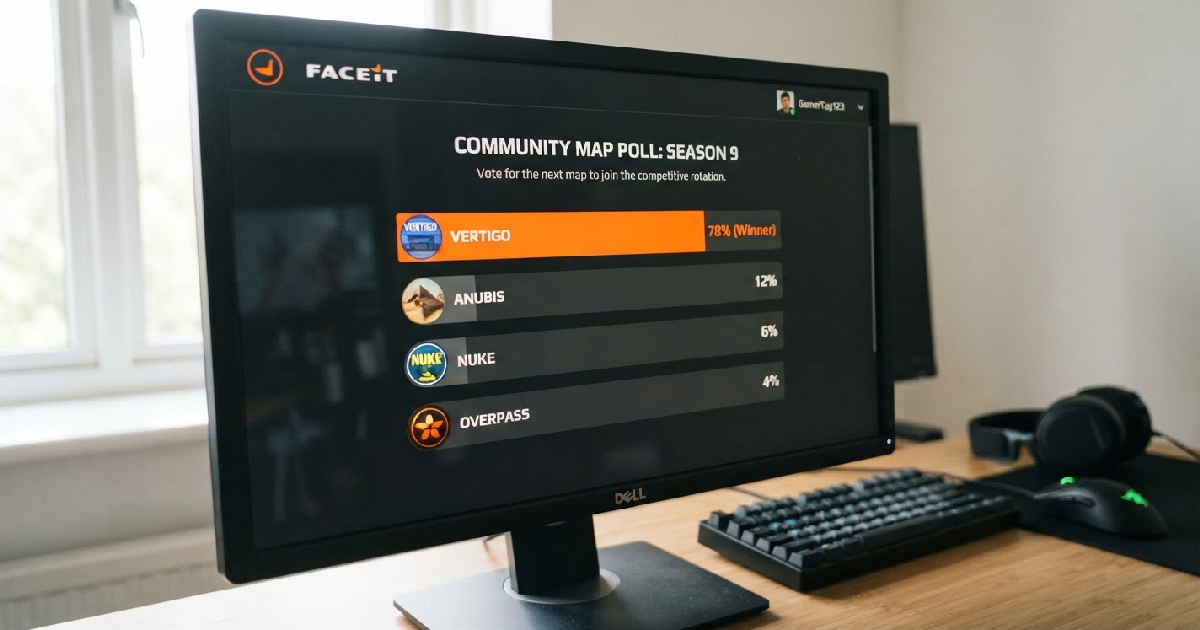
Vertigo dominates poll, FACEIT adds map to Season 9 competitive play
FACEIT, a leading independent competitive gaming platform, has confirmed the return of Vertigo to its Counter-Strike 2 (CS2) matchmaking map pool for Season 9. The map will go live on August 5, 2026, following a decisive community poll where it garnered nearly 100,000 votes, signaling strong player demand.
This move highlights FACEIT’s responsiveness to its user base, integrating player feedback directly into its competitive structure. Vertigo’s reintroduction marks a significant moment for many players who consider it a popular, accessible map within the CS2 ecosystem.
Community’s clear choice: Vertigo’s landslide victory
The decision to reinstate Vertigo wasn’t made lightly, but came as a direct result of an extensive community poll. Vertigo emerged as the overwhelming favourite, securing an impressive 97,421 votes.
It faced competition from four other maps, but none came close to matching its popularity. Train, its closest contender, received 64,744 votes, trailing Vertigo by a substantial 32,677 votes.
Other maps included Overpass, which gathered 49,000 votes, and two community-created maps: Fachwerk with 11,000 votes, and Boulder with 10,000 votes. The disparity in votes clearly indicated the community’s strong preference for Vertigo to return to the active rotation.
Understanding FACEIT’s competitive platform
Founded in London back in 2011 by Niccolo Maisto, Michele Attisani, and Alessandro Avallone, FACEIT has grown into an esports powerhouse. It boasts over 13 million users and facilitates more than 15 million online game sessions monthly across titles like CS2, League of Legends, and Dota 2.
The platform is known for its automated tournament management and matchmaking systems. FACEIT provides a structured environment for players to compete, improve their skills, and climb leaderboards outside of the official in-game ranking systems.
Gameplay impact: Optional pick, full Elo at stake
Vertigo’s return comes with specific implementation details designed to enhance the player experience without disrupting existing preferences. It will be an optional pick in the matchmaking queue.
This means players can actively choose to include Vertigo in their map preferences or opt out, ensuring flexibility. Matches played on Vertigo will be fully Elo-enabled, meaning wins and losses will count towards a player’s skill rating, just like any other competitive map.
The integrity of these matches will be upheld by the mandatory use of the FACEIT Anti-Cheat system. This helps maintain a fair competitive environment for everyone queuing on the map. Vertigo will remain in the Season 9 map pool for its entire duration, barring unforeseen circumstances like major bugs or significant updates.
Why map choice matters for CS2 strategy
For dedicated CS2 players, map availability profoundly impacts strategic development and team composition. Each map presents unique challenges and tactical opportunities, favouring different playstyles and utility usage.
The inclusion of Vertigo means teams will need to refresh their strategies, practice new executes, and adapt to its distinct verticality. This dynamic change can inject new life into the competitive scene and challenge established team metas, fostering innovation.
A familiar climb: Vertigo’s history in the rotation
This isn’t Vertigo’s first stint in the FACEIT map pool. The map has a long history, often evoking mixed feelings among the professional community but consistently remaining a favourite among casual players. It was removed from the FACEIT rotation in January 2025, when it was replaced by Train in the Active Duty rotation.
Its consistent popularity, even during periods of official competitive absence, likely fuelled its dominant performance in the recent community poll. Many players find Vertigo relatively easy to pick up and play, which contributes to its enduring appeal and broad player base support.
Precedent: Cache’s previous return
This marks the second time FACEIT has added a map outside of the official Active Duty pool to its rotation. Previously, Cache was included as an optional map during Season 8, a decision also met with considerable community enthusiasm.
The success of Cache’s reintroduction likely provided a blueprint for Vertigo. Importantly, both maps were sourced directly from CS2’s “competitive” queue, preventing issues with players missing workshop map downloads, a problem that sometimes plagued community-added content in the past.
Broader changes: Season 9 brings policy and ranking updates
Vertigo’s return is just one piece of a larger puzzle for FACEIT Season 9, which promises a suite of updates aimed at refining the competitive experience. The platform is rolling out a “lighter and personalized” Elo reset. This isn’t a flat, seasonal pullback; instead, it considers individual player’s recent win rates and performance scores, aiming for a more nuanced adjustment.
Beyond ranking adjustments, FACEIT is also introducing a rewritten and significantly tougher ban policy. This indicates a concerted effort to combat cheating and disruptive behaviour, reinforcing the platform’s commitment to fair play. Such measures are critical for maintaining competitive integrity and player trust.
Personalized Elo reset and stricter enforcement
The new Elo reset mechanism is particularly noteworthy, moving away from a blanket reset. By factoring in recent performance, FACEIT aims to place players more accurately from the outset of Season 9. This should lead to more balanced matches and a smoother competitive climb for dedicated players.
Meanwhile, the stricter ban policy targets a range of infractions, from cheating to smurfing and abusive conduct. These enhanced enforcement measures are crucial for fostering a healthy and enjoyable gaming environment. FACEIT recently issued bans to 12,478 smurf accounts, demonstrating their ongoing commitment to fair play.
Shifting tactics: What Vertigo’s return means for CS2 players
The reintroduction of Vertigo will undoubtedly shake up the strategic landscape for many Counter-Strike 2 players. Teams will need to re-evaluate their default setups, utility usage, and overall game plans to accommodate the unique characteristics of this map.
Vertigo is known for its multi-layered design and distinct bomb sites, which often lead to explosive, fast-paced rounds. Its verticality encourages creative grenade usage and precise aim, offering a different tactical challenge compared to flatter, more traditional maps.
This change could also impact professional teams who use FACEIT for practice, potentially influencing their broader competitive strategies even for official Valve-sanctioned events. It adds another layer of complexity to their preparation routines.
The power of the playerbase: Community influence on competitive platforms
FACEIT’s decision to bring back Vertigo underscores a growing trend in esports: the increasing influence of the player community on game development and platform management. Platforms that actively solicit and respond to player feedback tend to foster stronger, more loyal communities.
By conducting a public poll and acting on its results, FACEIT reinforces its commitment to its user base. This democratic approach helps validate players’ voices and creates a sense of shared ownership in the competitive ecosystem. It’s a model other platforms might increasingly adopt.
This move is also timely, arriving alongside a separate community vote concerning a one-week test for half-time voice chat between teams in FACEIT Matchmaking, slated for August 5 to August 12, 2026. Together, these initiatives signal a platform keen on evolving through direct user engagement.