

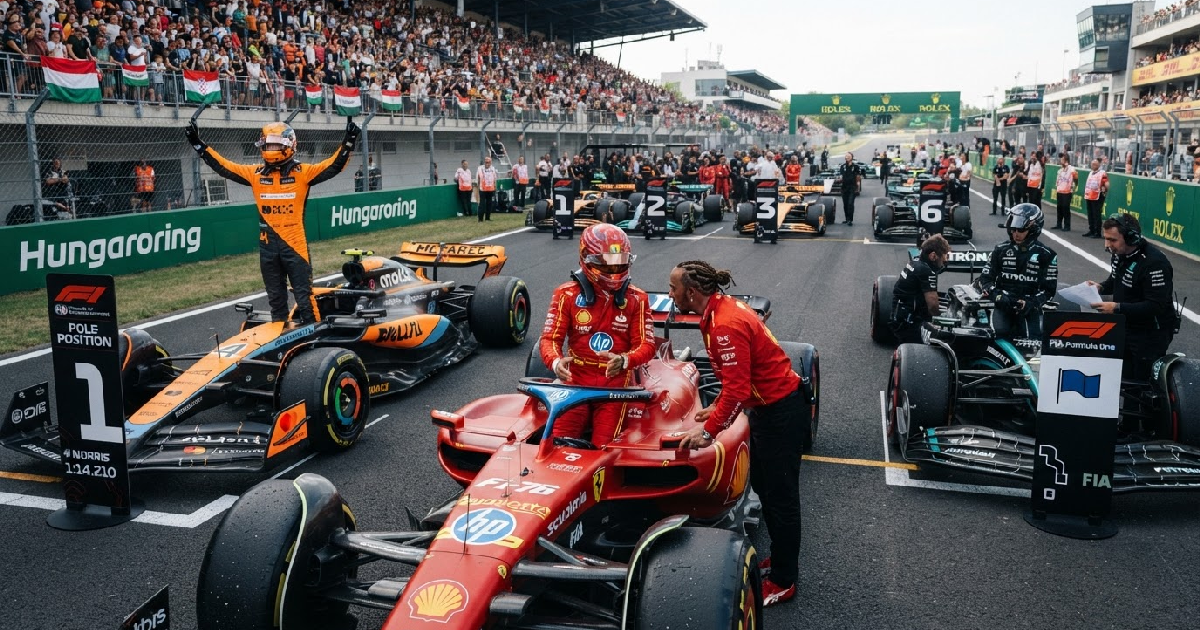
Penalties Shake Up 2026 F1 Hungarian Grand Prix Starting Grid
The 2026 Formula 1 Hungarian Grand Prix starting grid has been dramatically reshaped following penalty decisions issued on Saturday, July 25, 2026. Scuderia Ferrari HP driver Lewis Hamilton and Mercedes AMG Petronas F1 Team’s Andrea Kimi Antonelli both received three-place grid penalties, significantly altering their positions for Sunday’s race at the Hungaroring.
These rulings saw McLaren Mastercard F1 Team driver Lando Norris secure pole position, snatching it from Hamilton by a mere 0.012 seconds in a thrilling qualifying session. The stewards’ decisions have injected fresh intrigue into one of the season’s most anticipated races.
Driver penalties redefine Hungarian GP grid
Lewis Hamilton, driving for Scuderia Ferrari HP, had initially qualified second, putting him on the front row. However, F1 stewards handed him a three-place grid penalty for impeding Oscar Piastri (McLaren Mastercard F1 Team) during the crucial Q3 session.
The FIA determined that Hamilton’s car (Car 44) was moving too slowly on the racing line as Piastri’s car (Car 81) approached Turn 1 on a fast lap. This forced Piastri to take evasive action and abort his qualifying attempt. Ferrari reportedly informed Hamilton late about Piastri’s presence on track.
Antonelli penalised for yellow flag infringement
Andrea Kimi Antonelli, a championship leader for Mercedes AMG Petronas F1 Team, also faced a three-place demotion. He received his penalty and one penalty point on his license for failing to slow sufficiently under double-waved yellow flags during Q3.
The yellow flags came out after Max Verstappen spun his Oracle Red Bull Racing car at the final corner. Stewards found that while Antonelli lifted off the throttle, his speed reduction was “insufficient and unsustained.” Telemetry showed he was only 0.030 seconds slower in his mini-sector time.
He lifted 16 meters earlier and was 14 km/h slower when entering the yellow flag sector. But, crucially, Antonelli was 3 km/h faster when passing the incident site due to less braking, a clear breach of FIA F1 Regulations and the International Sporting Code.
Norris snatches pole amidst qualifying drama
Lando Norris of McLaren Mastercard F1 Team will now start from the top spot on the F1 Hungarian Grand Prix starting grid. He secured pole position by topping qualifying by just 0.012 seconds ahead of Lewis Hamilton, marking his first pole of the current season.
This dramatic turn of events follows a qualifying session where Mercedes’ previous contact in Montreal with Andrea Kimi Antonelli had seen him lose position. Charles Leclerc (Scuderia Ferrari HP), who originally qualified third, now moves up to second on the revised grid. Oscar Piastri, from McLaren Mastercard F1 Team, benefits from the penalties to start third.
Verstappen’s Q3 spin triggers yellow flags
Max Verstappen’s spin at the final corner during Q3 was the catalyst for the double-waved yellow flags that ultimately led to Antonelli’s penalty. Verstappen, despite his issues, moves up to fourth on the revised grid.
The Oracle Red Bull Racing driver later expressed frustration about “car degradation” during qualifying. He described his RB22 as “completely undriveable” at points, underscoring the tight margins and technical challenges faced by teams at the Hungaroring.
Confirmed 2026 F1 Hungarian Grand Prix starting grid
The official starting grid for the 2026 Formula 1 Hungarian Grand Prix, confirmed on Saturday, July 25, 2026, is as follows:
| Position | Driver | Team |
|---|---|---|
| 1 | Lando Norris | McLaren Mastercard F1 Team |
| 2 | Charles Leclerc | Scuderia Ferrari HP |
| 3 | Oscar Piastri | McLaren Mastercard F1 Team |
| 4 | Max Verstappen | Oracle Red Bull Racing |
| 5 | Lewis Hamilton | Scuderia Ferrari HP |
| 6 | George Russell | Mercedes AMG Petronas F1 Team |
| 7 | Kimi Antonelli | Mercedes AMG Petronas F1 Team |
| 8 | Isack Hadjar | Oracle Red Bull Racing |
| 9 | Arvid Lindblad | Racing Bulls |
| 10 | Nico Hulkenberg | Audi |
| 11 | Liam Lawson | Racing Bulls |
| 12 | Pierre Gasly | Alpine |
| 13 | Franco Colapinto | Alpine |
| 14 | Gabriel Bortoleto | Audi |
| 15 | Esteban Ocon | Haas |
| 16 | Fernando Alonso | Aston Martin |
| 17 | Oliver Bearman | Haas |
| 18 | Carlos Sainz | Williams |
| 19 | Alex Albon | Williams |
| 20 | Lance Stroll | Aston Martin |
| 21 | Valtteri Bottas | Cadillac |
Strategic implications for the Hungaroring race
The altered F1 Hungarian Grand Prix starting grid sets the stage for a compelling tactical battle at the Hungaroring. This circuit is well-known for being difficult to overtake on, making starting positions incredibly important for race strategy. Lando Norris and Charles Leclerc now find themselves in prime positions.
Max Verstappen, despite his Q3 challenges, is still a strong contender from fourth on the grid. Meanwhile, Lewis Hamilton at fifth and Andrea Kimi Antonelli at seventh will face tougher challenges to climb through the field and secure valuable championship points.
For Antonelli, who currently leads the championship, this penalty adds significant pressure. Starting further back forces the Mercedes AMG Petronas F1 Team to reconsider their initial race plans, potentially making this a pivotal weekend for his title aspirations. Such high-stakes encounters often define a season.
Broader impact of penalties on driver conduct and teams
These grid penalties underline the intense scrutiny placed on driver conduct and team communications during F1 qualifying sessions. Impeding incidents and failures to adequately respond to yellow flags are frequent subjects of steward investigations, reinforcing regulatory adherence.
The detailed telemetry presented in Antonelli’s case establishes a clear benchmark for what constitutes “sufficiently slowing” under yellow flags. It sends a strong message that minimal lift-off won’t meet regulations in critical safety situations. Timely communication about approaching traffic, as highlighted by Hamilton’s incident, is also vital to avoid costly penalties that can undo strong qualifying performances.
Beyond the top teams, Fernando Alonso (Aston Martin) demonstrated promising gains with his updated AMR26. He qualified 16th, marking his first Q2 appearance of the season, suggesting a potential shift in competitiveness further down the grid. This highlights the ongoing development race that characterises Formula 1.
Looking ahead: championship battles intensify
The Hungarian Grand Prix often serves as a key indicator for the second half of the Formula 1 season, and these penalties could have lasting implications for the championship battle. The intense competition, coupled with stringent regulations, means every decision on track carries significant weight.
Teams and drivers remain acutely aware of the precision needed as the championship intensifies. This F1 season continues to deliver unexpected twists, and how drivers like Hamilton and Antonelli respond to adversity, such as grid penalties, can often define their year. It’s a dynamic seen across other major sporting events, where every detail matters.