

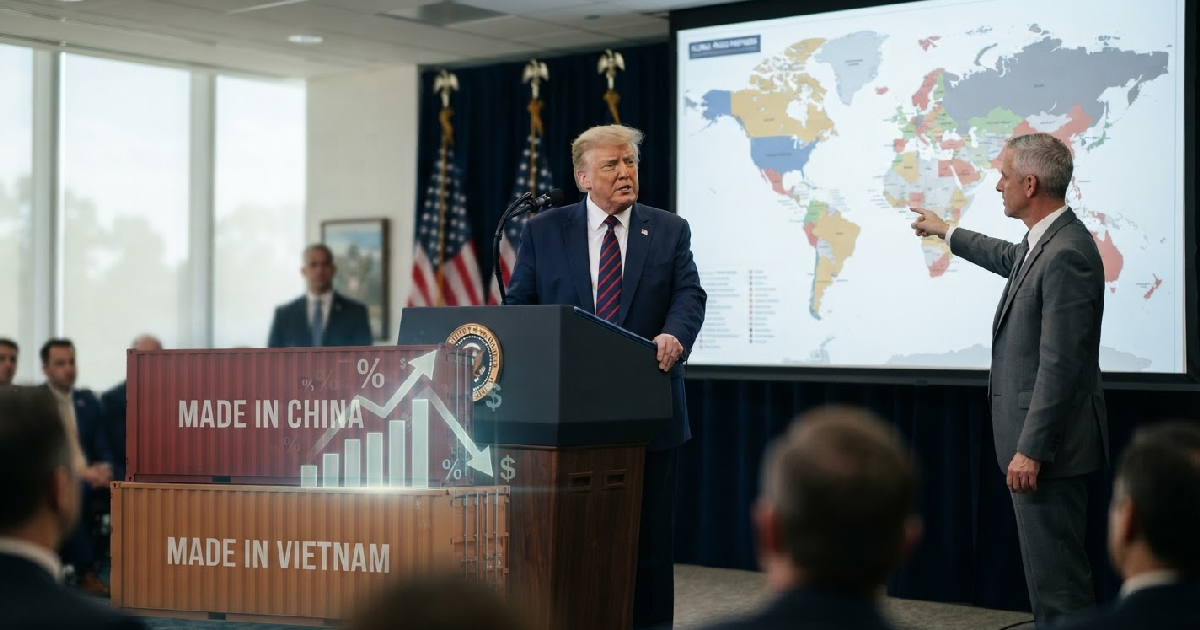
Trump administration launches new tariffs on 80+ nations, citing forced labor
Donald Trump’s administration has unleashed a fresh wave of tariffs on more than 80 international trading partners, with duties ranging from 10% to 12.5% on imported goods. These new Trump tariffs became effective at 12:01 a.m. EDT on Friday, July 24, 2026, and officially replace a temporary 10% global duty that was set to expire just hours later.
The move, announced by U.S. Trade Representative Jamieson Greer, cites concerns over forced labor practices as the primary justification. Critics, however, suggest it’s the latest effort to reinvigorate President Trump’s protectionist trade agenda following a series of legal setbacks, including a significant Supreme Court ruling earlier this year.
Global backlash to new Trump tariffs
The extensive list of affected nations includes major economic players like the United Kingdom, Mexico, Canada, Australia, India, China, Japan, Vietnam, and all 27 countries within the European Union. Other countries reportedly facing these new import duties include Argentina, El Salvador, Bangladesh, Pakistan, Singapore, South Korea, Brazil, and Trinidad and Tobago.
The immediate international reaction has been swift, with Canada, one of America’s largest trading partners, voicing strong opposition. Matthew Holmes, Executive Vice-President of the Canadian Chamber of Commerce, stated unequivocally that Canada “should not be targeted” by such measures.
Holmes emphasized that if the administration’s true intent is to combat forced labor, then a “coordinated approach through a multilateral mechanism” would be far more appropriate and effective. He also raised suspicions about the timing, noting that previous rounds of tariffs were set to expire.
Legal challenges persist over executive authority
This latest round of import duties marks President Trump’s third attempt to implement broad tariffs since April 2025. Each prior instance has faced considerable scrutiny and legal challenges regarding the president’s constitutional authority to unilaterally impose such taxes, an authority traditionally vested solely in Congress.
Back in April 2025, President Trump invoked the International Emergency Economic Powers Act to enact a baseline 10% tariff, a measure he controversially dubbed “liberation day.” However, that policy suffered a significant blow when the U.S. Supreme Court ruled 6-3 in February 2026 that presidents lack the power to levy tariffs during peacetime without Congressional approval.
Constitutional questions on presidential power
Undeterred by the Supreme Court’s decision, the administration then introduced another 10% tariff regime under a different trade law, limiting it to a 150-day period, which was set to expire moments before the new tariffs took effect. The current tariffs are imposed under Section 301 of the Trade Act of 1974.
Section 301 grants the USTR power to investigate and penalize foreign trade practices deemed unfair. While available, it has been used sparingly and remains highly controversial. Alan Wolff, a Senior Fellow at the Peterson Institute for International Economics and former Deputy Director-General of the World Trade Organization, quickly critiqued the latest move.
In an analysis published Thursday, Wolff argued that these new tariffs would likely fail to withstand judicial review. “The answer is no: Congress did not delegate authority of such breadth to the president. It cannot constitutionally do so,” Wolff asserted, suggesting the Supreme Court would probably overturn them if challenged.
The repeated legal battles highlight a fundamental tension between executive prerogative and legislative authority in U.S. trade policy. This ongoing struggle shapes how American businesses and consumers interact with the global market, creating an environment of uncertainty for many.
Economic impact and public sentiment
Beyond the courtroom, President Trump’s tariffs have consistently proven unpopular with American consumers, potentially creating political headwinds for Republicans ahead of this November’s midterm elections. A Harris Poll survey, conducted exclusively for The Guardian earlier this year, shed light on this sentiment.
The poll revealed that seven out of 10 Americans believe they’ve paid higher prices because of Trump’s tariffs, with a staggering 72% of voters overall reporting a negative impact on consumers. This perception wasn’t limited to opposition voters; 64% of Republican voters agreed that the tariffs led to increased prices, and 60% acknowledged a negative impact.
These findings come as American consumers already grapple with significant economic pressures. The ongoing war in the Middle East has sent energy costs and gas prices soaring, contributing to overall inflation. In fact, inflation jumped to a three-year high this past May.
Administration defends tariff benefits
Despite widespread public concern and economic data, the Trump administration remains steadfast in its defense of these trade policies. During a heated exchange with Democratic Senator Elizabeth Warren, U.S. Trade Representative Jamieson Greer adamantly denied that the tariffs had contributed to higher prices for American families.
“No,” Greer responded when asked directly about the tariffs’ impact on consumer costs. He pointed to core inflation, which excludes volatile food and energy prices, noting it had fallen to 2.6% year over year, a figure he claimed was “much better than in January 2025.” However, overall inflation remains slightly higher than it was when Joe Biden left office.
This stark divergence in views underscores the political tightrope the administration walks as it pursues its trade agenda. While it champions the tariffs as a means to protect American jobs and manufacturing, a significant portion of the electorate feels the pinch in their wallets.
Global trade partners brace for implications
The imposition of these new Trump tariffs will inevitably force global trading partners to reassess their economic strategies and potentially trigger retaliatory measures. Countries like China, the European Union, and Canada, already sensitive to trade disruptions, now face increased costs for exporting goods to the vast American market.
For some nations, particularly developing economies cited in the list, the added burden could strain nascent industries and economic growth. Trade disputes can quickly escalate, affecting international relations and the stability of global supply chains that have become increasingly integrated over decades.
This renewed protectionist stance by the U.S. could lead to a fragmentation of global trade. Businesses operating across borders might need to diversify their supply chains or seek new markets, potentially raising costs and reducing efficiency for consumers worldwide.
The official justification of combating forced labor practices, while a legitimate human rights concern, has been met with skepticism by some, who view it as a convenient pretext for broader economic nationalism. The international community will closely watch whether the U.S. pursues multilateral engagement on forced labor or continues with unilateral actions.
The political landscape of trade protectionism
President Donald Trump has long championed tariffs as a vital tool to rebalance trade deficits and protect American industries, famously calling “tariff” “the most beautiful word in the dictionary.” This latest action reinforces his administration’s commitment to an “America First” trade philosophy, even when facing internal and external opposition.
The timing of these tariffs, just months before the midterm elections, isn’t lost on political observers. Despite the unpopularity of tariffs among many consumers, the policy appeals to a segment of his base who believe it strengthens domestic manufacturing and punishes unfair foreign competition.
But the persistent legal challenges and the clear economic data on consumer price hikes could complicate the Republican party’s narrative on economic prosperity. As the election cycle heats up, the economic consequences of these tariffs will likely become a central point of debate, both within the U.S. and among its allies and rivals on the global stage.
The administration’s assertion that these policies ultimately improve workers’ welfare and rectify “distortive trade practices” will be tested by market realities and the reactions of affected countries. The coming months will show whether this aggressive trade strategy yields the desired outcomes or simply further destabilizes the global economic order.