

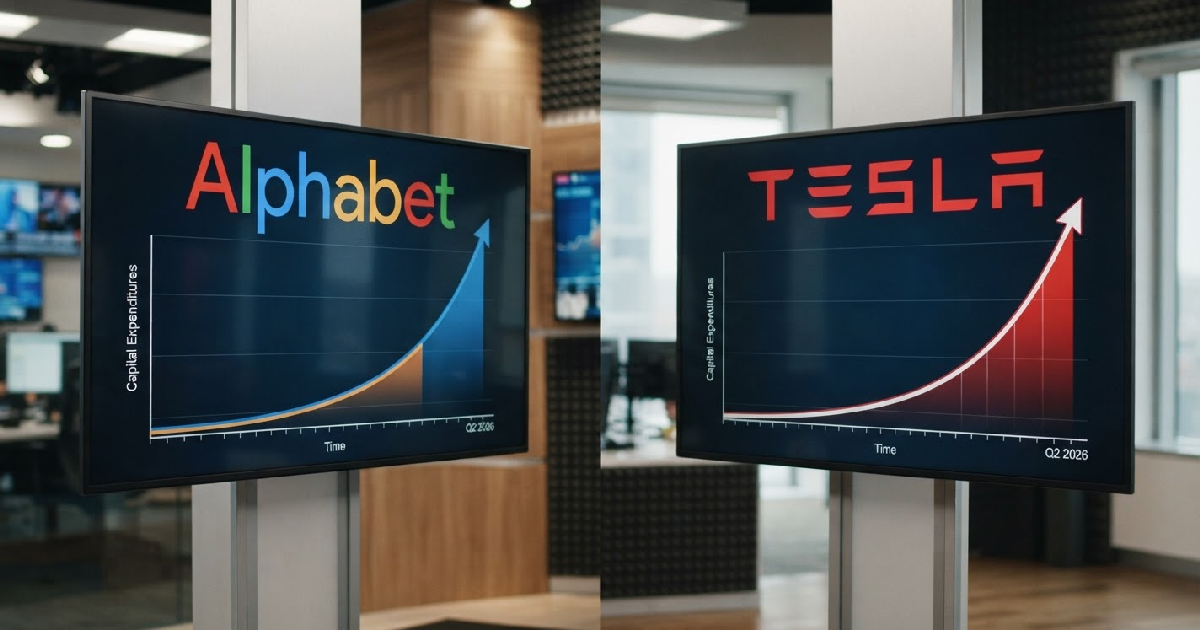
AI spending surge tests investor patience at Alphabet and Tesla
Alphabet Inc. and Tesla Inc. revealed significant increases in AI spending for the latest quarter, testing investor patience. and Tesla Inc. recently put investor patience to the test, as both companies revealed significant increases in AI spending for the latest quarter. These massive capital expenditures have led to negative free cash flow, prompting immediate after-market selloffs in their stock prices on Wednesday, July 22, 2026, despite better-than-expected revenue figures.
The earnings disclosures from the two prominent tech giants quickly set a nervous tone for the rest of the earnings season. They underscored a growing Wall Street concern over whether aggressive AI investments will translate into sustainable profits and growth, or simply consume cash at an alarming rate.
Megacaps face investor scrutiny over AI ambitions
The latest earnings reports from Alphabet and Tesla have illuminated a clear theme across the technology sector: AI spending is under intense scrutiny. Investors are closely watching how much the industry’s largest players are pouring into this burgeoning field. Despite both companies beating revenue expectations, the market reacted negatively to the increased spending forecasts.
Tesla shares slid 4% and Alphabet shares dropped more than 3% in after-hours trading following their quarterly disclosures. This immediate market reaction could foreshadow challenges for other megacap tech firms. Companies like Meta Platforms, Microsoft Corporation, Amazon.com Inc., and Apple Inc. are all slated to report their own quarterly results next week, with similar AI investment levels expected.
Alphabet’s significant infrastructure investment
Google’s parent company, Alphabet, laid out staggering capital expenditure forecasts for the year. It projects spending between $195 billion and $205 billion for 2026, an upward revision of $15 billion from previous guidance. The company also warned that these numbers would likely climb even higher in 2027.
Chief Financial Officer Anat Ashkenazi clarified that most of Alphabet’s $44.9 billion in capital expenditure during the second quarter went directly into supporting its AI buildout. This includes extensive investments in data centers, advanced AI servers, and custom Tensor Processing Unit (TPU) chips designed to accelerate its AI progress.
Alphabet CEO Sundar Pichai has consistently championed the company’s AI initiatives, guiding breakthroughs in areas like voice recognition, image processing, and generative AI chatbots such as Google Gemini. Mizuho analysts, however, expressed surprise at Alphabet’s stock dip, calling the capital expenditure increase “broadly anticipated.”
They highlighted the positive impact of an 82% year-over-year surge in Google Cloud revenue and expanded cloud margins, along with accelerated usage of Google’s Gemini AI model.
Tesla’s strategic shift beyond electric vehicles
Tesla, led by CEO Elon Musk, reiterated its ambitious plan to spend over $25 billion on AI and robotics this year. This figure represents an astonishing 200% year-over-year growth in capital expenditure. The second quarter alone saw capex soar 142% to $5.79 billion, fueling initiatives like self-driving technology and Optimus humanoid robots.
Musk candidly stated on the earnings call that the company should be “spending on capex as fast as we can spend.” He emphasized a willingness to be “a little less capital efficient” if it means accelerating progress on these long-term projects, signaling a strategic pivot beyond its core automotive business.
The company is actively retooling factories to produce the two-seater driverless Cybercab and preparing for a sprawling AI chip-manufacturing plant in Texas. This strategic shift points to Tesla’s intent to move beyond just electric vehicles, positioning itself as a leader in broader physical AI technologies and solidifying its long-term vision for a fully autonomous future.
Deepening free cash flow challenges
The aggressive growth strategies pursued by both Alphabet and Tesla are taking a significant toll on their immediate cash reserves. Both companies reported substantial negative free cash flow for the latest quarter, signaling a crucial moment for their financial health and investor confidence.
Alphabet’s free cash flow plummeted to negative $5.9 billion. This marks a drastic change from generating almost $25 billion in free cash flow just a year ago, primarily from its highly profitable online advertising business. CFO Anat Ashkenazi noted that free cash flow is expected to “remain under pressure” as investments continue.
Tesla, on the other hand, was expected to report its first quarterly cash burn in over two years, with a deficit of approximately $3.3 billion in free cash flow for Q2 2026. This contrasts sharply with the $146 million it generated a year ago and the $1.4 billion seen in the first quarter of 2026.
This significant cash outflow highlights the scale of its current investment phase.
Tesla’s Q1 2026 financials showed revenue at $22.38 billion, up 16% year-over-year, alongside $1.4 billion in free cash flow. However, expected Q2 2026 results indicated a net income of $1.11 billion, falling short of analysts’ forecasts, despite revenue beating expectations at $28.24 billion. Research and development spending also surged by 49% to $2.37 billion.
Tesla’s Chief Financial Officer Vaibhav Taneja noted that capital expenditures are expected to rise further in the second half of 2026. He anticipates this growth continuing for the next “2 to 3 years,” indicating sustained pressure on the company’s cash flow as it finances its ambitious AI and robotics projects.
Wall Street’s skepticism versus long-term vision
The market’s immediate negative reaction to the earnings reports highlights a fundamental tension. Investors’ demand for short-term profitability often clashes with the long-term, capital-intensive vision of AI development. For many, the substantial outlays by Alphabet and Tesla trigger concerns about delayed or uncertain returns on these massive investments.
Elon Musk expressed confidence that Tesla’s investments would “yield incredible returns,” drawing parallels to Henry Ford’s industrial scale-up. He framed the current period as possibly “the fastest industrial scale-up since World War II in America,” underlining the ambitious scope and potential historical significance of their endeavors.
Haris Khurshid, chief investment officer at Karobaar Capital, noted that capital expenditure serves as a “credibility check” for companies like Tesla. These firms often sell a long-term vision, and their spending demonstrates commitment to that future, even if it comes at a short-term cost.
Keith Fitz-Gerald, principal at Fitz-Gerald Group, acknowledged that “profitability is being sacrificed for infrastructure” at Tesla, mirroring early stages of companies such as Amazon and Netflix. He projects these investments will “pay off in spades” over the next 12 to 36 months, suggesting that patience is a virtue in this high-stakes game.
Similarly, Mike Tyndall, an HSBC analyst, reinforced this perspective by stating, “For a growth stock, capex is the best indication of future growth. If you’re not spending the money, then you’re not going to get the growth.” This sentiment supports the idea that current outlays are necessary precursors to future expansion and market leadership.
Evolving AI investment landscape and future outlook
The backdrop to these spending sprees is an AI boom fueled by historical infrastructure investments from a select group of companies. Much of this growth has come from hefty investments into model developers like OpenAI and Anthropic, shaping the early contours of the AI industry.
However, the market is starting to evolve rapidly. The emergence of cheaper open-source AI models, many originating from China, is changing cost dynamics significantly. These alternatives offer competitive performance at a lower price point, potentially reducing the need for all companies to build out their own costly proprietary models.
Corporate America also appears to be adopting a more frugal approach to AI services. This shift introduces questions about the future return on investment for the colossal sums being deployed, especially into cutting-edge, proprietary AI development. It’s creating a more competitive and cost-conscious environment for AI adoption.
Rebecca Wettemann, CEO of tech research firm Valoir, believes Google’s core business remains strong despite the high spending. She suggests the company’s AI investments are already generating returns, which should “calm some market fears about AI overspending” in the long run. The accelerating usage of Google’s Gemini model and the robust cloud revenue growth underscore this view.
As the broader tech sector braces for its own earnings reports next week, the performance of Alphabet and Tesla offers both a cautionary tale and a potential blueprint. The market is clearly signaling that even robust revenue growth won’t placate investors if free cash flow tanks due to unchecked spending, especially without clear monetization paths.
Both Sundar Pichai and Elon Musk are betting heavily that their current AI investments will secure dominant positions in future technological landscapes. For Google, this means cementing its lead in cloud computing and generative AI, extending its reach in digital services. Tesla aims to redefine transportation and robotics, transforming from an automotive company into a broader AI and automation powerhouse.
The coming quarters will be crucial in determining whether Wall Street’s patience holds. Investors will be looking for tangible signs that these aggressive capital expenditures are not just creating advanced infrastructure, but also translating into measurable, long-term profitability and shareholder value.
The challenge for these tech titans is to demonstrate that their bold visions aren’t simply expensive dreams, but rather calculated moves toward future market dominance.