

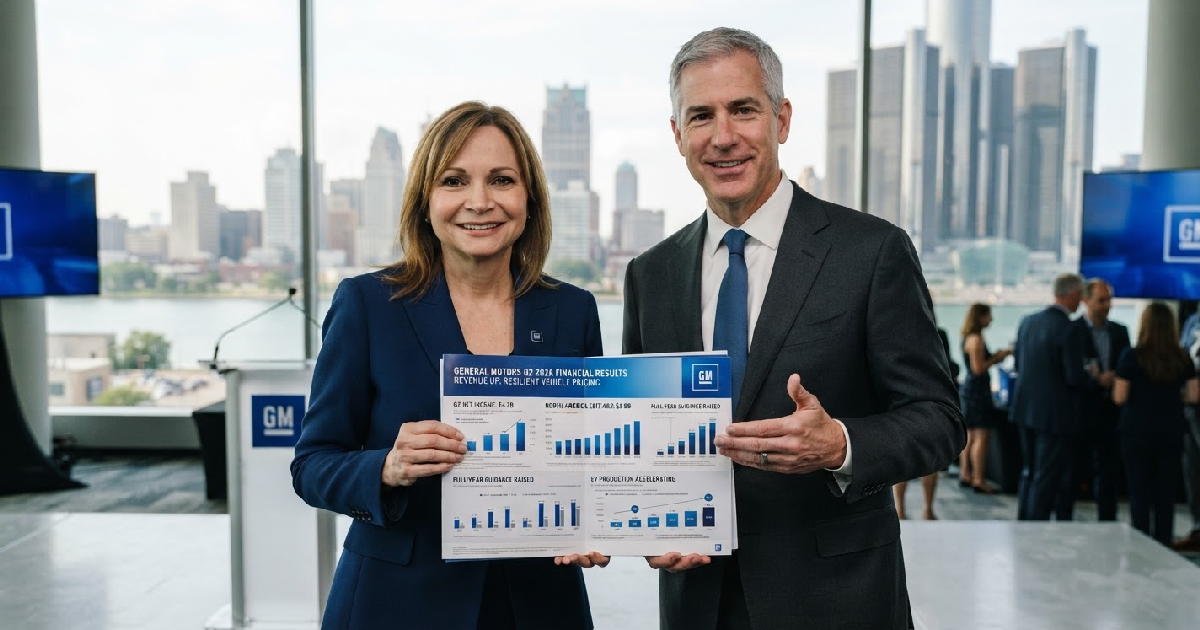
General Motors exceeds Q2 earnings forecasts, lifts full-year guidance
General Motors (GM) announced strong second-quarter 2026 results on Tuesday, July 21, 2026, exceeding Wall Street’s expectations for earnings and boosting its full-year guidance. The Detroit-based automaker, led by Chair and CEO Mary Barra and Chief Financial Officer Paul Jacobson, released its financial figures at 6:30 AM ET, highlighting resilient vehicle pricing as a key driver.
The company reported adjusted earnings per share (EPS) of $3.57. This significantly beat the Zacks Consensus Estimate of $3.13 per share and an analyst estimate of $3.18 per share. Total revenue for the quarter reached $48.0 billion, surpassing analyst expectations ranging from $46.99 billion to $47.03 billion.
Upward revisions to 2026 financial forecasts
GM’s strong performance has prompted the company to raise its full-year 2026 financial outlook across several key metrics. The adjusted earnings before interest and taxes (EBIT-adjusted) guidance now stands between $14.0 billion and $16.0 billion, up from the previous $13.5 billion to $15.5 billion.
Similarly, the adjusted diluted EPS forecast has increased to a range of $12.00 to $14.00, marking a rise from earlier projections of $11.50 to $13.50. The midpoint of this new range, $13.00, is now above the analyst consensus of $12.79, signaling strong confidence in future profitability.
Navigating net income adjustments and EV restructuring
Despite the overall positive adjusted figures, General Motors did lower its full-year expectations for net income attributable to stockholders. The updated guidance is now between $8.4 billion and $9.8 billion, a decrease from the prior range of $9.9 billion to $11.4 billion.
This decline in statutory net income primarily reflects approximately $2.3 billion in costs for restructuring its electric-vehicle factory footprint during Q2 2026. This is the second consecutive quarter GM has lowered this particular net income guidance while simultaneously raising other financial forecasts.
The revised guidance also considers an anticipated $500 million in tariff refunds, following a U.S. Supreme Court ruling concerning IEEPA authority. This rebate helps to offset some of the EV restructuring costs, although not entirely.
Robust Q2 financial performance metrics
Beyond the headline earnings beat, General Motors delivered impressive figures across its balance sheet. Quarterly revenue climbed to $48.0 billion, a 1.9% increase from $47.1 billion reported in the second quarter of 2025. This growth underscores the company’s ability to expand its top line.
Adjusted earnings before interest and taxes (EBIT-adjusted) rose significantly by 29.8% year-over-year, reaching $3.9 billion, compared to $3.0 billion in Q2 2025. This translates to an 8.2% adjusted profit margin for the quarter, showcasing improved operational efficiency.
Automotive free cash flow and shareholder returns
General Motors reported a substantial increase in adjusted automotive free cash flow, which grew by 78.0% year-over-year to $5.0 billion. This strong cash generation provides the company with greater flexibility for investments and shareholder returns.
In a move reflecting this financial health, the company declared a quarterly cash dividend of $0.18 per share. This dividend is scheduled for payment on September 17, 2026, to shareholders of record as of September 4, 2026, reinforcing investor confidence.
North American operations drive profitability
General Motors North America (GMNA) once again proved to be the primary engine of the company’s second-quarter success. GMNA’s EBIT-adjusted surged to $3.4 billion, a substantial 42.7% increase year-over-year from Q2 2025.
Its operating margin for the region also expanded to 8.6%, up significantly from 6.1% in the second quarter of 2025. This improvement highlights the division’s operational strength and market leadership.
“Our 8.6% EBIT-adjusted margin in North America was up 2.5 points from a year ago,” said Chair and CEO Mary Barra. She added, “we continue to lower our warranty costs, reduce EV losses, and increase operating efficiency.”
International segments and emerging revenue streams
While North America led the charge, GM’s international operations also contributed positively. GM International (GMI), including its China joint ventures, reported a profitable quarter with EBIT-adjusted of $190 million.
China equity income specifically climbed to $83 million, an increase from $71 million a year earlier. These contributions underscore the company’s diversified global presence and improving performance in key overseas markets.
Beyond traditional vehicle sales, GM is actively expanding its digital services, which are proving to be a growing revenue stream. Digital subscription revenues reached $750 million in Q1 2026, signaling the potential for future growth in this sector.
Strategic vehicle portfolio and pricing power
GM’s strategy of focusing on its robust portfolio of pickup trucks and SUVs continues to pay dividends. Duncan Aldred, GM President of North America, attributed the strong results to the resilience of customer demand for these high-margin vehicles.
“The depth, breadth and appeal of our vehicle portfolio allows us to lead the market in sales, while maintaining discipline on inventory, pricing and incentives to deliver strong margins,” Aldred stated. This strategic pricing has been critical in a dynamic market.
Even with overall U.S. deliveries for GM down 4.2% to 714,900 vehicles in Q2 2026, the disciplined pricing strategy ensured revenue per vehicle remained strong. This shows a focus on profitability over sheer volume, a crucial distinction in the automotive industry.
Individual models demonstrated exceptional performance; the GMC Sierra achieved a new sales high, for example. Chevrolet’s popular Trailblazer and Traverse models also recorded impressive gains, increasing sales by 28% and 20% respectively during the quarter.
The company’s emphasis on popular segments contrasts with broader mixed U.S. sales results across automakers for Q2 2026. GM’s ability to maintain strong pricing despite a volume dip highlights effective market positioning.
Investor outlook and future considerations
General Motors has consistently outperformed analyst expectations, surpassing EPS projections in four consecutive quarters with an average positive surprise of 20.25%. This consistent track record bodes well for sustained investor confidence.
The company’s executives, including Chair and CEO Mary Barra and Chief Financial Officer Paul Jacobson, hosted an investor conference call at 8:30 AM ET on July 21, 2026. They provided further insights into the company’s strategic direction and financial health.
Discussions likely covered ongoing efforts to manage the transition to electric vehicles, optimize supply chains, and capitalize on evolving market demand. While other companies also see valuation rises after beating guidance, GM’s consistent outperformance sets it apart.
GM’s updated guidance for adjusted automotive free cash flow, now projected between $9.5 billion and $11.5 billion, underscores its robust financial position. This upward revision suggests ample liquidity for strategic initiatives and long-term growth.
The company’s commitment to lowering warranty costs and reducing losses from electric vehicles indicates a pragmatic approach to its EV strategy. This involves a careful balance between aggressive investment in new technologies and disciplined financial management.
Looking ahead, the Detroit automaker appears focused on maintaining its core strengths in profitable truck and SUV segments while steadily building out its digital and EV capabilities. The blend of traditional market dominance and forward-looking investments positions GM strategically for future success.