

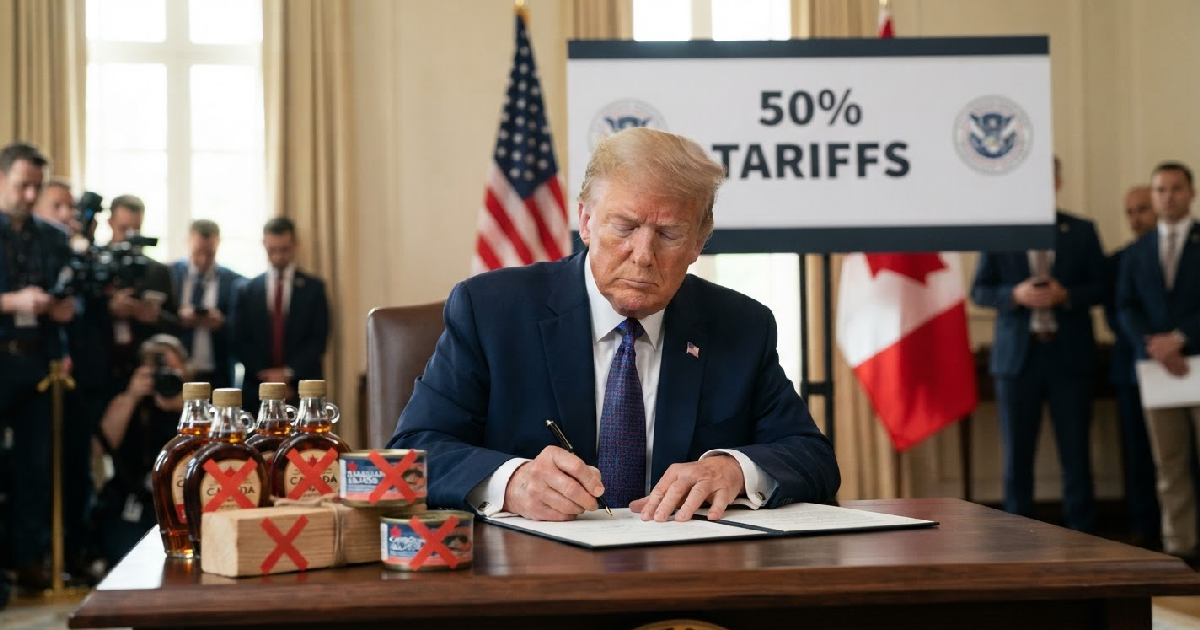
US imposes 50% tariffs on Canadian goods, escalating trade war
The United States has dramatically escalated trade tensions with Canada, with U.S. President Donald J. Trump signing proclamations yesterday to impose new 50% tariffs on a broad range of Canadian goods. This aggressive move, set to take effect on August 19, 2026, targets nearly $20 billion in imports, citing Canada’s “discriminatory treatment” of American products.
The tariffs mark a significant deterioration in economic relations between the two North American allies, coming despite the existence of the U.S.-Mexico-Canada Agreement (USMCA/CUSMA). Both countries now face the prospect of a deepening trade dispute impacting various sectors.
Washington justifies stiff new tariffs on Canadian imports
President Trump’s administration invoked Section 338 of the Tariff Act of 1930 to implement these tariffs, a provision granting the President authority to levy duties of up to 50% on imports from nations deemed to discriminate against U.S. commerce. Ambassador Greer, U.S. Trade Representative (USTR), issued a statement underscoring the U.S. position, framing the tariffs as necessary “defensive measures.”
The U.S. points to several areas of concern where it claims Canada has unfairly disadvantaged American goods. For instance, Canada reportedly imposes specific tariffs and quotas on cars from the U.S. not applied to other countries, allegedly compelling American auto manufacturers to invest in Canadian production. This perceived barrier comes as Canadian imports of U.S.
motor vehicles saw a substantial 22% decrease, or $5.6 billion, from April 2025 through March 2026, compared to the previous year.
The alcohol industry also features prominently in the U.S. rationale. All but two Canadian provinces and territories have reportedly halted the purchase, distribution, or retailing of U.S. alcoholic beverages, a restriction not applied to other countries. This policy coincided with an approximate 81% decrease, or $582 million, in Canadian imports of U.S.
alcoholic beverages from March 2025 through February 2026, relative to the same period a year earlier.
Canada’s supply-managed dairy system and alleged discriminatory tariffs on U.S. cheese, while seemingly not imposing similar tariffs on EU cheese, further fuel Washington’s arguments. These new Section 338 tariffs will apply universally to covered Canadian goods, regardless of whether they technically originate under the USMCA/CUSMA agreement.
Canada braces for impact, considers retaliation
In Ottawa, Prime Minister Mark Carney quickly issued a statement in response to the U.S. tariff announcement. While the specifics of Canada’s counter-measures remain under review, early signals suggest a strong reaction is on the horizon. Ontario Premier Doug Ford has already publicly suggested Canada should respond in kind with its own retaliatory tariffs.
The tariffs will hit a diverse array of Canadian products, from everyday items to industrial goods. Wine, hockey sticks, and cement are all on the list, alongside certain dairy products, some blended syrup and molasses products, and non-alcoholic beer. These sectors now face immediate uncertainty and potential disruption to their U.S. market access.
Not all Canadian exports will be affected, however. The new tariffs explicitly exclude key sectors such as energy, potash, fish, and critical minerals. Products already subject to tariffs under Section 232, namely steel and aluminum, are also exempt, indicating a strategic targeting by the U.S. administration.
A long, acrimonious history of trade disputes
This latest move isn’t happening in a vacuum; it’s the newest chapter in a series of trade disputes between the U.S. and Canada. Both nations have previously engaged in tit-for-tat tariff battles, particularly concerning steel and aluminum imports. Canada had imposed retaliatory tariffs on a range of U.S. goods in response to earlier American duties, though some of those measures were later rolled back.
The Trump administration has a history of using tariffs as a tool in its trade policy against Canada. In July 2025, President Trump announced a 35% tariff increase on numerous Canadian imports. At the time, he cited concerns over fentanyl trafficking, existing Canadian tariff barriers, and a growing trade deficit as justifications for the action.
The legal landscape surrounding U.S. tariff powers has also seen recent developments. In February 2026, the U.S. Supreme Court invalidated tariffs that had been levied under the International Emergency Economic Powers Act (IEEPA), potentially pushing the administration towards other statutory authorities like Section 338.
More recently, on June 3, 2026, the USTR had proposed additional tariffs of up to 12.5% on imports from 60 countries, including Canada, foreshadowing a broader push for trade concessions.
Economic fallout and navigating the uncertain future
The imposition of 50% tariffs on nearly $20 billion worth of Canadian imports will undoubtedly send ripples through both economies. Businesses on both sides of the border, many with deeply integrated supply chains, will need to rapidly assess the financial implications and adjust their strategies. Consumers may also see higher prices for affected goods.
Candace Laing, President and CEO of the Canadian Chamber of Commerce, voiced significant concern about the escalation. She highlighted the potential for severe disruption and economic damage if the dispute continues unchecked, stressing the need for diplomatic resolution rather than punitive measures. The current move threatens to unravel years of careful economic integration.
Looking ahead, the immediate question is how far Canada will go with its retaliatory measures. The rhetoric from Ontario Premier Doug Ford suggests a willingness to meet force with force, which could lead to a full-blown trade war impacting an even wider range of goods and services. Both nations now face a critical juncture in their economic relationship.
Divergent interpretations of fair trade and international norms
At the heart of this dispute lies a fundamental disagreement over what constitutes fair trade practices. The U.S. views Canada’s policies regarding autos, alcohol, and dairy as protectionist and discriminatory, directly harming American producers and exporters. Washington’s reliance on Section 338 of the Tariff Act of 1930 underscores this interpretation.
But Canada will almost certainly frame its policies as legitimate efforts to protect its domestic industries and maintain national economic interests. The U.S.-Mexico-Canada Agreement was meant to provide a framework for resolving such disputes, yet the U.S. has opted for unilateral action outside that specific agreement’s mechanisms for these new tariffs.
This choice raises questions about the long-term stability and enforceability of broader trade pacts when national interests clash so directly.
The international community will be watching closely to see how this situation unfolds. A protracted trade battle between two of the world’s largest economies, and close neighbors, could set a problematic precedent for global trade relations. It also raises questions about the future of the North American economic bloc and its ability to present a united front in a competitive global landscape.
The path ahead: diplomacy or further escalation?
With the tariffs set to take effect on August 19, 2026, there remains a window, albeit a shrinking one, for diplomatic engagement. Both U.S. President Donald J. Trump and Prime Minister Mark Carney face pressure to de-escalate, but also to stand firm for their respective national interests.
The business communities in both countries are likely advocating for a swift resolution to avoid prolonged uncertainty and economic pain.
Analysts suggest that a return to negotiations, perhaps mediated by international trade bodies, could be one path forward. However, the current U.S. administration has shown a preference for bilateral negotiations and unilateral actions, often bypassing traditional multilateral frameworks. This approach makes predicting the outcome particularly challenging.
The impact of these US Canada tariffs extends beyond mere economic figures; it touches on the political relationship and foundational alliance between two nations that share the longest undefended border in the world. How this specific dispute is managed will be a test of their enduring partnership in an increasingly complex global trade environment.