

New York Fed President Williams: Inflation has peaked, rates ‘well positioned’
New York Fed President John C. Williams stated on Wednesday, July 15, 2026, that US inflation has likely peaked. Williams, President and Chief Executive Officer of the Federal Reserve Bank of New York, declared on Wednesday, July 15, 2026, that US inflation has likely peaked.
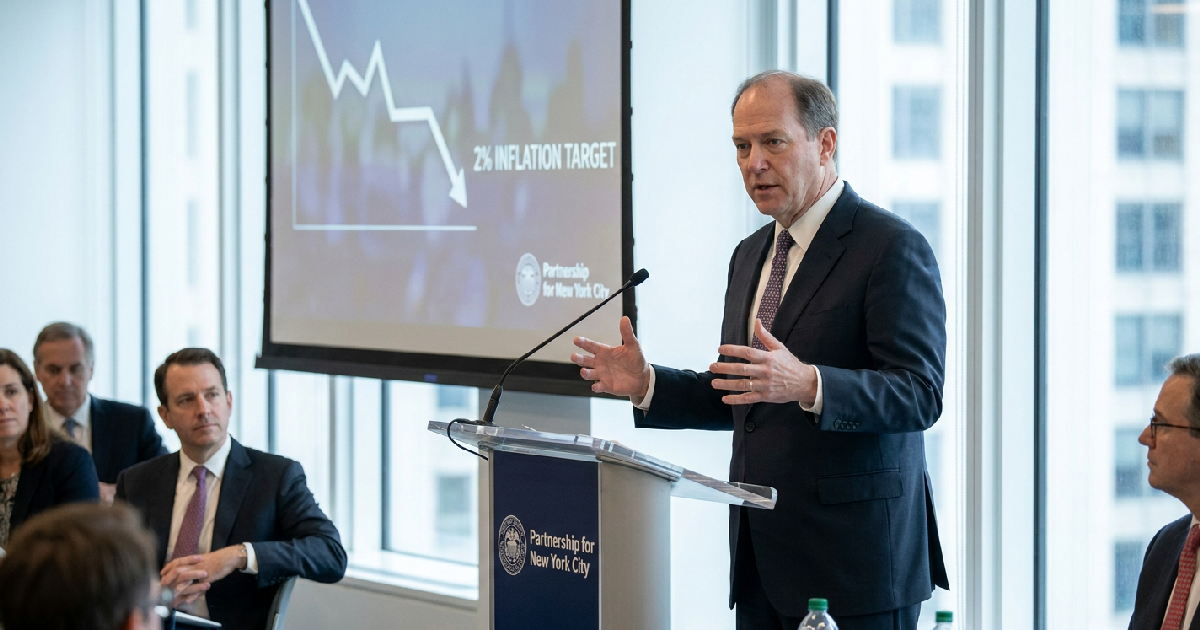
Speaking across several forums, including an interview with CNBC, a speech to New York State business leaders, and the ‘Stability of Thy Times’ event at the Partnership for New York City, Williams affirmed the current federal funds rate is “well positioned” to guide inflation back to the central bank’s 2% target.
Williams’s assessment: signs of easing inflationary pressures
His assessment follows recent economic data showing a significant cooling in consumer prices. The Consumer Price Index (CPI) notably fell from 4.2% in May to 2.7% in July, indicating a clear deceleration in the pace of price increases.
Williams outlined several key factors contributing to his belief that the latest price surge has run its course. He expects overall inflation to decline to around 3.25% by the end of 2026. From there, he anticipates it will continue its path toward the 2% goal in 2027, ultimately landing on target in 2028.
Easing energy costs play a significant role in this outlook. The oil price spike, which followed the US and Israel’s attack on Iran in late February, appears to have likely peaked. Williams believes these prices will trend closer to levels seen before the conflict.
Moreover, the economy has largely absorbed the direct effects of existing tariffs. Williams indicated that any new tariffs would primarily replace expiring ones, preventing them from creating significant additional inflationary pressures. This stability in trade policy is crucial for moderating price hikes.
Artificial intelligence investments, while driving recent economic activity, are expected to see their supply-demand imbalances ease as more supply comes online. The New York Fed President also noted the current labor market doesn’t pose additional inflationary pressure, with long-term inflation expectations remaining “well anchored.”
Economic growth and labor market stability
Williams presented a stable picture of the US economy, forecasting real GDP growth of about 2.25% this year and over the next two years. “Growth in the economy is solid and on trend, and the labor market is likewise solid and stable,” he stated.
The current unemployment rate stands at 4.3%, reflecting a healthy job market that isn’t generating undue wage-driven inflation. Williams also expects shelter inflation, a persistent component of overall price levels, to continue slowing in the coming quarters.
Market expectations diverge from Fed’s steady stance
Despite Williams’s confident stance, financial markets still show some divergence regarding future monetary policy. Market pricing suggests a reduced likelihood of a rate hike in 2026, with the odds falling from 66% to 50.5% for an increase within the year.
Data from the CME FedWatch tool indicates 46.3% odds in favor of a 25 basis point rate hike by October this year. This highlights an ongoing debate between central bank officials and market participants on the necessity of further tightening.
Contrasting views on inflation’s future
The Federal Open Market Committee (FOMC) held its target interest rate steady at 3.5% to 3.75% at its June meeting. This decision reflects a consensus to pause and assess the impact of previous rate adjustments on the economy.
Adding to the discussion, Fed Chairman Kevin Warsh testified before Congress a day earlier, on July 14, 2026. Warsh asserted that “inflation will be a thing of the past,” offering a distinctly optimistic view on the future trajectory of prices. Williams himself acknowledged that “Inflation at 4% is ‘unquestionably too high’,” highlighting the Fed’s commitment to its 2% target.
The policy landscape: holding steady for price stability
Williams emphasized repeatedly that the current policy stance is “well positioned” to achieve the Fed’s objectives. “The current stance of monetary policy is well positioned to do that,” he affirmed, referring to the central bank’s dual mandate of achieving both price stability and maximum employment.
The Federal Reserve aims to strike a delicate balance: bringing inflation down without triggering an unnecessary economic downturn. Williams’s remarks suggest confidence that existing measures are sufficient, potentially allowing the central bank to avoid additional aggressive steps.
He stressed, “But with inflation running high, it is imperative that we restore it to the Fed’s 2% longer-run goal on a sustained basis.” The Fed’s preferred measure of inflation hit 3.8% in April from a year earlier, underscoring the distance still to cover to reach the 2% target.
Implications for global stability and future outlook
As a permanent voting member of the FOMC, John C. Williams holds significant influence over the Federal Reserve’s monetary policy. His tempered optimism provides a key insight into the central bank’s thinking, particularly given previous warnings he issued about potential inflation stemming from strong AI-driven demand.
While the focus remains domestic, global events continue to shape the economic landscape. The energy shock following the Iran war, for instance, significantly impacted oil prices earlier this year, demonstrating how international conflicts can quickly affect the US economy. Meanwhile, the rapid investment in artificial intelligence continues to drive capital flows and reshape industries, presenting both opportunities and new inflationary dynamics for policymakers to monitor.
The path forward for monetary policy isn’t without its challenges. Unforeseen disruptions, whether geopolitical or economic, could alter the current trajectory. For now, however, Williams’s message points to a period of measured stability, where the Fed believes its current approach is adequate to tame inflation and maintain a healthy economy.