

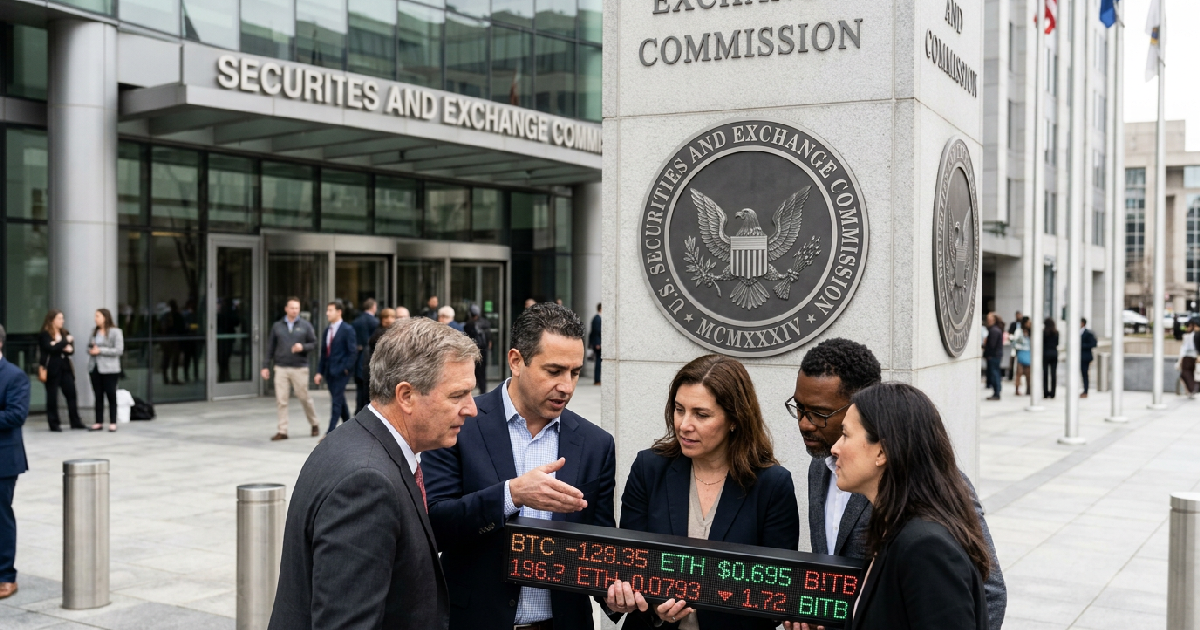
Securities and Exchange Commission questions novel
The U.S. Securities and Exchange Commission (SEC) has initiated a sweeping review to determine if increasingly complex exchange-traded funds (ETFs) are stretching the trust of retail investors too far. This exploratory inquiry focuses on whether the familiar “wrapper” of these funds is being used to house volatile assets that do not align with the perceived simplicity and liquidity of the traditional ETF structure.
The regulatory scrutiny comes as issuers continue to push into new territory, following the successful market entry of spot Bitcoin products. The SEC issued a request for public comment on June 30, 2026, regarding “novel” ETFs, defining them as funds that invest in innovative asset classes or employ novel strategies.
The ETF’s evolution and expanding market reach
For decades, the ETF has served as one of Wall Street’s most efficient distribution tools. It transformed complex market themes into easy-to-understand retail products that could be traded alongside blue-chip stocks. This convenience reshaped both investor behavior and the incentives for issuers, encouraging them to continuously innovate and explore new applications for the ETF structure.
The global ETF market now offers over 4,972 products and has surpassed $13.96 trillion in assets under management (AUM) as of March 2026. This immense growth underscores the ETF’s role as a primary vehicle for millions of buyers to gain exposure to diverse markets. But now, the SEC is questioning whether that inherent trust is being asked to do too much.
Evaluating the limits of the familiar fund wrapper
This review marks a critical juncture where the focus moves from basic asset access to the risks inherent in engineered product design. The agency is specifically looking at how much leverage, derivative exposure, structural complexity, and valuation risk public investors should bear within these vehicles. SEC Chair Paul Atkins, for instance, requested a pause on proposed novel ETFs in May 2026, citing “novel questions” that needed to be addressed.
The June 30 request for comment listed several areas of concern, including crypto assets, commodity-focused instruments, and blockchain-enabled opportunities. Regulators are also assessing heightened leverage, single-stock strategies, private assets, and event contracts. The agency has asked the public whether existing rules require new portfolio limits, strategy restrictions, or even exclusions to maintain market integrity, beginning an exploratory review ahead of any proposed changes.
The debate over ETP versus ETF labels
The legal terminology matters here, particularly the distinction between different regulatory frameworks. Spot Bitcoin products, such as the Fidelity Wise Origin Bitcoin Trust (FBTC), are structured as exchange-traded products (ETPs) rather than funds governed by the Investment Company Act of 1940. While widely called ETFs, this technical difference is crucial.
The SEC’s request specifically asks whether ETPs that sit outside the investment-company framework should be allowed to use the “ETF” or “fund” labels at all. This question highlights a fundamental concern: whether the common perception of safety and simplicity associated with the “ETF” brand accurately reflects the underlying risks of these newer products.
Crypto funds under the microscope
Crypto funds are at the center of this debate because they represent the intersection of highly volatile underlying markets and familiar retail packaging. Unlike traditional equities or bonds, digital assets trade on a 24/7 basis, often on fragmented exchanges that operate differently from ordinary equity markets. This creates potential friction when these assets are wrapped in a product designed for standard brokerage hours.
Even the disclosure pages for products like Fidelity’s FBTC highlight this disconnect, noting that the underlying market and the fund wrapper operate on entirely different schedules. The SEC is concerned that the familiarity of the brokerage account may mask systemic risks like weekend trading volatility and liquidity gaps, affecting investor understanding and behavior under stress.
Historical concerns about complex ETPs
The SEC’s current scrutiny of complex products isn’t entirely new. For over a decade, staff and commissioners have warned the public about the inherent risks of leveraged and inverse ETFs, especially for individual investors. As far back as 2009, the SEC’s Office of Investor Education and Advocacy highlighted concerns for investors holding certain ETFs for longer than a single day.
In 2015, the commission sought public comment on various issues related to ETPs, including listing standards and broker-dealer sales practices. More recently, in November 2020, the SEC settled charges against financial professionals who had recommended that retail customers buy and hold ETPs designed exclusively for very short-term trading strategies. This historical pattern shows a consistent regulatory vigilance against products that might mislead retail investors due to their structure or marketing.
Legitimacy and political symbolism in crypto ETFs
Beyond structural complexity, crypto ETFs also carry significant political symbolism. Every new approval for a crypto ETF is often perceived as a signal about the federal government’s broader stance toward the asset class. This can create an impression of endorsement, even when regulators are explicitly trying to avoid it.
This symbolism was particularly evident in the SEC’s 2024 statement approving spot Bitcoin ETPs. The agency explicitly stressed that its approval did not amount to an endorsement of Bitcoin itself, underscoring the delicate balance regulators attempt to strike. It was framed purely as a legal and market-structure judgment, but the public interpretation often differed.
This nuance is critical as issuers look to launch even more complex products, such as leveraged token baskets or hybrid structures. If the Clarity Act advances to establish firmer federal rules for digital assets, it could coincide with these stricter SEC boundaries on how innovative assets are marketed and packaged for public consumption.
What tighter regulation means for market participants
The outcome of this exploratory review could lead to firmer boundaries around ETF design. If the SEC decides that certain strategies are too complex or opaque for the familiar “ETF” label, approvals for exotic crypto vehicles may slow significantly. Brian Daly, Director of the SEC Division of Investment Management, stated in July 2026 that “Public engagement is essential to answering key questions to make the next years of development a success” regarding novel ETFs.
Disclosure expectations are likely to become stricter, forcing issuers to prove that their products are sufficiently legible for financial advisors, fiduciaries, and ordinary investors before they reach a mass audience. This could mean less room for issuers to build products that rely heavily on investors trusting the wrapper more than they understand the underlying exposure.
This scrutiny is more than just a clash between Washington and the crypto industry; it’s about defining the future of mainstream investing. As Brian Armstrong warns finance must move on-chain, the SEC is simultaneously ensuring that legacy distribution systems remain transparent and understandable for those using them in retirement accounts and self-directed brokerage portfolios.
Crypto’s long-term place in public markets will depend as much on which of those cultures takes hold—one built on transparency or one on engineered complexity—as on whether the next fund gets approved. The industry has every reason to want broader access, but it needs access that remains understandable once the wrapper is stripped away, and the product design has to stand on its own.