

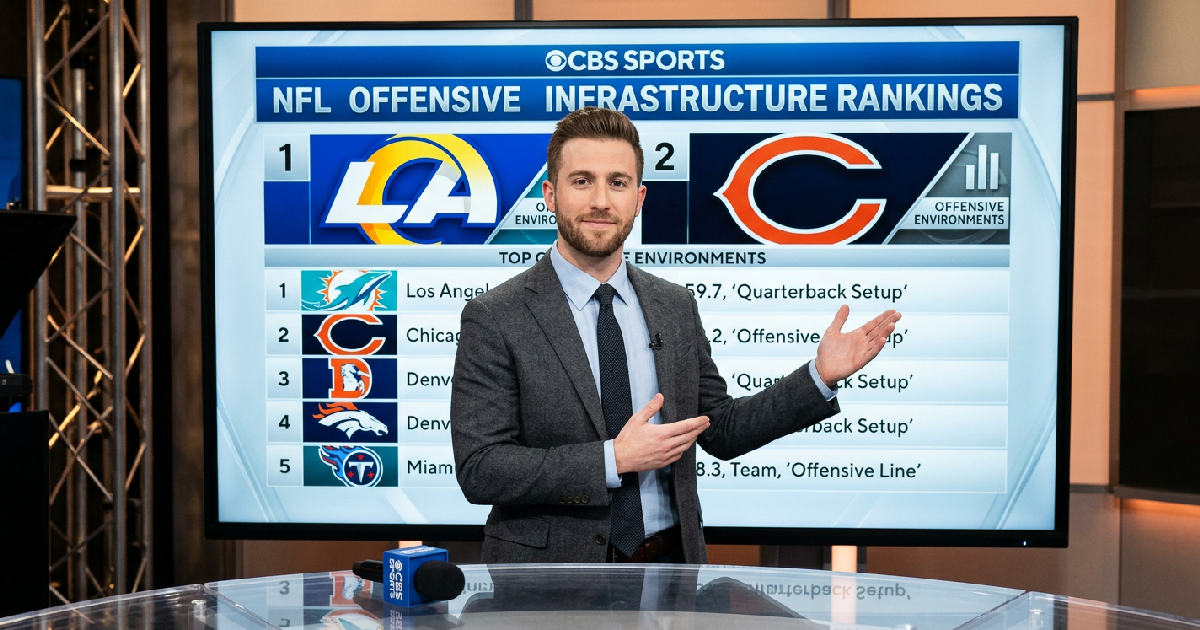
CBS Sports ranks Los Angeles Rams, Chicago Bears as top offensive environments
The CBS Sports NFL staff released the sixth edition of its offensive infrastructure rankings on July 8, 2026, naming the Los Angeles Rams and Chicago Bears as the league’s premier environments for quarterback success. Lead reporter Jared Dubin utilized a weighted grading system to evaluate all 32 supporting casts, excluding the quarterback’s individual talent to determine which organizations have built the most effective “incubators.”
The grading system assigned scores from 1 to 5 across four key areas: play-callers, offensive lines, pass-catchers, and running backs. While the Los Angeles Rams and Chicago Bears claimed the top two spots with identical grades of 4.45, the Miami Dolphins bottomed out the rankings with a 2.55. Jared Dubin noted that the gap between the Dolphins in 32nd place and the next-closest team is larger than any other distance in the study.
Elite environments and the rise of Tier 1 teams
The Los Angeles Rams and Chicago Bears represent the gold standard for offensive infrastructure in 2026. Los Angeles relies on the strategic depth of Head Coach Sean McVay, while Chicago has built a deep roster of weapons managed by offensive mind Ben Johnson. Both teams narrowly edged out the Detroit Lions and Dallas Cowboys, who tied for third with weighted grades of 4.40.
Detroit’s ranking was propped up by a running back room led by Jahmyr Gibbs, which helped offset a slight decline in their offensive line. Conversely, Dallas continues to benefit from play-caller Brian Schottenheimer and star receiver CeeDee Lamb. High-level stability in these organizations contrasts sharply with more volatile corporate environments, such as those discussed when Bobby Kotick addressed legal impacts on industry deals earlier this year.
The San Francisco 49ers rounded out the top five with a 4.20 grade. Despite the brilliance of Kyle Shanahan and versatility of Christian McCaffrey, injury concerns limited their final score. Tight end George Kittle is currently recovering from a torn Achilles, and depth behind McCaffrey remains unproven. The 49ers did add third-round rookie Kaelon Black to the backfield to address these depth issues.
Parity and ties across the very good environments
The 2026 study revealed a significant clustering of talent in Tier 2, highlighted by a four-way tie for seventh place. The Jacksonville Jaguars, Buffalo Bills, Kansas City Chiefs, and Cincinnati Bengals all finished with a 4.00 grade. Each team reached that total through different strengths: Cincinnati boasts the elite receiving duo of Ja’Marr Chase and Tee Higgins, while Kansas City relies on interior pass protection from Creed Humphrey and Trey Smith.
Buffalo’s infrastructure is anchored by an offensive line Dubin described as the best among this tied group, featuring Dion Dawkins and Spencer Brown. Jacksonville’s No. 6 overall ranking was driven by play-caller Liam Coen and depth at the receiver position, including former first-round pick Brian Thomas Jr. These environments ensure that quarterbacks are not forced to carry the load entirely alone.
Offensive line dominance and the Denver Broncos
In terms of pure trench play, the Denver Broncos emerged as a consensus top-tier unit for the 2026 season. Under Head Coach Sean Payton, the Broncos returned all five starters, including Garett Bolles, Quinn Meinerz, and Mike McGlinchey. Despite the high quality of the line, Denver’s overall infrastructure grade of 3.80 was suppressed because the team is reportedly using Davis Mills to call plays.
CBS Sports methodology grants an average grade of 3 to all first-time play-callers, a factor that also impacted the Philadelphia Eagles. Following the departure of long-time assistant Jeff Stoutland, the Eagles sit at 16th with a 3.75 grade. They still possess high-end tackle talent in Jordan Mailata and Lane Johnson, but face a transition period in coaching leadership.
Struggles at the bottom of the infrastructure rankings
The Miami Dolphins occupy Tier 7 as the league’s worst environment for a quarterback, largely due to a “terrible” grade for their pass-catching group. Options for quarterback Malik Willis include Jalen Tolbert, Malik Washington, and an injured Chris Bell. Dubin described the infrastructure as significantly lacking in vertical options, leading to a league-low 2.55 grade.
The Tennessee Titans rank 31st with a 2.85 grade. While the hiring of Brian Daboll improved the play-calling grade to average, the team reportedly did not do nearly enough to address pre-existing issues along the offensive line. This surrounding cast faces high expectations as they attempt to support rookie quarterback Cam Ward in his debut season.
Cleveland and Washington face uphill battles
Rounding out the bottom four are the Cleveland Browns (2.90) and the Washington Commanders (2.95). Cleveland’s situation is complicated by an offensive line and weapon group that Dubin noted must be considered “below-average until we see proof that they’re better.” Even the running back pairing, featuring Quinshon Judkins, was noted for having underwhelming production in the previous season.
Washington’s ranking suffered due to a very thin receiving corps and one of the league’s weakest running back rooms. While the Washington Commanders received an average 3.0 grade for play-caller David Blough, the lack of skill-position talent dragged down an offensive line that is considered above-average at best. These franchises remain under pressure to provide better “incubators” for their passers as the 2026 season nears.