

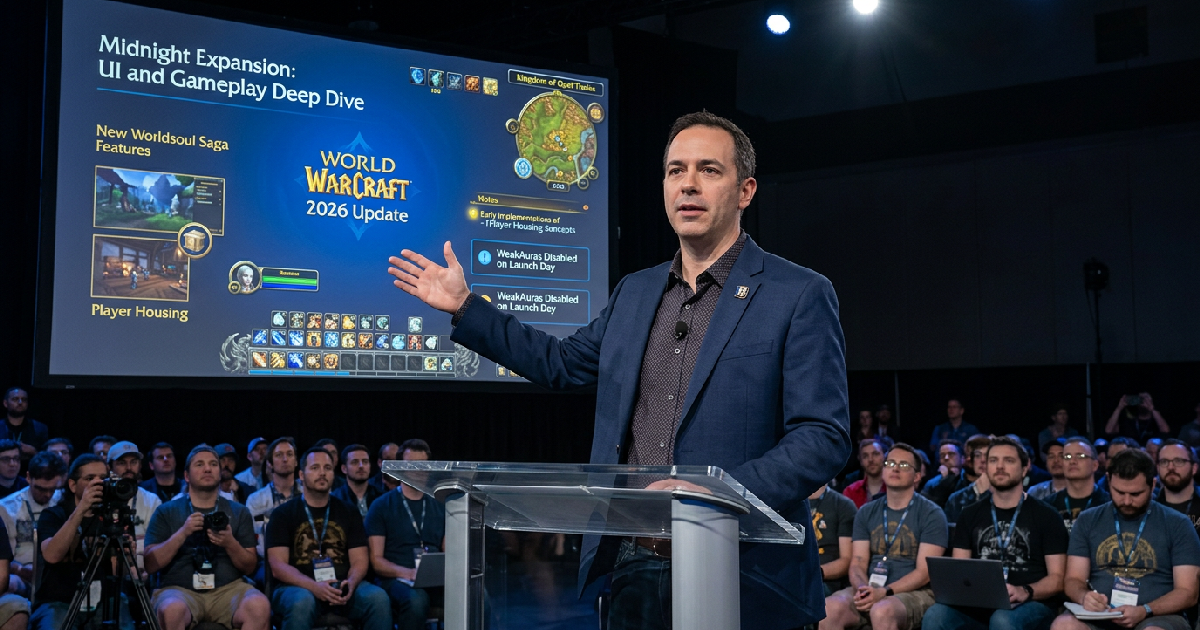
Ion Hazzikostas details Midnight expansion’s UI overhaul on July 8, 2026
World of Warcraft Game Director Ion Hazzikostas has detailed the ongoing transformation of the long-running MMORPG, as the “Midnight” expansion seeks to unify the game’s classic roots with modern features.
Speaking on July 8, 2026, Game Director Ion Hazzikostas emphasized that the current era represents a pivot toward broadening the game’s appeal, offering flexibility for solo players through Delves while navigating a high-profile transition in the game’s user interface.
User interface changes and the end of WeakAuras
The expansion, which serves as the “middle child” of the Worldsoul Saga trilogy, centers the plight of Azeroth in the Kingdom of Quel’Thalas, moving away from the multiversal themes that defined previous chapters.
The launch of Patch 12.0.5, titled Revelations, has proven to be a significant test for the development team at Blizzard Entertainment. The update was marked by a glitch in the new player housing system where decor would snap to the floor and save, forcing the feature offline.
Game Director Ion Hazzikostas explained that this was a “knock-on effect” of changes made to the Mists of Pandaria-era Siege of Orgrimmar. This technical challenge comes as the game moves past its 20th anniversary, which it celebrated in 2024, placing it at 22 years of service in 2026.
One of the most significant shifts in Midnight is Blizzard Entertainment’s move to “level the playing field” by overhauling the base user interface. For years, players have relied on external tools like WeakAuras, GTFO, and BigWigs to solve in-game challenges.
Game Director Ion Hazzikostas admitted that these tools were impacting encounter creation, leading to a cycle where designers felt they had to build instances around the addons. Consequently, WeakAuras and several other community-made creations have “bit the dust” in an effort to ensure newer players are not disadvantaged by a lack of external software.
To fill the gap left by these restrictions, Blizzard Entertainment has integrated a native damage meter and a standardized boss timer system into the core UI. This overhaul aims to surface trackable information that was previously missing, such as many healing spells and self-buffs that are no longer classified as “secret” auras.
While the decision was met with a negative reaction from some longtime players and creators, Game Director Ion Hazzikostas believes the transition has been successful, noting that the vast majority of players are still completing content at their usual levels without feeling the need to seek out external tools.
The upcoming Patch 12.1 is set to continue this work with a comprehensive overhaul of the security backend of the addon interface. This update is intended to make it easier for authorized authors to create customization options while closing “loopholes” that allowed for complex computational logic during combat.
This follows a period of “internally relearning” how to build raids and dungeons in a world where players are no longer using logic-heavy scripts to solve mechanics in real-time.
For more on how the gaming industry is evolving, readers can look at how Valve debuts IEM Cologne Major 2026 stickers and manages its own digital hubs.
Exploring the Kingdom of Quel’Thalas in Midnight
Narratively, Midnight takes players back to iconic locations that have been reimagined for the modern era. The expansion focuses on the conflict between the Light and the Void, with the entity Xal’atath leading an invasion that threatens the Sunwell. Players are returning to lands such as Eversong Woods, Zul’Aman, and a redesigned Silvermoon City.
There was initial internal doubt at Blizzard Entertainment about whether players would embrace these familiar locales, but Game Director Ion Hazzikostas noted that the enthusiasm for seeing these historic sites updated has opened doors for future stories in central Azerothian locations.
In addition to the geographic return, Midnight introduces several major gameplay pillars:
- Level Cap: The maximum level has been raised to 90.
- Player Housing: A full system featuring customizable interiors, 3D placement tools, and trophy displays.
- New Allied Race: The Haranir, a Void-touched race tied to the assault on the Sunwell.
- Demon Hunter Specialization: The “Devourer,” a Void-themed mid-range DPS specialization using soul-harvesting mechanics.
- Delves: 11 soloable dungeons designed to expand the experience for single players.
These features represent a broader philosophy of serving different player types. Game Director Ion Hazzikostas remarked that in 2026, World of Warcraft is designed so a player can accomplish something meaningful in a 20-minute session after lunch or spend hours immersed in the lore.
As the industry shifts toward integrated experiences, companies like Blizzard are ensuring their core titles remain competitive, much like how Strauss Zelnick confirms Grand Theft Auto 6 release date movements signal major era shifts for other franchises.
Endgame schedule and Season 1 rollout
The launch window for Midnight in early 2026 has established a clear roadmap for endgame progression. Following the official global release on March 2, 2026, players have been introduced to a structured calendar of raid and dungeon unlocks.
Alongside these traditional instances, a new social hub called the Arcantina—a magical pub in a pocket dimension—serves as a community focal point between battles against the Void invasion. The expansion also features a “Prey” system, which acts as a bounty hunter mechanic to give players consistent activities in the open world.
The Season 1 schedule for Midnight is detailed below:
| Date | Event/Unlock |
|---|---|
| March 17, 2026 | Voidspire Raid (LFR Wing 1, Normal, Heroic) opens in the Voidstorm; Bountiful Delves unlock. |
| March 24, 2026 | Mythic difficulty opens for the Voidspire and Dreamrift raids. |
| March 31, 2026 | March on Quel’Danas 2-boss mini-raid opens (Normal, Heroic, Mythic). |
| April 7, 2026 | Story Mode and LFR become available for the March on Quel’Danas mini-raid. |
Reflecting on his 18-year career at Blizzard, Game Director Ion Hazzikostas expressed confidence in the game’s current state. He noted that while World of Warcraft was once known as a “life-consuming” commitment, the 2026 version of Azeroth is built on flexibility.
“I think for players in retail, Blizzard has been learning for 20 years, and refining its ability to serve players, tell stories, offer depth, offer meaningful rewards, and offer increasing flexibility,” Hazzikostas said. For a game that has spanned generations, he maintains that “there couldn’t be a better time to jump in than right now.”