

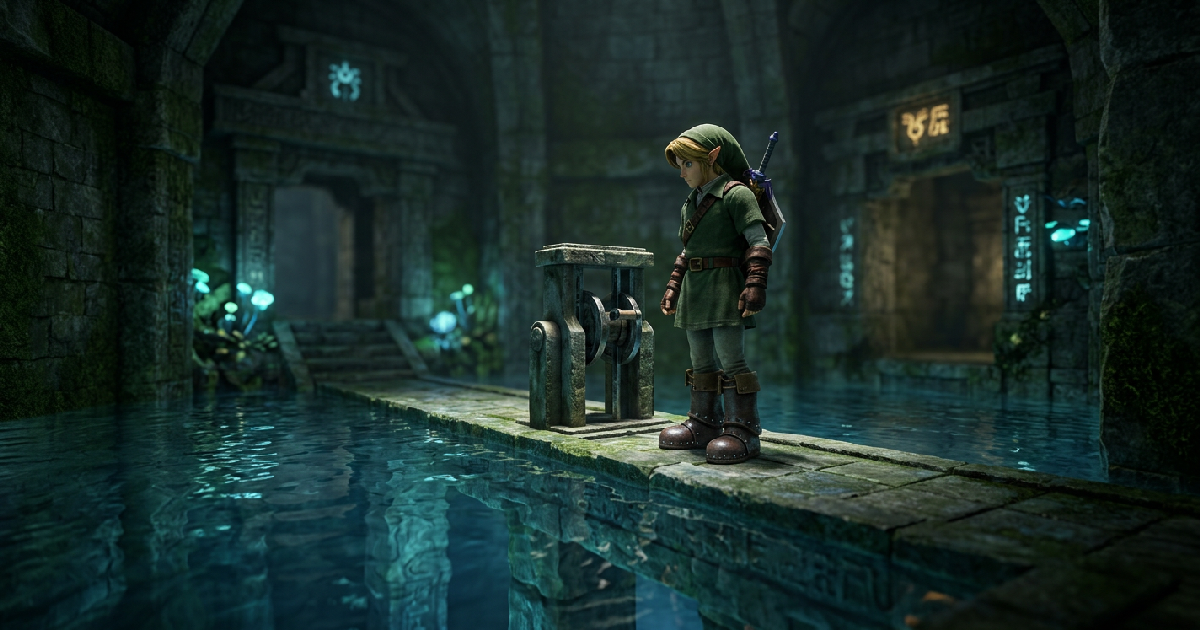
Nintendo reportedly fixes Ocarina of Time’s Water Temple for Switch 2
The Legend of Zelda: Ocarina of Time remake slated for the upcoming Nintendo Switch 2 in late 2026 reportedly features a built-in solution for the original game’s most criticized segment: the Water Temple. By leveraging design choices first implemented in the 2011 Nintendo 3DS version, the new iteration aims to fix the slow pacing and cumbersome menu navigation that defined the 1998 experience. This move addresses a decades-old pain point where players were forced to pause the game constantly just to progress through the dungeon’s aquatic puzzles.
For many who played the original on the Nintendo 64, the Water Temple was synonymous with frustration. The central mechanic required Link to equip and unequip Iron Boots to sink or float in the reservoir. Because the original hardware lacked sufficient buttons for quick-toggling, this meant entering a sub-menu dozens of times. The Switch 2 version looks to rectify this by adopting the 3DS remake’s template, which assigned the boots to a dedicated button for instant use.
Ocarina of Time’s Water Temple puzzle box mechanics streamlined for Switch 2
The Water Temple has long been regarded as a “puzzle box” rather than a linear crawl, making it easy for players to lose their way or overlook critical items. To counter this, the Switch 2 version is expected to include the visual aids introduced in the Ocarina of Time 3D remake. These include color-coded markings placed throughout the dungeon to indicate water levels and camera-focused hints that draw the player’s eye toward missed keys or hidden alcoves.
These changes are not just about making the game easier; they are about removing technical friction. The Nintendo 3DS version proved that visual cues could help pinpoint Link’s location without sacrificing the dungeon’s inherent challenge. While some purists may worry about over-simplification, the consensus remains that the original game’s difficulty often stemmed from design oversights rather than intentional logic puzzles.
Strategic timing for the Switch 2 Zelda release
Nintendo has yet to announce a formal release date for the Ocarina of Time remake, but its arrival in the latter half of 2026 places it in a competitive window. Industry analysts are closely watching how the title will perform alongside Rockstar’s Grand Theft Auto 6, which is also confirmed for a November release. This period is already being described as a “wasteland” for other competitors due to the expected market dominance of Rockstar’s sequel.
By offering a high-profile remake of a beloved classic, Nintendo provides a stable alternative for its core audience. The company has a history of long-term planning for its flagship franchises, much like how Bobby Kotick discussed industry shifts during the Activision-Microsoft deal regarding market competition. For Zelda, a polished Ocarina of Time remake serves as a safe bet for the Switch 2’s debut year.
The broader future of Legend of Zelda projects
The rumors of an Ocarina of Time remake have sparked intense speculation regarding other potential projects. Fans are already looking toward possible remakes of Majora’s Mask or Twilight Princess, though Nintendo remains focused on the immediate horizon. Beyond the gaming hardware, the franchise is expanding into other media, most notably with the Legend of Zelda live-action movie currently scheduled to debut in April 2027.
There are also persistent reports of another open-world Zelda game in development. As Nintendo navigates the transition to new hardware, these projects ensure the series remains at the forefront of the industry. The careful management of the Ocarina of Time IP suggests that the developer is hyper-aware of the legacy it carries. As Strauss Zelnick confirmed Grand Theft Auto 6 for late 2026, Nintendo appears ready to field its strongest legacy title as a counter-balance.
Maintaining the balance of dungeon difficulty
The ultimate goal for the Switch 2 version is to strike a balance between modern accessibility and nostalgic challenge. If the developers add too many hints, they risk stripping the Water Temple of its identity. However, if they ignore the quality-of-life improvements made in the 3DS era, they risk alienating a generation of players accustomed to modern, fluid gameplay.
The original Ocarina of Time remains a timeless classic, but the Water Temple represents an era where level design was still catching up to the possibilities of 3D environments. By refining the camera guidance and equipment management, Nintendo is ensuring that the difficulty remains focused on the environment, not the controller. As the Switch 2 era begins, Link’s journey through the depths of Lake Hylia looks set to be more about exploration and less about inventory management.
The evolution of game design and player experience
The gap between the original N64 release in 1998 and the upcoming Switch 2 remake is significant, spanning nearly three decades of game development innovation. This extended period has seen drastic improvements in level design philosophies and user interface. Modern gamers, many of whom may have first experienced Ocarina of Time through its 3DS iteration, would likely find the unadulterated N64 Water Temple design jarring.
Nintendo understands this evolving player expectation. What was once considered a challenging design choice in the late 90s, like constant menu-diving for equipment, is now recognized as an impediment to flow. The inclusion of subtle but effective alterations reflects a design maturity that prioritizes intuitive gameplay without compromising the core experience of exploration and puzzle-solving.
Preserving the essence of a classic with smart tweaks
Remakes inherently walk a fine line, aiming to honor the original while making it palatable for contemporary audiences. The Ocarina of Time 3D version of the Water Temple serves as a prime example of how simple, focused adjustments can dramatically improve a notorious segment without gutting its original spirit. Adding colored markers and contextual camera cues, for instance, helps players orient themselves in an otherwise labyrinthine environment.
These seemingly minor enhancements allow the dungeon