

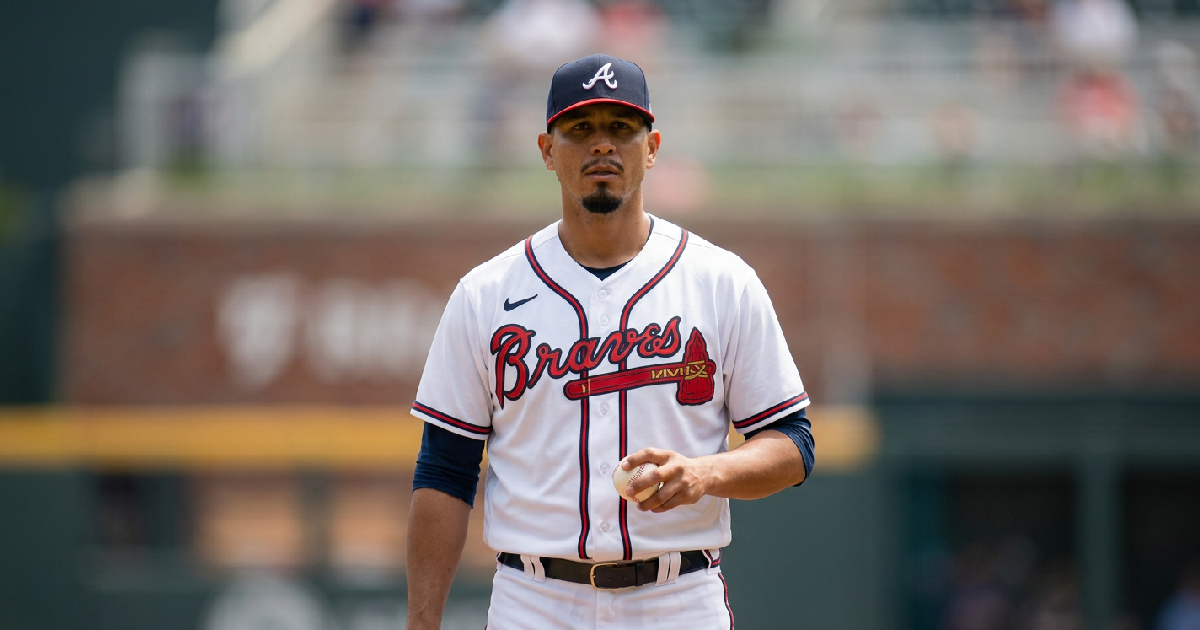
Atlanta Braves re-sign Carlos Carrasco for sixth time this season
The Atlanta Braves re-signed veteran right-hander Carlos Carrasco to a minor league contract on Sunday, June 28, 2026, marking a continuation of one of the most unusual roster management strategies in Major League Baseball this season.
The 39-year-old pitcher returns to the organization just days after being designated for assignment on June 25 to make room for the return of Raisel Iglesias. This latest transaction represents the sixth time during the 2026 campaign that Atlanta has released and subsequently brought back the Venezuelan-American veteran on a minor league deal.
Atlanta Braves leverage veteran service time for roster flexibility
Carlos Carrasco had cleared waivers after his mid-week departure and briefly elected free agency before agreeing to terms on this new pact. By moving him back into the system, the Braves maintain a layer of experienced pitching depth at Triple-A Gwinnett without occupying a coveted spot on the 40-man roster.
The right-hander has become a specialized “41st man” for manager Walt Weiss, providing a reliable arm that can be summoned whenever the bullpen faces a sudden workload crisis or injury setback.
The recurring cycle of designations and re-signings is born from a specific quirk in the MLB Collective Bargaining Agreement concerning service time. Because Carlos Carrasco is a seasoned veteran with over five years of major league service, he cannot be optioned to the minor leagues without his explicit consent.
If the Braves wish to move him off the active roster, they must designate him for assignment (DFA), a process that exposes him to all other 29 teams through the waiver wire.
In this specific 2026 dynamic, the Braves have successfully gambled that Carrasco’s age and current profile will allow him to clear waivers consistently. Once he clears, he has the right to elect free agency, which he has done each time.
However, the mutual interest between the player and the organization has led to six separate minor league agreements. This allows Atlanta to keep an experienced pitcher in their “back pocket,” ready to fly to the next series at a moment’s notice.
This strategy is particularly vital as the Braves managed a heavy bullpen workload in the weeks leading up to this move. While younger prospects might be easier to shuttle back and forth, they often lack the composure and “mop-up” efficiency that Carlos Carrasco has displayed.
Key details
The veteran knows his role is to eat innings in low-leverage situations, preserving the high-leverage arms like Tyler Kinley and Ian Hamilton for closer games.
Recent performance and durability metrics for the veteran
Despite his journeyman status this season, Carlos Carrasco has actually provided solid, if non-flashy, results when called upon. In his 14 2/3 innings of major league work for Atlanta in 2026, he has posted a respectable 3.68 ERA and a 1.16 WHIP.
His ability to throw strikes has been his greatest asset, as evidenced by his 6:1 strikeout-to-walk ratio. While his 9.8% strikeout rate is well below the league average, his efficiency in limiting free passes has kept him out of major trouble.
Durability remains a key selling point for the 39-year-old righty. In each of his last four appearances for the big league club, he has surpassed the 30-pitch mark, signaling that his arm is conditioned for multi-inning relief. This is a contrast to many modern relievers who are strictly one-inning specialists.
When a starter leaves a game in the third or fourth inning, having an “innings eater” like Carrasco prevents a complete collapse of the bullpen hierarchy.
His performance at Triple-A Gwinnett has been even more dominant. Earlier in the 2026 season, he logged four starts with the Stripers, pitching 21 innings and recording a stellar 1.71 ERA.
While he operates as a starter in the minors to keep his stamina high, the Braves clearly view his primary value as a long reliever who understands how to navigate major league hitters during the middle innings of a blowout.
Roster implications and the Raisel Iglesias factor
The move to designate Carlos Carrasco on Wednesday was a direct result of the Braves needing to activate star closer Raisel Iglesias from the injured list. With the 40-man roster at capacity and the active roster needing a slot for the team’s primary ninth-inning weapon, the veteran was the odd man out.
This decision followed a series of other moves, including the addition of Ian Hamilton and the removal of prospect JR Ritchie from the active list.
Atlanta’s front office has perfected the timing of these moves. By re-signing him on Sunday, they ensure that if another injury occurs during the upcoming week, Carrasco will have already completed his administrative “free agency” period and be available for a call-up.
Key details
History suggests this call will come sooner rather than later; in three of his previous five designations this year, he was back in a Braves uniform within 72 hours.
Managing a bullpen in 2026 requires this kind of creative accounting, especially for a team with championship aspirations. The Braves are currently navigating a competitive NL East where every roster spot matters.
While some fans might view the constant shuffling of a 39-year-old pitcher as minor news, it directly impacts the health and longevity of the team’s starting rotation by preventing over-taxation.
Even in other sports, roster stability is under the microscope, such as how Toto Wolff reacted to recent contact between his drivers, showing that managing personnel and their roles is a universal challenge in high-level competition.
Why Carlos Carrasco continues to choose the Braves
For a player of Carlos Carrasco’s tenure, electing free agency six times in one season usually signals the end of a career or a move to a new city. However, the pitcher has shown a clear preference for the Atlanta environment.
The Braves’ reputation for treating veterans with respect, combined with their status as perennial contenders, likely plays a significant role in his desire to remain with the organization despite the frequent paperwork changes.
There is also the proximity factor. With the Triple-A affiliate located in Gwinnett, just a short drive from Truist Park, the transition between the majors and minors is seamless for the player. For a 39-year-old with a family, avoid a cross-country move is a major incentive.
Key details
The Braves have essentially provided him with a “home base” where he can remain sharp and contribute to a winning culture without the instability of joining a new clubhouse every three weeks.
From the team’s perspective, Carrasco is the ultimate professional. He doesn’t complain about the “DFA-to-minor-league” cycle and remains ready to pitch whenever the phone rings. This level of maturity is rare, as many veterans would find the constant designation process insulting.
Instead, it has become a functional partnership that suits both the team’s need for flexibility and the player’s need for a stable employment environment within a top-tier organization.
Looking ahead to the 2026 trade deadline
As the July trade deadline approaches, the presence of Carlos Carrasco becomes even more strategically significant. Having a veteran depth arm allows the Braves to potentially trade away younger, more roster-valuable pitching prospects for a high-impact bat or a front-line starter.
Because they know they have Carrasco to bridge the gap in the bullpen, they can afford to be aggressive in their negotiations with other teams.
The Braves are also monitoring other injury situations across the roster. The frustration of being sidelined is a common theme in the division this year, much like how Gleyber Torres admitted his injury absence was taking a mental toll.
By keeping Carrasco in the fold, Atlanta ensures they don’t have to rush their own injured pitchers back prematurely. They have a “safety valve” that can give them quality innings, allowing the training staff to be conservative with the health of the primary rotation.
Key details
Whether this is the last time Carrasco signs a minor league deal in 2026 remains to be seen. Given the patterns established over the first half of the season, there is a distinct possibility he could reach double-digit signings before the year is out.
For now, he returns to the Gwinnett Stripers, waiting for the inevitable moment when the Braves need a veteran presence to stabilize a long game in Atlanta.
The “Cookie” saga is a testament to the modern era of baseball, where the 26-man roster is often just a suggestion and the real depth is found in the relationships between veterans and the teams that know exactly how to use them.
As long as Carrasco can throw 30 pitches and find the strike zone, the Braves seem intent on keeping him as a permanent fixture in their extended pitching plans.