

British International Investment commits $1.1 billion to climate finance
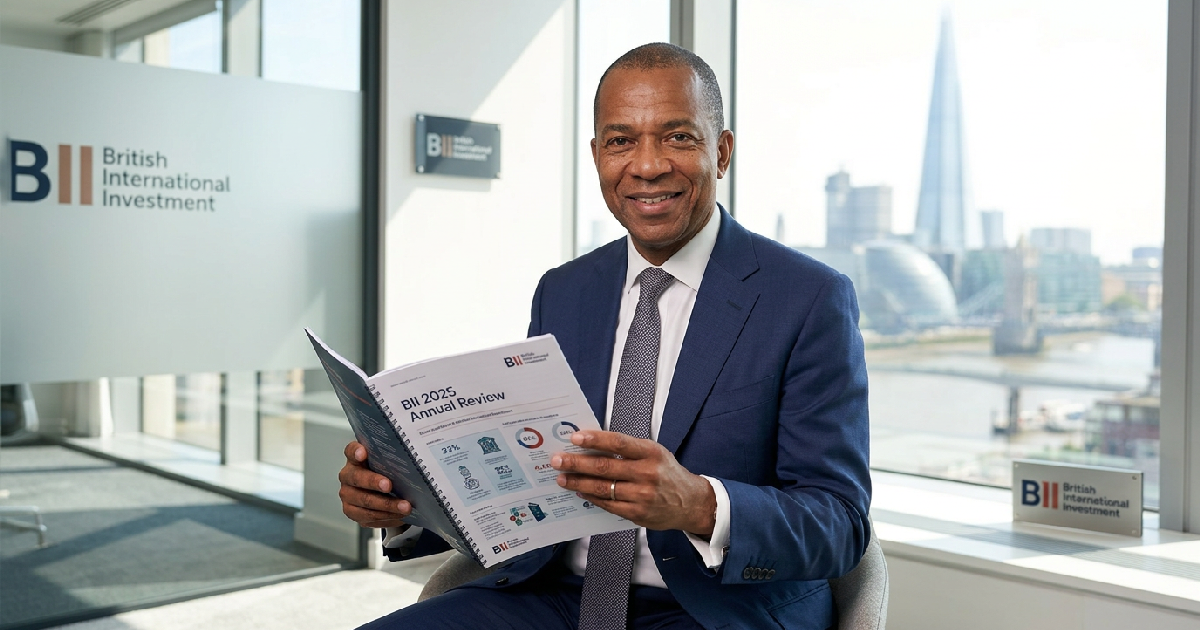
British International Investment (BII) published its 2025 Annual Review on June 26, 2026, announcing it has committed a record $1.1 billion (£827 million) to climate finance. The UK’s development finance institution reported total investments of £1.8 billion for the 2025 period, with nearly 60% of that capital directed toward African businesses.
Under the leadership of Chief Executive Leslie Maasdorp, the organization surpassed the $1 billion annual climate finance threshold for the first time in its history.
Geographical distribution and portfolio performance
The record climate commitments represent a sharp increase from the £449 million provided in 2023. This surge aligns with a UK government target requiring at least 30% of the institution’s total commitments between 2022 and 2026 to count as climate finance.
BII indicated it is currently exceeding this benchmark, with 42% of commitments qualifying as climate finance during the first two years of the strategy period.
Chief Executive Leslie Maasdorp stated that climate finance is a core priority for supporting countries most vulnerable to environmental shifts. He clarified that at least 40% of all BII investments over the next five years will be designated for climate-related initiatives. Maasdorp added that supporting fragile regions delivers a “security dividend” to the UK taxpayer by fostering stable economies while providing financial returns.
Of the £1.8 billion total invested in 2025, BII committed £1.07 billion to African businesses and £712 million to companies in Asia. The institution also provided approximately £40 million in capital to Ukraine.
Key details
At the end of 2024, the total portfolio stood at £6.6 billion, consisting of 899 businesses in Africa and 760 businesses in Asia. This broader portfolio, which includes nearly 1,700 companies in total, achieved a seven-year weighted average return of 3.8%.
African growth remains the primary target for the institution’s long-term capital. Chris Chijiutomi, Managing Director and Head of Africa at BII, noted that the institution has supported African enterprises for nearly eight decades.
While total portfolio figures from the end of 2024 include 899 African entities, BII continues to prioritize major markets such as Egypt, Kenya, South Africa, and Nigeria for new deal flows. This includes investments in firms like ARC Ride, an electric motorbike manufacturer in Kenya, aimed at reducing urban carbon footprints.
As the global economy faces shifting energy prices and geopolitical uncertainty, BII is increasingly targeting frontier markets. A new strategy announced earlier this year mandates that at least 25% of new investments be directed toward countries classified by the United Nations as least developed countries (LDCs).
Strategic milestones in green energy and climate finance
The 2025 review detailed several high-profile green energy projects, including a $100 million commitment to ReNew in India to expand solar manufacturing. In North Africa, the institution backed the Gulf of Suez Wind Farm and the Obelisk solar and battery storage development in Egypt.
These projects are part of a broader effort that saw BII mobilize $774 million in additional climate finance from private investors during the year.
Blended finance remains a critical tool for scaling these environmental projects. The Allianz ACE Fund, anchored by BII with a $150 million commitment, is designed to draw $850 million from private institutional investors. Similarly, the institution invested $60 million in the Green Investment Partnership (GIP), a platform managed by Pentagreen Capital. This venture, involving HSBC and Temasek, focuses on sustainable infrastructure across Southeast Asia.
Maintaining strong capital deployment despite market volatility is essential for long-term development. Similar to how transportation firms monitor valuation trends to ensure operational efficiency, BII uses its portfolio returns to recycle capital into new impactful projects. This recycling helps limit the direct financial burden on the UK government, which has provided nearly £6 billion in capital to the institution since 2015.
Gender equality and the 2X challenge performance
Beyond climate, BII reported progress on its inclusive development goals through the 2X Challenge, a global standard for gender-lens investing. The institution aims for 25% of its new investments during the 2022-2026 period to support gender equality.
During the first two years of this strategy, 38% of new commitments were 2X qualified, significantly outperforming the core target. In 2023 specifically, BII committed £297 million toward this goal, representing 25% of that year’s new commitments.
BII Chair Diana Layfield explained that the investment landscape has become more complex and demanding of long-term capital. She noted that global shifts are reshaping development finance, requiring the institution to be more agile as it concludes its current strategy period.
Key details
This complexity has led BII to launch initiatives like the £1.1 billion British Climate Partners program, which assists coal-dependent economies in Asia with the transition to cleaner energy sources.
The 2025 Annual Review suggests that the institution is successfully balancing its dual mandate of development impact and financial sustainability. By achieving record climate finance levels and maintaining a diverse portfolio across nearly 1,700 companies, BII is positioning itself as a key player in the transition toward a green global economy.
The focus now turns to the final year of the current strategy period ending in 2026.