

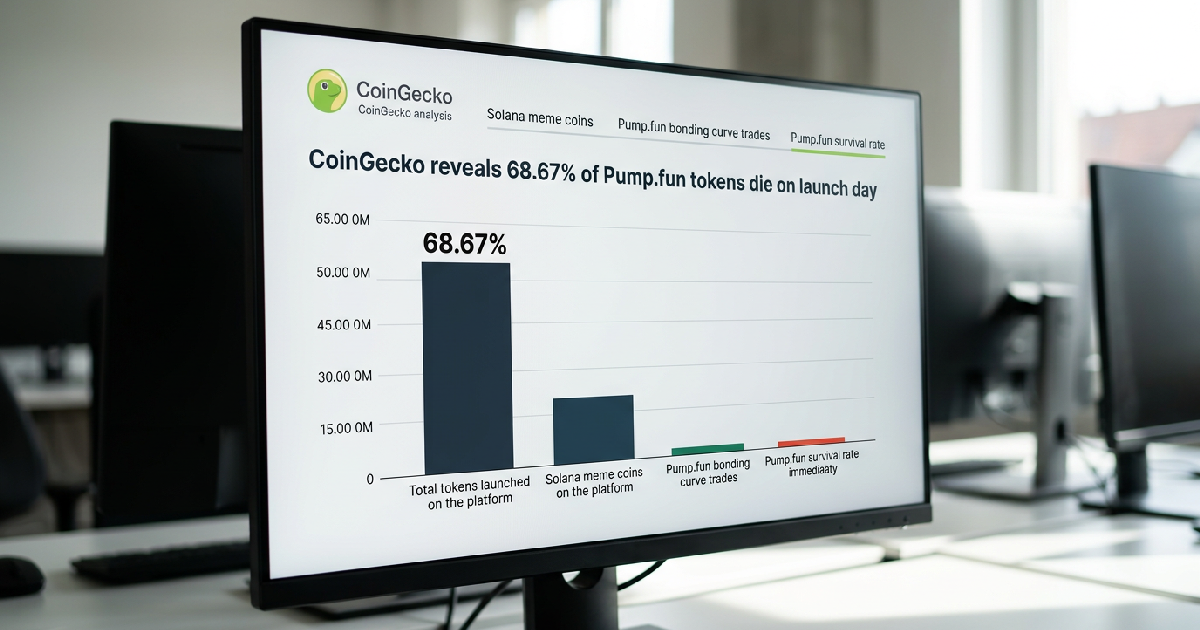
CoinGecko reveals 68.67% of Pump.fun tokens die on launch day
A comprehensive study by cryptocurrency data aggregator CoinGecko has revealed that 68.67% of tokens launched on the Solana-based platform Pump.fun cease trading on the same day they are created. This “launch-day death rate” underscores the extreme volatility within the meme coin ecosystem, where speculative interest often evaporates within hours of a project’s inception.
The analysis reviewed 18.67 million tokens launched between January 14, 2024, and June 18, 2026, finding that approximately 12.8 million assets recorded their final bonding-curve trade during their first 24 hours.
Massive mortality rates define Pump.fun token ecosystem
The findings illustrate the high risks facing retail participants on the Solana blockchain. CoinGecko attributes the high mortality rate to Pump.fun’s “near-zero barriers” for token creation, which allows users to deploy new coins for a fee of roughly 0.02 SOL.
Because the cost of entry is so low, creators often launch many projects in rapid succession, abandoning them if early demand does not materialize.
This data arrives at a difficult time for the broader meme coin market, with Dogecoin (DOGE) losing almost 25%, Shiba Inu (SHIB) down nearly 20%, and Pepe (PEPE) shedding over 27% in the month prior to the report.
The CoinGecko study provides a granular look at the lifespan of assets within the “token factory” environment. Researchers excluded tokens that never recorded a single trade to ensure the data accurately reflected active market interest. Beyond the 12.8 million tokens that died on day one, another 2.18 million survived only one additional day.
This means that 14.99 million tokens, or 80.37% of all reviewed launches, stopped trading within 48 hours of their creation.
Key details
Lifespan was measured by the number of calendar days between a token’s creation and its last recorded trade on the Pump.fun bonding curve. For the vast majority of these projects, interest is fleeting and tied to social media trends or early wallet activity.
While Brian Armstrong warns finance must move on-chain to stay relevant, the current state of memecoin launchpads highlights the chaotic nature of highly accessible decentralized finance. The attention-driven market ensures that once a token falls off the “trending” page, trading volume often disappears entirely.
Key details
Only a tiny fraction of tokens on Pump.fun achieve what could be considered longevity. According to the data, 850,180 tokens, or roughly 4.55%, lasted more than 90 days.
While this figure may be slightly understated because it does not track activity on external exchanges after a token completes its bonding curve, it remains a staggering minority of the 18.67 million tokens reviewed. The statistic reinforces the high-stakes nature of participating in fresh meme coin launches.
The report underscores that Pump.fun operates as a high-velocity environment where volume and attention are the primary metrics. With millions of tokens launched in just over two years, the competition for capital is intense.
As the broader market faces corrections—such as the double-digit losses recently seen in PEPE and SHIB—investors are becoming increasingly wary of projects with no utility. The massive failure rates shown in the CoinGecko study serve as a stark reminder of the mathematical odds involved in the meme coin factory.
Methodology behind the CoinGecko Solana study
To produce these figures, CoinGecko utilized Dune Analytics to query the `tokens_solana.transfers` table. They specifically filtered for minting actions associated with the Pump.fun program address on the Solana blockchain. By cross-referencing these with the `pumpdotfun_solana.pump_evt_tradeevent` data, researchers established the exact timestamp of the final trade for each asset.
The study period of January 2024 to June 2026 captured the peak of the recent meme coin mania.
The platform itself has become a major revenue generator, according to broader research, accumulating over $800 million in cumulative fees. It earns through a 1% trading fee on its bonding curves and a graduation fee when a token moves to an external exchange.
While the financial success of the platform is clear, the CoinGecko data suggests that the vast majority of its “products” are transient, existing primarily as tools for short-term speculation rather than enduring digital assets.