

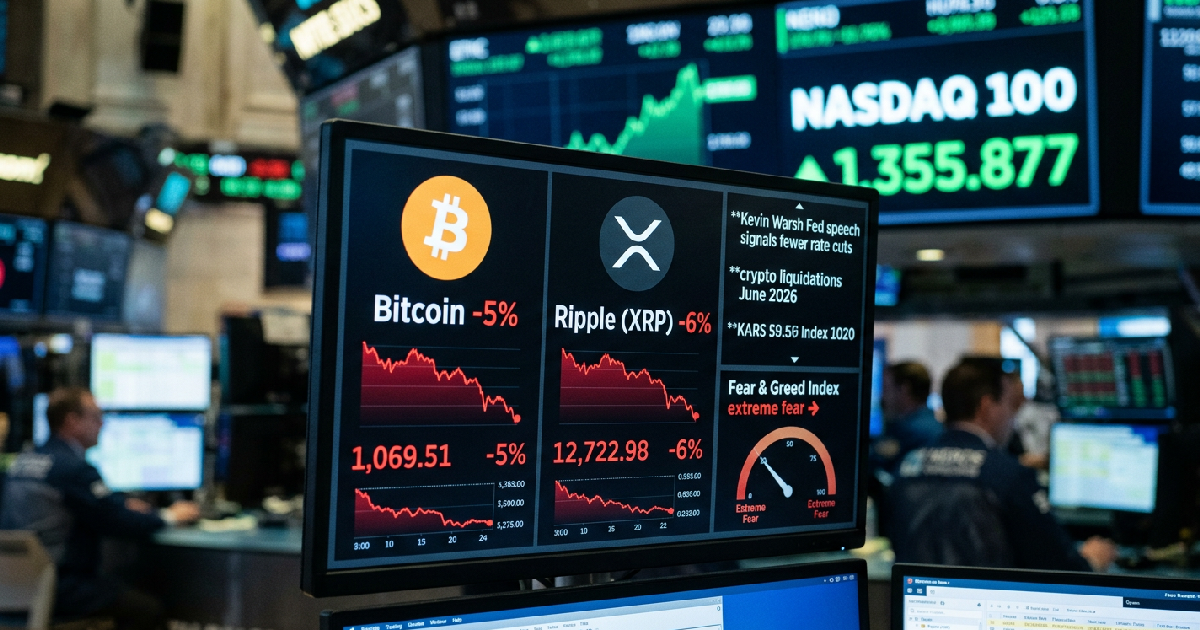
Bitcoin, Ripple prices fall as Kevin Warsh’s Fed signals fewer rate cuts
Ripple and Bitcoin prices retreated sharply on Thursday afternoon, June 18, 2026, as the digital asset market underwent a “risk-off” transition following hawkish signals from the Federal Reserve. Ripple (XRP) dropped 6% over a 24-hour period to approximately $1.14, while Bitcoin (BTC) fell 5% to settle around $62,500.
This downturn occurred despite a rally in U.S. equities, reflecting a stark divergence between traditional stocks and cryptocurrencies.
The sudden selloff triggered over $200 million in crypto long liquidations within a four-hour window, accelerating the market’s decline. This downward momentum caused the total cryptocurrency market capitalization to ease to about $2.15 trillion, a level analysts identify as being near a yearly-low technical floor.
While digital assets absorbed a fresh wave of selling, the NASDAQ 100 traded 2.4% higher, buoyed by tech stock strength that failed to support the crypto sector.
Market sentiment has shifted rapidly, with the Crypto Fear & Greed Index hitting 19, signaling “extreme fear” among investors. The pullback followed weeks of instability, but Thursday’s price action represented the cleanest sector-wide flush in recent history. The 10-year Treasury yield, currently at 4.
43%, continues to sit at the upper end of its 12-month range, maintaining pressure on high-risk speculative assets like Bitcoin and Ethereum.
Federal Reserve policy shift serves as catalyst
The primary driver for the pullback appears to be the Federal Open Market Committee (FOMC) meeting concluded on Wednesday, June 17, 2026. This session was the first led by the new Federal Reserve Chairman Kevin Warsh. During the meeting, the Fed held its policy rate steady at 3.75% but delivered a more hawkish outlook than markets had anticipated.
In his inaugural speech, Chairman Kevin Warsh suggested that hopes for an “easy money” leadership would not come to fruition. The Fed signaled fewer rate cuts on the horizon, leading to a stronger U.S. dollar. This policy shift reduced the appetite for non-yielding risk assets, hitting digital tokens harder than traditional stocks.
The 10-year minus 2-year spread also compressed to 0.29%, marking a 12-month low and hinting at broader macro uncertainty.
Ripple slides below key technical support
Ripple (XRP) experienced significant volatility as it fell 6% to roughly $1.14 by Thursday afternoon. During the slide, the token dropped below a key support level at $1.20 and recorded a 1.6% decline on the day. This move marked a sharp risk-off turn for the token, which had previously been caught in the broader market’s attempt to find stable footing.
Ethereum also joined the downward trend, sliding just over 1% in the past 24 hours to fall below the $1,750 mark. Historical data shows that Ethereum whales accumulate large portions of the supply during various market cycles, but the current hawkish environment has dampened short-term sentiment across all major altcoins.
Bitcoin liquidations and market dominance
Bitcoin’s price movement was particularly volatile on the morning of June 18, 2026. The leading digital currency dropped to $63,600 earlier in the day, a move that left over $400 million in liquidations in its wake. BTC slid by over $2,000 from top to bottom before finding support. By Thursday afternoon, it had recovered to over $64,000 but remained 1% down on the day.
The market capitalization for Bitcoin has declined to $1.290 trillion following the recent price action. Additionally, Bitcoin is struggling to remain above 56% dominance over altcoins on CoinGecko. This struggle for dominance comes despite earlier gains this month, such as on June 14, when President Donald Trump promised a deal with Iran, briefly sending Bitcoin to $67,200 before those gains evaporated.
As digital assets navigate this new interest rate environment, the total market cap’s position near its yearly-low floor of $2.15 trillion remains a critical point for technical observers. With the VIX at 16.68, equity volatility remains within a normal range, further highlighting the unique pressure currently facing the cryptocurrency sector compared to the broader financial market.