

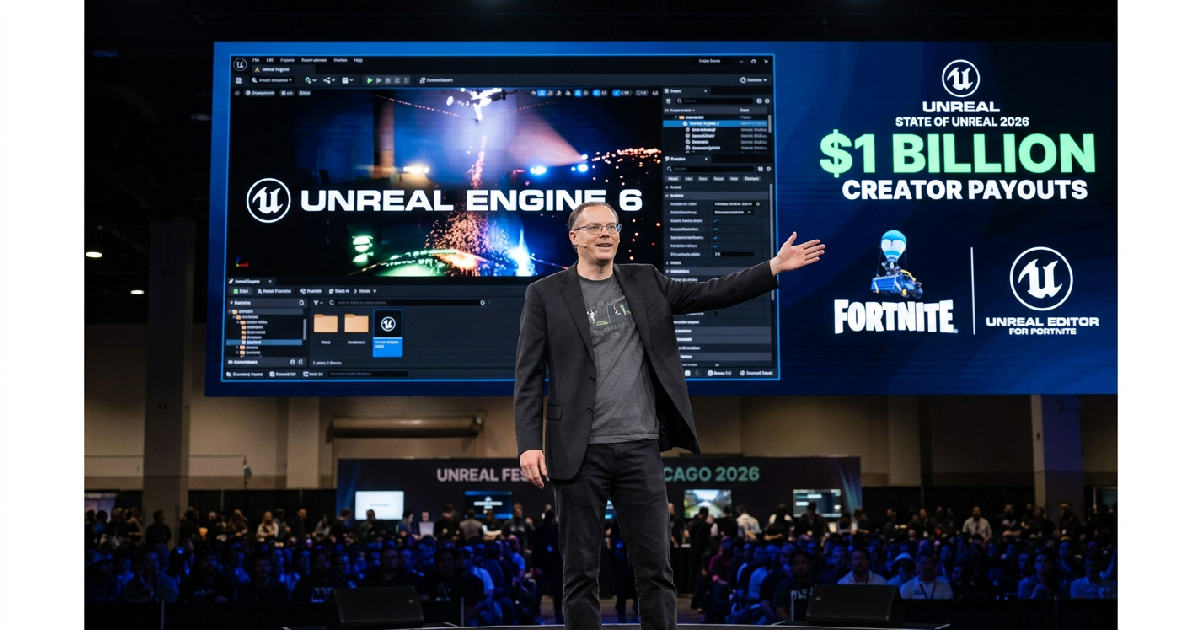
Epic Games unveils Unreal Engine 6, pays creators $1 billion
Epic Games officially unveiled Unreal Engine 6 and released Unreal Engine 5.8 during the State of Unreal keynote at Unreal Fest Chicago on June 17, 2026.
The tech giant announced that its next-generation engine, targeting an early access launch by the end of 2027, will leverage a development pipeline refined within Fortnite to support massive-scale live experiences.
Alongside these technical milestones, the company confirmed it has paid out over $1 billion to creators using the Unreal Editor for Fortnite (UEFN) since its inception.
The announcement at McCormick Place marks a shift for the company toward structural interoperability across different gaming ecosystems. Unreal Engine 6 aims to allow developers to build a game once and deploy it across traditional consoles, Fortnite, or their own live multi-product environments.
By moving the gameplay programming model to Verse, the engine seeks to “transactionalize” C++, making it easier for thousands of contributors to work on single persistent worlds without the stability bottlenecks of legacy systems.
While the industry looks toward the next decade of development, many studios remain focused on immediate pipelines. For those managing complex digital assets, Epic is addressing collaborative friction by launching Lore.
This new open-source version control system is designed specifically to handle the massive binary datasets common in modern production, offering a high-performance alternative to existing proprietary solutions. Much like how supply chain resiliency increasingly prioritised over cost has become a theme in global logistics, Epic is prioritizing the reliability of its development infrastructure.
Unreal Engine 6 targets cross-platform interoperability
The core of the Unreal Engine 6 initiative is the “convergence” of AAA tools with the flexibility of live-service platforms. The engine will move away from the traditional Actor and Blueprint systems that have defined the software for years. Instead, it will gradually transition to “Scene Graph” entities and an “Entity Component System” (ECS).
This architectural change is expected to solve long-standing performance and inheritance limitations in games featuring thousands of interactive objects.
Verse will become the primary scripting language for the new engine, offering a more accessible entry point for contributors while remaining robust enough for persistent, large-scale experiences. However, this transition may not be seamless for every studio.
Migration from Unreal Engine 5 to Unreal Engine 6 will likely be more challenging than the previous jump from version 4 to 5 because of deep-lying revisions to the material pipeline and coordinate systems. Rocket League is expected to be the first flagship title to transition to the new engine.
Three pillars of the next-generation pipeline
- Verse Programming Model: Transitioning to Verse to allow thousands of developers to contribute to persistent, live environments simultaneously.
- Economic Portability: Enabling content, code, and economies to move freely between games and engines through open standards.
- AI Productivity Multipliers: Integrating a Model Context Protocol (MCP) allowing models like Claude and Gemini to act as active collaborators in the workflow.
Unreal Engine 5.8 focuses on mobile and AI performance
While the next generation is in development, Unreal Engine 5.8 is available for download today. Epic Games identified this as the “last planned major release” for the 5.x cycle, though it retains the option for a 5.9 if needed. A primary highlight is the optimization of the Lumen global illumination system.
It now supports 60 frames per second on the Nintendo Switch 2 and PCs, bringing high-end dynamic lighting to diverse hardware profiles.
The 5.8 update also introduces the Experimental Model Context Protocol plugin. This tool allows developers to connect AI models directly to their projects to understand and operate within specific Unreal Engine workflows. This could assist with automated asset creation, testing, and optimization. As com/international-news/ubs-khan-china-business-ai-impact-analysis-2026/”>AI as the biggest transformation continues to reshape professional landscapes globally, these tools represent a move toward AI as a collaborator rather than a simple copy-paste assistant.
New authoring tools and production-ready features
Several formerly experimental tools have reached “Production Ready” status in version 5.8. Developers can now fully utilize MegaLights, Audio Insights, Dataflow for Chaos Cloth, and the Movie Render Graph. The update also includes Mesh Terrain, a system for authoring complex 3D landscapes—including overhangs and tunnels—without the rigid limitations of traditional heightfields. Shader compilation has also been optimized, which helped cut Fortnite’s shader count by 68%.
Fortnite creator payouts and IP expansions
The financial health of the Fortnite ecosystem was a major talking point during the Chicago event. Epic Games revealed that creator payouts have surpassed $1 billion since UEFN launched. This surge in revenue for independent developers coincides with the return of Fortnite to mobile storefronts like Google Play and the App Store. Mobile playtime in user-created islands has more than doubled over the past year.
To keep this momentum, several updates are coming to the Fortnite platform. A full redesign of the Discover interface will replace the lobby as the first thing players see, featuring video previews and social signals. New intellectual property is also coming to the ecosystem.
Following the success of Star Wars content in May, The Simpsons will arrive soon. This will provide developers with an official toolkit to build experiences featuring iconic characters and locations from Springfield.
Epic Games Store growth and launcher overhaul
The Epic Games Store has grown to host more than 6,000 games from 3,000 partners. Player spending on third-party PC games reached an all-time high of $400 million in 2025, which reflects a 57% increase. To maintain this growth, the company is undertaking a complete rebuild of the launcher and storefront backend.
This overhaul is intended to make the store faster and allow for more frequent feature updates through 2026 and 2027.
A new integration strategy will link the store more closely to Fortnite. Players who buy specific partner games on the Epic Games Store will now be granted cosmetic items from that IP for use within Fortnite. Over 30 of these collaborations are planned for 2026.
This move reinforces the goal of creating a “multi-product ecosystem” where digital identities carry across different games. While studios look to these tools, the industry is also preparing for major releases; for example, Strauss Zelnick confirms Grand Theft Auto 6 release date for November 2026, setting a high bar for current-gen performance.