

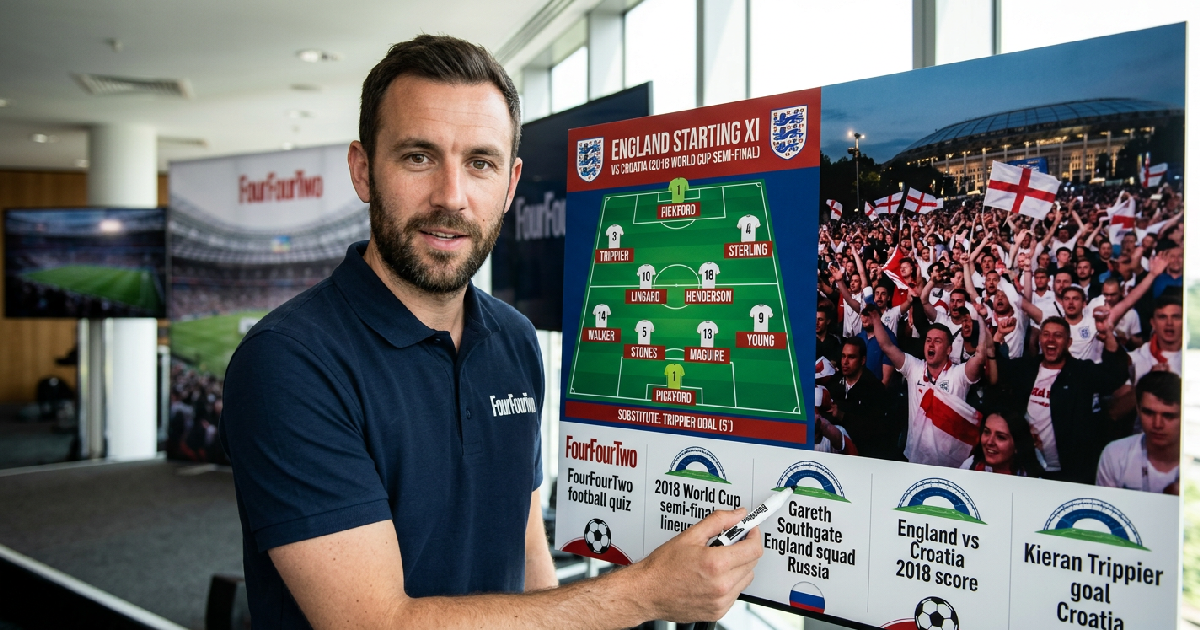
Chris Nee challenges fans to recall England’s 2018 World Cup final four starting XI
FourFourTwo author Chris Nee has released a new retrospective football challenge tasking fans with naming the England starting XI from the 2018 World Cup semi-final against Croatia.
The match, held on July 11, 2018, at the Luzhniki Stadium in Moscow, remains a pivotal moment in English football history as it marked the national team’s first appearance in a World Cup semi-final for 28 years.
Although the game ended in a 2-1 defeat for the Three Lions after extra time, the squad remains highly regarded for its unexpected run through the tournament in Russia.
The 2018 squad brought together one of the youngest groups of players in the competition, with manager Gareth Southgate selecting a roster that featured only five players with prior World Cup experience.
The semi-final itself began with significant optimism as Kieran Trippier scored a direct free-kick in the 5th minute to give England an early lead. However, Croatia equalised through Ivan Perišić in the 68th minute before Mario Mandžukić secured the winning goal in the 109th minute.
This quiz serves as a bridge for fans looking back at the 2018 era while preparing for the 2026 FIFA World Cup, where 48 nations are set to compete. Discussions around the legacy of this squad are common, as seen in recent debates on the com/sport-news/fox-sports-reveals-2026-fifa-world-cup-punditry-panel-with-zlatan-ibrahimovic/”>Fox Sports 2026 World Cup punditry panel featuring Zlatan Ibrahimovic. The 2018 match was broadcast in the UK on ITV and concluded with Croatia becoming the first team in World Cup history to secure three consecutive come-from-behind victories, all involving extra time.
The starting XI Gareth Southgate named against Croatia
The starting lineup chosen by Southgate for the clash in Moscow focused on a defensive foundation that allowed for creative output from the flanks. Captain Harry Kane led the attack, supported by Raheem Sterling, while the midfield trio was tasked with containing a technical Croatian side. Fans attempting the FourFourTwo challenge will need to recall the following confirmed starting eleven:
- Goalkeeper: Jordan Pickford
- Defenders: Kyle Walker, John Stones, Harry Maguire
- Wing-backs: Kieran Trippier, Ashley Young
- Midfielders: Jesse Lingard, Jordan Henderson, Dele Alli
- Forwards: Raheem Sterling, Harry Kane (Captain)
As the match progressed into the latter stages, Southgate utilised several substitutions to freshen his side. Marcus Rashford replaced Sterling in the 74th minute, while Eric Dier was introduced for Jordan Henderson in the 97th minute of extra time.
Danny Rose took the place of Ashley Young at the start of the additional period, and Jamie Vardy was the final introduction, replacing Kyle Walker in the 112th minute as England chased an equaliser.
Historical context of the Moscow semi-final
Croatia’s victory at the Luzhniki Stadium moved them into their first-ever World Cup final, where they ultimately lost to France. The match highlighted the durability of the Croatian veterans who managed to overturn a deficit for the third time in the knockout stages. For England, the tournament helped rebuild the connection between the team and its supporters, despite the immediate heartbreak of the Moscow result.
The digital archiving of these matches offers a way for fans to maintain these memories as the sports industry evolves. Much like the logistics of global sports events, the way football data is consumed has become increasingly digitised. The FourFourTwo quiz reflects this shift, allowing fans to test their knowledge against a clock and share their results within the football community.
Looking back, the 2018 semi-final remains the most significant competitive meeting between England and Croatia. It stood as a test of Southgate’s youth-oriented philosophy and remains a primary reference point for modern Three Lions squads. While the squad failed to reach the final, their performance in Russia established a new baseline for English expectations on the international stage.