

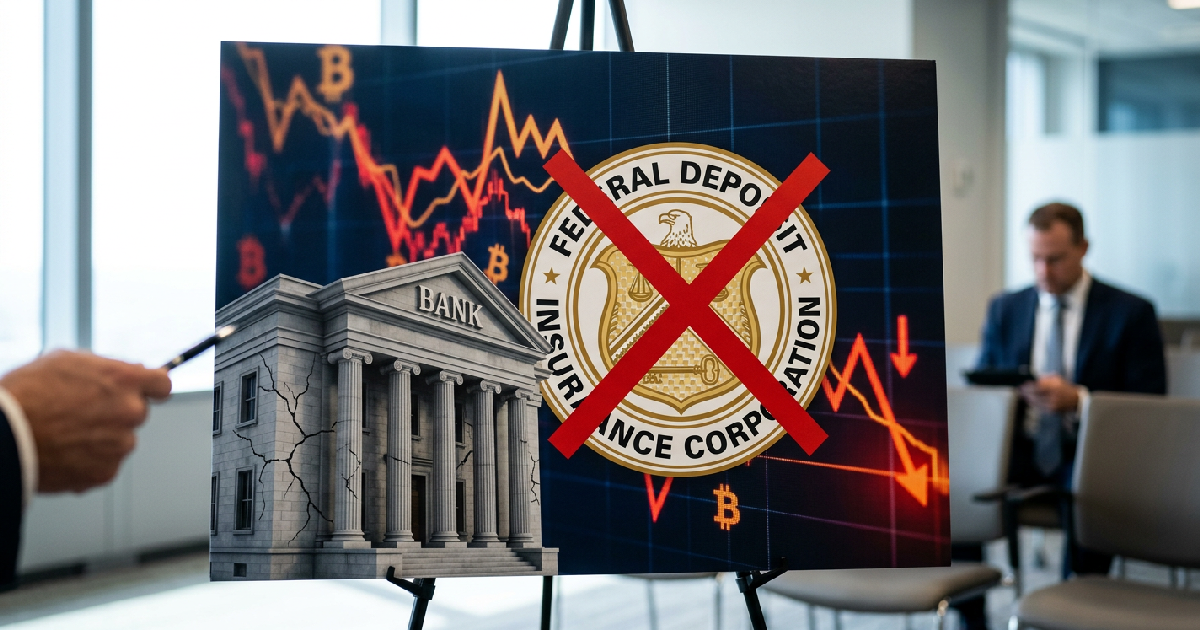
U.S. Government Accountability Office warns banking regulator on digital asset risks
The U.S. Government Accountability Office (GAO) has formally pressured the Federal Deposit Insurance Corporation (FDIC) to address glaring deficiencies in its oversight of the crypto asset sector.
In a report published on June 16, 2026, the federal watchdog warned that current regulatory gaps leave the American banking system vulnerable to the unique volatility and contagion risks associated with digital currencies.
The GAO report demands that the FDIC establish clearer guidelines for how traditional banks interact with crypto firms to prevent a repeat of recent financial instabilities.
The timing of this intervention is particularly sharp. Despite several high-profile bank failures in recent years linked to digital asset exposure, the GAO argues that the FDIC has failed to provide a comprehensive framework. This lack of clarity reportedly leaves both examiners and financial institutions guessing about the boundaries of safe operations.
As the Bitcoin drops to $72,868 on $733 million institutional outflow demonstrate, the market remains highly reactive, making the need for stable regulatory footing more urgent than ever.
And while the FDIC has issued some guidance through financial institution letters, the GAO contends these are insufficient. The watchdog specifically pointed to the “crypto-asset risk” that was exacerbated during the 2023 banking crisis. It argues that without a formal, codified approach, the agency’s ability to monitor risk is reactive rather than proactive.
This critique comes at a time when major institutional players are deeper into the ecosystem than ever.
Watchdog identifies regulatory blind spots in FDIC protocols
The GAO investigation revealed that the FDIC lacks a streamlined process for reviewing the crypto-related activities of the banks it supervises. Currently, banks are required to notify the FDIC if they intend to engage in crypto activities, but the GAO found that the subsequent “no-objection” process is inconsistent. This creates a bottleneck that hampers innovation while simultaneously failing to mitigate systemic risk.
Inconsistency in bank examination procedures
According to the report, FDIC examiners don’t have a standardized toolkit to evaluate the quality of a bank’s crypto custody services or its exposure to stablecoin issuers. This leads to a patchwork of enforcement where two banks with similar risk profiles might be treated differently based on which regional office handles their supervision.
The GAO has called for a mandatory update to the FDIC Manual of Examination Policies to include specific modules for digital assets.
Risks of deposit insurance misrepresentation
Another area of focus for the GAO is the “prevalent” misrepresentation of FDIC insurance by non-bank crypto firms. These companies often suggest to customers that their digital holdings are federally insured, which is factually incorrect.
The GAO warns that if the FDIC doesn’t step up its enforcement against these deceptive practices, it risks a massive loss of public trust when a platform eventually collapses and users find their funds are not protected.
Implications for the broader financial sector
The pressure on the FDIC is part of a larger trend of federal agencies grappling with the “biggest transformation” of their roles. Just as com/international-news/ubs-khan-china-business-ai-impact-analysis-2026/”>UBS Asia President Iqbal Khan views AI as a major shift for banking jobs, the integration of blockchain into the financial core is forcing regulators to rethink their staffing and expertise. The GAO noted that the FDIC is currently understaffed in terms of specialists who actually understand smart contracts or decentralized finance (DeFi) protocols.
This lack of expertise means the agency is often playing catch-up. For the crypto industry, the GAO’s demand for more rigorous oversight is a double-edged sword. On one hand, clearer rules provide the “regulatory certainty” that large financial institutions crave before committing more capital.
On the other hand, the GAO is pushing for a more restrictive environment that could make it harder for small banks to compete in the digital space.
The political dimensions cannot be ignored either. The GAO report arrives as the influence of the sector grows in Washington. We have recently seen how political shifts occur, such as when Christian D. Menefee unseated Al Green following a significant surge in crypto-backed political action committee spending. This political pressure often conflicts with the sober, risk-averse mandates of federal watchdogs like the GAO.
Future steps for the FDIC and industry stakeholders
The FDIC now has a limited window to respond to the GAO recommendations. It is expected that the agency will have to develop a more transparent timeline for banks seeking to enter the crypto space. This would involve moving away from the “regulation by enforcement” model that has characterized much of the U.S. approach to date and moving toward a more structured application process.
But the agency faces internal hurdles. Rewriting examination manuals and hiring high-level blockchain analysts takes time and significant budget allocations. Industry experts suggest that the FDIC might look to coordinate more closely with the Office of the Comptroller of the Currency (OCC) to create a unified federal front, rather than continuing to operate in a silo.
For investors and bank customers, the GAO’s push serves as a reminder that the safety net of the traditional banking system does not naturally extend to the world of tokens and coins. If the FDIC follows the GAO’s roadmap, we can expect a tighter leash on how banks manage liquidity when dealing with crypto clients.
This could lead to higher fees for crypto businesses using traditional banks, but it should also lower the risk of a contagion-driven bank run.