

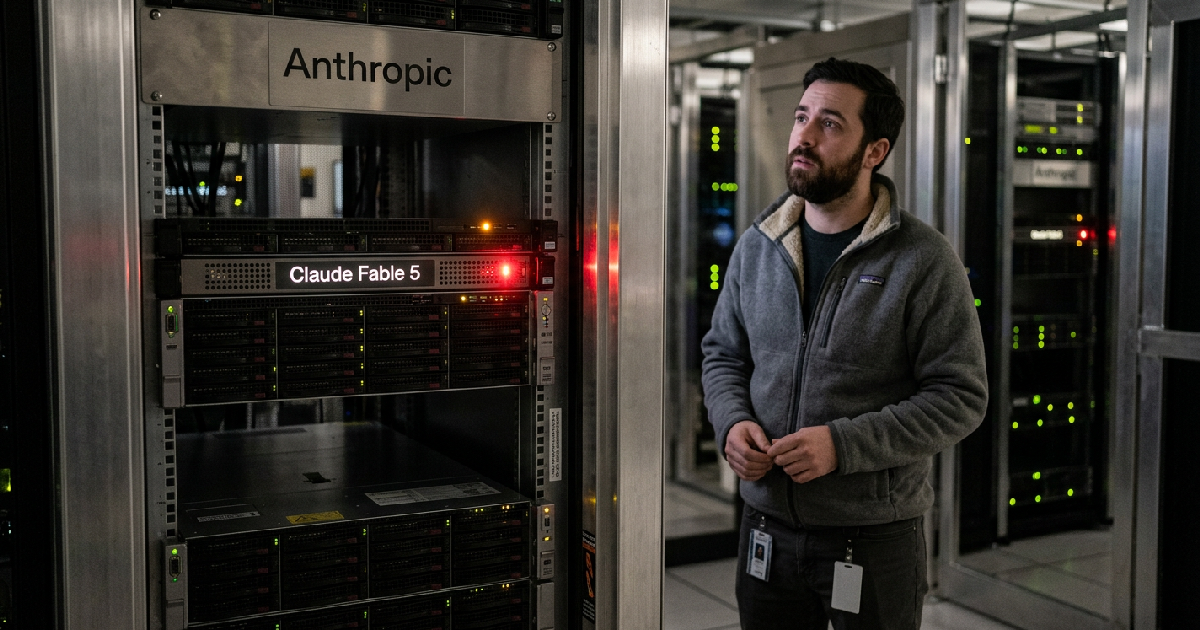
Anthropic disables Claude Fable 5 models over US export control order
Anthropic will abruptly disable its most sophisticated artificial intelligence models, including the newly released Claude Fable 5, after receiving a U.S. government export control directive. The order, confirmed by an official on Saturday, June 13, 2026, requires the company to suspend access for foreign nationals to its Fable 5 and Mythos 5 models.
Anthropic stated it must now disable these specific models for all customers to ensure compliance with the mandate. This development comes as the company prepares for an initial public offering (IPO), having filed confidentially last month.
The government’s intervention stems from concerns that safeguards on these high-tier models can be bypassed. Anthropic, an AI firm that has positioned itself as a safety-conscious developer, said it was told the government believes there is a potential “jailbreak” method. This technique could allow Fable 5 to be used for identifying software vulnerabilities.
While Anthropic acknowledged receiving verbal evidence of a “narrow, non-universal” vulnerability, it has publicly disagreed that such a finding justifies recalling a commercial model.
The directive represents a shift in how Washington manages the risks of advanced computing. Traditionally, export controls have focused on physical hardware such as semiconductors and manufacturing tools. This move targets the software capabilities themselves, highlighting concerns that “Mythos-class” intelligence could accelerate cyber-attacks.
Experts suggest that sectors like banking, which rely on interconnected legacy systems, are particularly at risk if such AI tools are misused by foreign adversaries.
National security concerns over software vulnerability identification
The U.S. Department of Commerce issued the directive based on the potential for jailbroken models to unearth bugs in critical code. Anthropic noted that similar capabilities exist in rival AI models and that its own tools include guardrails specifically designed to bar cybersecurity misuse. However, the government believes these protections are insufficient.
This tension reflects a broader geopolitical environment where supply chain resiliency increasingly prioritised over open market access.
The Pentagon has stood firmly behind the decision to limit access. Kirsten Davies, the Department of Defense’s chief information officer, indicated that national security interests must outweigh commercial milestones. In a post on X, Davies said that “America First” priorities should take precedence over revenue cycles and pre-IPO valuations.
This hardline stance suggests that the government is willing to disrupt the business models of leading domestic tech firms to prevent foreign technological gains.
Technical risks of Mythos-class AI models
Fable 5, which launched earlier this week, introduced what Anthropic calls “Mythos-class” capabilities. This tier of reasoning is powerful enough that experts fear it could be used to map out vulnerabilities in sensitive infrastructure. The potential for AI to disrupt global finance is a growing concern for leadership. For example, com/international-news/ubs-khan-china-business-ai-impact-analysis-2026/”>UBS Asia President Iqbal Khan views AI as a massive transformation for the sector, but the same tools could pose a high-stakes threat if unsecured.
Anthropic stated that it had worked with the government on safety measures prior to the launch of Fable 5. Despite these efforts, some users had already complained that the model’s guardrails were “overly broad.” The company expressed a desire for clearer regulatory frameworks, having called for greater U.0.S. oversight as recently as Wednesday.
However, it maintained that the current abrupt order did not follow principles of fair and fact-based regulation.
Strained relations with the Trump administration
The export control order follows a significant rupture in the relationship between Anthropic and the government earlier this year. The friction began after the company refused to allow the U.S. military to use its AI models for domestic surveillance and fully autonomous weapons systems.
In response, the government placed Anthropic on a supply chain blacklist, which is scheduled to take effect later in the year. This latest move to disable Fable 5 suggests an escalation of that conflict.
The timing of the directive is particularly challenging for Anthropic as it seeks to outpace OpenAI in the race to public markets. By forcing a shutdown of the company’s most advanced offerings, the commerce department has hit Anthropic’s competitive edge.
Legal battles over such directives are common in international trade, much like how the United States Department of Justice appeals judicial directive decisions in other regulatory arenas. Anthropic said it believes there is a misunderstanding and is seeking to restore access.
For now, only Fable 5 and Mythos 5 are affected by the shutdown. Anthropic confirmed that access to its other AI models will not be interrupted. The company has not provided a timeline for when its most advanced technology might be back online.
It maintains that the model in question was intended to be deployed to hundreds of millions of people before the government order forced its removal from the market.