

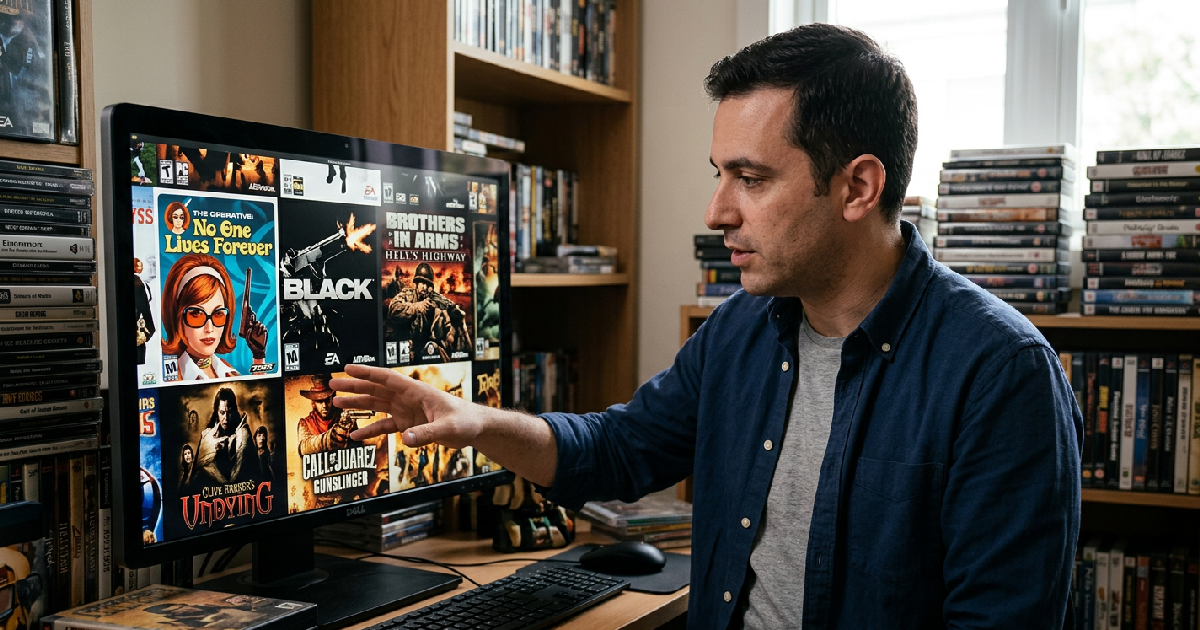
Mark Sammut reveals 15% of worthwhile projects are overlooked masterpieces
Mark Sammut, the lead editor of Evergreen gaming lists at GameRant, published a curated selection of criminally overlooked FPS masterpieces on June 11, 2026, targeting titles that have unfairly faded from public view. Sammut asserts that even the most exhaustive players likely experience only about 15% of the worthwhile projects released over the decades.
This leaves countless high-quality “AA” releases from the late 2000s and early 2010s buried under modern titles or lost to digital delisting. The analysis identifies games like Monolith Productions’ The Operative: No One Lives Forever and Criterion Games’ Black as essential benchmarks that modern audiences should revisit.
The first-person shooter market is notoriously crowded, particularly on PC, where only a few titles manage to break through the noise annually. While massive franchises maintain their grip on the spotlight, many creative mid-tier projects are quickly forgotten or replaced by the newest releases. For players currently browsing the com/game-news/xbox-deals-unlocked-sale-2026-slashes-prices-on-over-1-800-g/”>Xbox Deals Unlocked Sale 2026, these older gems offer a level of mechanical risk-taking that is increasingly rare today. Sammut notes that older FPS titles have aged better than most other genres, making them ideal candidates for a backlog clear-out.
Most of these “lost” masterpieces fall into three categories of neglect: they are digitally delisted, overshadowed by other popular entries in their own franchise, or were mislabeled as “bad” games during their initial launch.
Whether caught in licensing limbo or launching on the eve of hardware obsolescence, these titles represent a significant portion of gaming history that is becoming harder to access. Sammut argues that the charm and technical ambition of these projects still resonate in 2026.
The vanishing legacy of No One Lives Forever
The Operative: No One Lives Forever, released on November 9, 2000, by Monolith Productions, is perhaps the most famous case of a “lost” masterpiece. A 1960s spy thriller that blends FPS action with stealth mechanics, it parodies James Bond films and period spy shows with sharp, hilarious writing.
Players control Cate Archer, using eccentric gadgets like lipstick explosives and lock-pick hairpins to navigate meticulously designed missions. The game and its 2002 sequel, No One Lives Forever 2: A Spy in H.A.R.M.’s Way, are celebrated for their mission variety and aesthetic charm.
But despite their pedigree, both titles are stuck in “publisher hell” and have been delisted for longer than they were ever available for purchase. The intellectual property is trapped in a licensing limbo involving multiple publishers, making a legal remaster or digital re-release virtually impossible.
This stalemate effectively retired Cate Archer from the gaming pantheon, despite her once standing alongside icons like Lara Croft as one of the best female protagonists in the medium. In 2026, the only way to experience these games legally is through original PS2 physical copies or dusty PC discs.
Black and the limit of legacy hardware
Criterion Games’ 2006 title Black occupies a different niche of the overlooked. Released at the very end of the PlayStation 2 and original Xbox life cycle, it pushed that hardware to limits that seemed impossible at the time.
The game focused on visceral “gun porn” aesthetics and environmental destruction that caught players by surprise long before the Battlefield series popularized the concept. It was designed to let players “turn off your brain in the best way possible,” delivering non-stop action through a single-player campaign that lasted roughly six hours.
And while the game was a technical marvel, it lacked multiplayer and arrived just as the industry shifted its attention toward the Xbox 360 and PlayStation 3. In 2026, the graphics may not seem as revolutionary as they did 20 years ago, but the intensity of the set pieces remains impressive.
It was a blockbuster title that arrived at the wrong time, ensuring it never reached the legendary status of its contemporaries despite its “absurdly impressive” production values.
Reviving tactical grit in Brothers in Arms
Gearbox Software’s Brothers in Arms: Hell’s Highway, released in 2008, represents the last true entry in a legendary World War II trilogy. Unlike the “Rambo-style” approach of many modern military shooters, Hell’s Highway focuses on authentic military tactics, requiring players to lead a squad rather than act as a lone wolf.
A run-and-gun approach results in immediate death, forcing a reliance on suppression and flanking. The game also explored heavy narrative themes, including survivor’s guilt and PTSD, which were uncommon in the genre at the time.
The series has been largely dormant for over a decade, receiving only mobile titles and a pinball spin-off. There has been no news of a proper new entry in at least five years, making the 2008 title the series’ definitive peak. For gamers waiting on the com/game-news/gta-6-release-date-confirmed-take-two-nov-2026-update/”>November 2026 Grand Theft Auto 6 release, these grounded tactical experiences provide a stark contrast to high-octane open-world chaos. Hell’s Highway remains the most playable entry in the trilogy for modern audiences due to Its sim-style mechanics.
Supernatural shooters and Old West adventures
Horror fans often look back at Clive Barker’s Undying as a benchmark for atmosphere. Released in 2001 and partially produced by the legendary horror writer, the game is set on the fictional Covenant estate.
It used the first iteration of the Unreal Engine to create an eerie, terrifying atmosphere that many modern titles struggle to replicate. Players learned about the estate’s dark origins while balancing traditional firearms with mystical spells and supernatural weapons like the “Tibetan War Cannon,” which shoots ice balls from a dragon-shaped barrel.
Techland’s Call of Juarez: Gunslinger also stands out for its unique presentation of the Old West. Before the developer became famous for Dead Island and Dying Light, they crafted this fast-paced arcade shooter that focused on frontier myths and bullet-time gunplay.
Unlike the somber tone of previous entries in the series, Gunslinger prioritized fun and “old-timey shooting irons.” It remains a masterpiece of presentation that doesn’t take itself too seriously while delivering some of the most satisfying gunplay of its era.
Overshadowed gems and cult classics
Raven Software’s Wolfenstein (2009) is a prime example of a game overshadowed by a successful reboot. While MachineGames’ 2014 revival became the standard for the franchise, the 2009 version stayed closer to the series’ supernatural roots.
It featured an eclectic roster of upgradeable weapons and magical abilities that set it apart from the more grounded sequels. Similarly, The Darkness 2, developed by Digital Extremes, is often considered superior to the original due to its fast-paced combat and cel-shaded graphics that captured the feel of the source material.
As the industry moves toward live-service models, these standalone titles risk being lost to history. If players are waiting for the June 2 Major in Cologne to see the latest in esports, taking time to clear a backlog of these historical landmarks can offer a refreshing perspective.
Other notable mentions in this category include High Moon Studios’ Darkwatch, which combined vampires with an Old West setting, and People Can Fly’s Bulletstorm, which focused on creative, point-based kills.
A checklist of overlooked FPS titles
- Darkwatch: Fast and frantic vampire-hunting in a supernatural Western setting.
- Bulletstorm: An aggressive shooter that rewards creative and stylish environmental kills.
- System Shock 2: A pioneer of the “immersive sim” genre and spiritual predecessor to Bioshock.
- Shadow Warrior (2013): A reboot that transitions from a joke-heavy opening to a dark, bittersweet narrative.
- Wolfenstein (2009): A supernatural-heavy take on the Nazi-fighting franchise with upgradeable magic.