

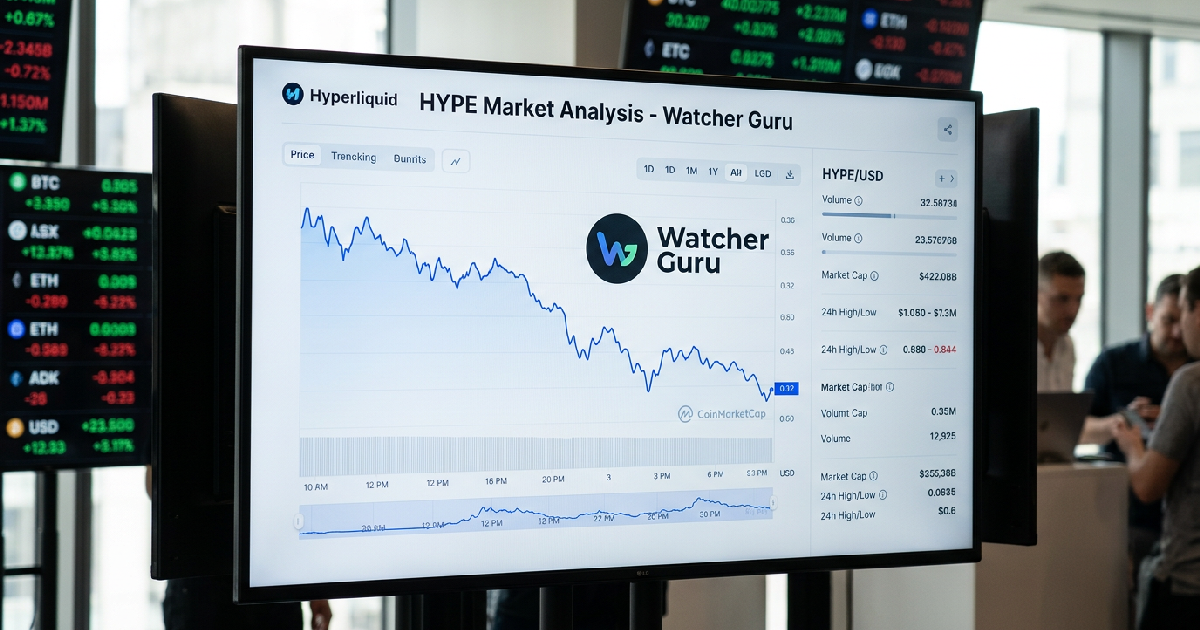
Watcher Guru warns Hyperliquid unlikely reliable crypto protection despite 60% market share
Hyperliquid (HYPE) is unlikely to serve as a reliable crypto hedge despite its recent price surge and dominant market position, according to a recent analysis from Watcher Guru.
While the decentralized exchange (DEX) founded by CEO Jeff Yan and the pseudonymous “iliensinc” has captured over 60% of the decentralized perpetual contracts market, analysts warn its high correlation with the broader digital asset sector makes it a poor defensive play.
The native token reached an all-time high price of $75.48 on June 2, 2026, but the rally has not convinced market observers that it can decouple from the systemic risks of the cryptocurrency industry. Data as of June 9, 2026, shows HYPE trading at approximately $61.95 on CoinMarketCap.
The asset remains subject to the same price fluctuations as Bitcoin (BTC) during periods of geopolitical tension and macroeconomic uncertainty.
While some professional traders use the platform’s 24/7 access to trade digital assets, commodities, and equity indices, this utility does not grant it “hedge” status. For an asset to function as such, it must typically show stability when the rest of the market falls. Instead, HYPE persists as a high-risk investment. Watcher Guru maintains that gold remains the only hedge with a proven track record.
Market performance and the reality of the HYPE retreat
The market capitalization for HYPE varies across providers, with CoinMarketCap reporting $15,718,758,038 and Kraken listing it at $13,771,813,602 as of June 9. Trading volume also shows wide disparity between platforms. While CoinMarketCap recorded 24-hour volume at $936,518,713, Robinhood reported a much higher figure of $19.32 billion for the same period.
The token’s circulating supply is currently reported as 253,755,203 HYPE by Coinbase, whereas CoinGecko places the figure at 220 million tokens. These supply figures support a community that now exceeds 200,000 users. However, even with strong adoption, the token remains exposed to broader market liquidations. We have previously seen how bitcoin price drops can liquidate millions in contracts, and Hyperliquid’s leveraged environment is not immune.
The platform’s futures open interest stood at $8,881,372,324.57 according to CoinGecko’s June 9 data. This concentration of leverage can exacerbate price swings during a sell-off. If the broader market dips, the forced closing of these positions often leads to a cascade that drags the platform’s native token down regardless of its technical utility.
Dominating the decentralized perpetuals market
Hyperliquid’s technical achievements are extensive, even if its status as a hedge is under scrutiny. Throughout the first quarter of 2026, the protocol processed roughly $383 billion in monthly trading volume. This volume accounted for about 70% of the entire DeFi perpetuals DEX market, establishing it as the clear leader among on-chain trading venues.
In April 2026, the protocol reported a single-day revenue of $3.27 million, which ranked it third among all crypto protocols that day. This growth was achieved by Hyperliquid Labs, a small team of approximately 10 to 11 people. CEO Jeff Yan bootstrapped the project using profits from his prior market-making firm, Chameleon Trading, without raising venture capital or conducting an ICO.
Institutional interest has grown because the platform offers sub-second latency and features usually reserved for centralized exchanges. Professional traders especially value the 15 trillion dollars in cumulative trading volume the platform had already reached by May 2025. As companies target Nasdaq listings to bridge the gap with traditional finance, Hyperliquid’s role as a high-performance Layer 1 blockchain becomes more prominent.
Regulatory pressure from traditional finance heavyweights
The Hyperliquid team relocated to Singapore by spring 2024, a move driven partly by regulatory uncertainty. The protocol is now facing aggressive pressure from traditional finance giants. The Chicago Mercantile Exchange (CME) and the Intercontinental Exchange (ICE) have reportedly urged regulators to investigate the platform, citing risks to market integrity and sanctions enforcement.
These legacy institutions represent a significant hurdle for the decentralized platform. Because Hyperliquid allows for the 24/7 trading of private-market companies and indices outside of traditional exchange hours, it is viewed as a challenge to established market structures. Such regulatory tension often creates downward pressure on token prices during periods of legal scrutiny.
This friction is common across the sector as decentralized finance matures. We saw similar shifts when bitcoin dropped on institutional outflow, affecting the valuation of various infrastructure tokens. For Hyperliquid, being at the center of these regulatory headlines often conflicts with the “safe haven” environment required for a true hedge.
Operational statistics as of June 9, 2026
The following data reflects the current scale of the Hyperliquid ecosystem across various tracking platforms:
- All-Time High: $75.48 (Reached June 2, 2026)
- Fully Diluted Market Cap: $62.07 billion (Coinbase)
- 24h Futures Trading Volume: $8,414,586,619.78
Total Value Locked (TVL): $5.53 billion (Reported)
The outlook for Hyperliquid in 2026
Looking ahead, Hyperliquid must maintain its market share while navigating the “heavyweight” pressure from CME and ICE. While the platform has successfully merged the transparency of DeFi with the speed of a centralized exchange, it remains firmly within the “risk-on” category of investments. It is not currently functioning as a stable store of value.
For investors searching for a hedge, the consensus remains cautious. Diversification into non-correlated assets like gold continues to be the standard recommendation during times of macroeconomic stress. Hyperliquid may be a “blue chip” of the decentralized perpetuals market, but in the current climate, it behaves more like a high-growth technology asset than a defensive shield.
The platform currently provides a venue for trading digital assets, commodities, and private-market companies. This has attracted significant interest from hedge funds looking to adjust positions outside traditional hours. Whether the HYPE token can eventually decouple from broader market volatility remains a question that only a sustained market downturn will settle.