

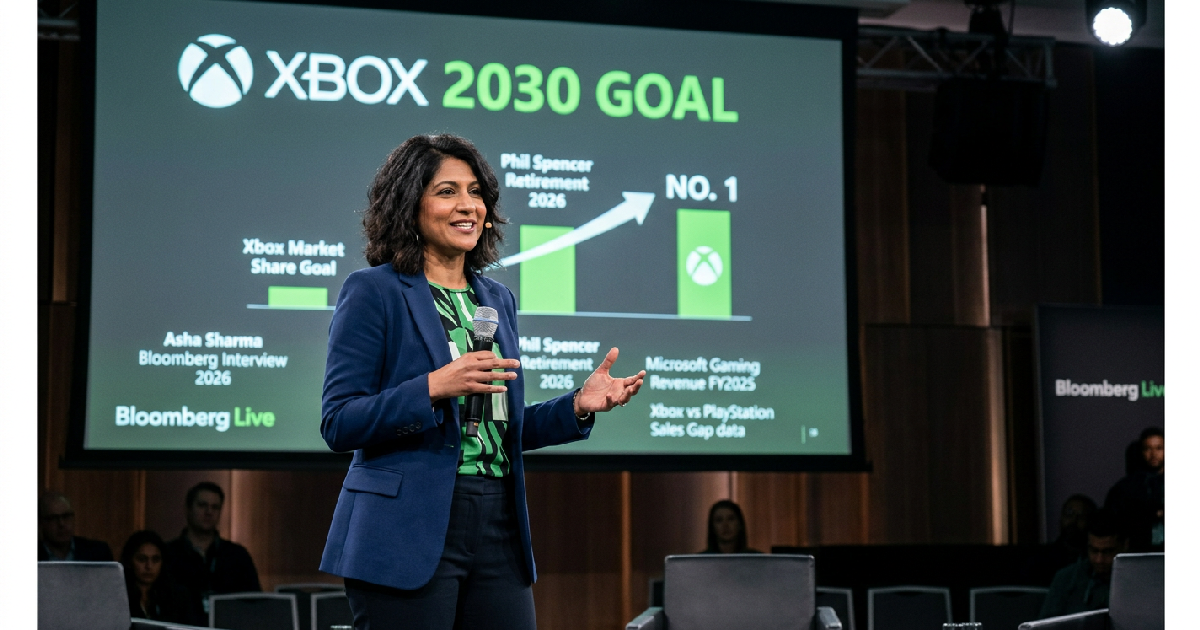
Asha Sharma targets Xbox to be number one by 2030, dismisses 30% margin goal
Xbox CEO Asha Sharma announced on Thursday, June 4, 2026, that she intends to make Xbox the “number one gaming and entertainment company” by 2030. Speaking at a Bloomberg Live event marking her first 100 days in the role, Sharma outlined a shift in strategy.
She emphasized that while Xbox is currently the number two publisher in the world, the goal is to evolve into a dominant platform through exclusive content and services. This move comes as the division prepares for the Xbox Games Showcase scheduled for Sunday, June 7, 2026.
The leadership transition that brought Asha Sharma to the helm followed the retirement of Phil Spencer from Microsoft in February 2026. Spencer left the company after 38 years, including a 12-year tenure leading the gaming division.
Former Xbox President Sarah Bond also departed during this period, while Matt Booty was promoted to Executive Vice President and Chief Content Officer. Sharma’s new mandate appears to prioritize market expansion over strict financial targets that were previously reported by industry analysts.
Reports from October 2025 indicated that Xbox faced internal pressure from Microsoft to raise its “accountability margins” by 30 percent by the end of the decade. Microsoft CFO Amy Hood was reportedly behind this target, which led to speculation regarding higher hardware prices and Game Pass subscription costs.
However, Sharma distanced herself from these specific figures during her Bloomberg appearance. “My mandate is not 30% accountability margins,” she stated, adding that her focus is on reaching the top spot in the global entertainment market.
Addressing the competitive gap in console hardware
Xbox currently faces a significant uphill battle in the hardware sector. Data indicates that the PlayStation 5 is outselling the Xbox Series X|S by a rate of more than three-to-one.
To find a difference that large between the number of PlayStation and Xbox consoles sold, one would have to go back 25 years to the launch of the original Xbox. As of early 2026, Xbox holds a 23% global console market share, compared to 45% for PlayStation and 27% for Nintendo.
The financial pressure is evident in recent sales performance. Xbox recorded its worst yearly console sales numbers ever in 2024, with hardware revenue decreasing by 13% that fiscal year. While rival platforms also saw dips, the contraction for Microsoft’s hardware was particularly sharp.
Sharma plans to “reset the business” over the next 100 days, focusing on investments and operational changes designed to return the hardware segment to growth through a more prioritized approach.
Despite hardware struggles, the software side of the business has shown resilience. Revenue for the gaming division reached $23.46 billion in fiscal year 2025. This growth was boosted by the $69 billion acquisition of Activision Blizzard King, which added significant weight to Microsoft’s publishing portfolio.
You can read more about how industry shifts affect major players in our analysis of legal challenges involving Activision Blizzard and its competitors.
A platform strategy built on exclusive content
Asha Sharma’s strategy relies on Microsoft’s massive creative workforce, which has grown to 11,200 developers. These teams oversee nearly 40 game studios tasked with creating unique experiences. Sharma noted that in order to be a great publisher, games must reach large audiences, but to be a successful platform, Xbox must have exclusive content.
This balance is critical as the company seeks to offer something distinct from its rivals, PlayStation and Nintendo.
The integration of Activision Blizzard has already had a measurable impact. In fiscal year 2024, Xbox content and services revenue increased by 50%, with 44 points of that growth attributed to the acquisition. By controlling more high-value intellectual property, Microsoft aims to drive more users toward the Xbox ecosystem.
This mirrors efforts in other sectors to secure platform dominance, such as updates for upcoming hardware releases that prioritize online features to keep players engaged.
Gaming also accounts for an increasing share of Microsoft’s total revenue, rising to 15.2% in fiscal year 2025. This financial contribution gives Sharma some leverage to pursue long-term growth rather than immediate margin expansion. The ultimate goal is to leverage the company’s 500 million monthly active users across all devices to bypass traditional hardware limitations.
Expanding the reach of Game Pass and Cloud Gaming
Game Pass remains the cornerstone of Sharma’s vision for a number one entertainment company. The service returned to growth in early 2026, reaching 40 million subscribers by the first quarter. This is up from 37 million a year earlier.
Perhaps more importantly for revenue, Game Pass Ultimate subscribers now represent 70% of the total user base. This tier provides the most robust set of features and the highest retention rates for the platform.
Cloud gaming is another area where Microsoft currently leads. Usage rose to 1.7 billion hours in 2025, a significant increase from 1.2 billion hours the year before. Xbox now commands a 62% market share in the cloud gaming space.
This technology allows Microsoft to reach the hundreds of millions of players who do not own a dedicated console, providing a path to the top spot that does not rely solely on hardware unit sales.
As the industry moves toward these digital-first models, players are seeing changes across various digital marketplaces. For example, some platforms are experimenting with new pricing structures, as seen when Valve introduced dynamic pricing systems for digital assets in major competitions. For Xbox, the focus remains on keeping the Game Pass subscription attractive enough to justify price increases that occurred in 2025 following corporate pressure.
Operational resets and the road to 2030
The next four years will be defining for Asha Sharma’s leadership. Her plan to “reset the business” involves three main pillars:
- Aggressive prioritization of investments to ensure software growth offsets hardware declines.
- Operational changes to streamline the workforce of 11,200 developers across nearly 40 studios.
- Increasing the focus on exclusive services that make the Xbox platform essential for high-end gaming.
Sharma mentioned that the company would need to deliver a playing field where it can “upset people less” than its competitors, especially as hardware prices rise across the industry.
There is a hypothetical possibility that if Xbox can navigate these challenges, it could return to a level playing field by the time a new generation of hardware arrives. However, reaching the number one spot by 2030 requires leapfrogging Sony and Nintendo during a period of slowing global console sales.
Ultimately, the success of this 2030 goal will depend on the upcoming software slate. The Xbox Games Showcase this Sunday will provide the first real test of whether Sharma’s vision can translate into the “must-play” content required to shift market share.
With roughly four years left to meet her ambitious deadline, the “reset” starting today marks the most aggressive push for dominance in the brand’s history.