

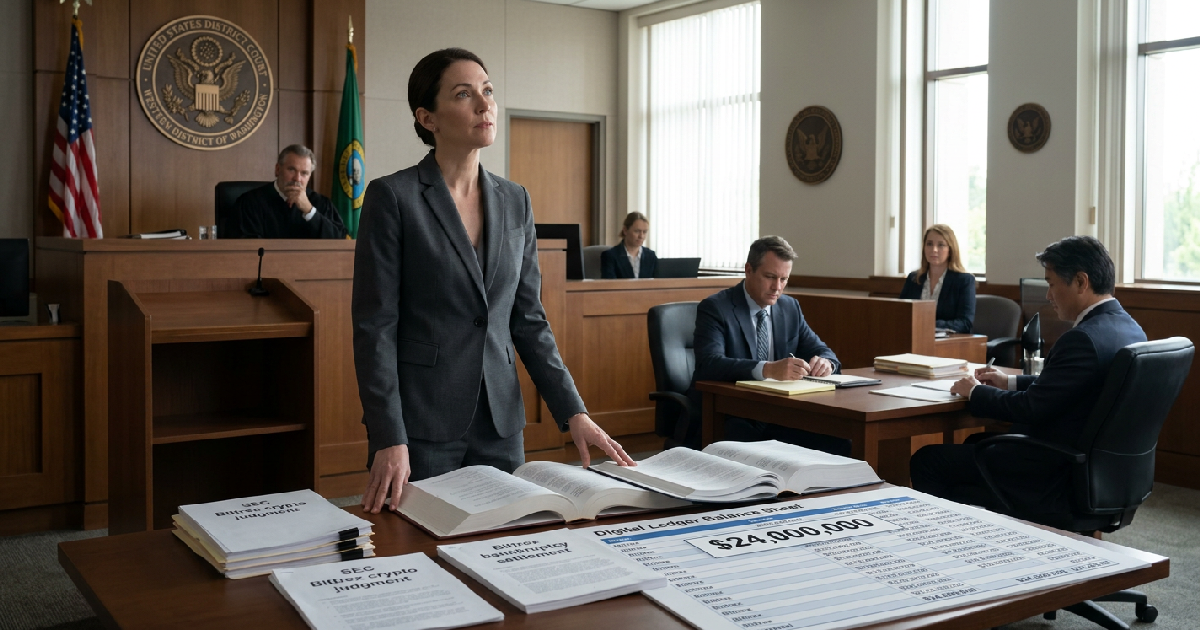
SEC rejects Bittrex’s bid to reclaim $24 million settlement funds
The U.S. Securities and Exchange Commission (SEC) is formally opposing a bid from the administrator of the bankrupt cryptocurrency exchange Bittrex to vacate a 2023 legal judgment and reclaim a $24 million settlement. Registered in the U.S.
District Court for the Western District of Washington, the SEC’s opposition seeks to block the estate’s attempt to recoup funds paid following allegations that the exchange operated as an unregistered securities broker.
The dispute stems from a final judgment reached on August 15, 2023, against Bittrex, Inc., Bittrex Global GmbH, and co-founder William Hiroaki Shihara. While the defendants settled without admitting or denying the charges, the bankruptcy administrator now argues that the SEC’s original legal theory has been effectively abandoned. The administrator’s request to overturn the judgment highlights a dramatic shift in the regulatory environment.
Attorneys for the Bittrex estate filed their request this week, asserting that the SEC’s pursuit of the exchange was “misguided from the start.” They contend that the commission has since dropped nearly all comparable enforcement actions. However, the SEC remains defiant, arguing that the settlement is a final consent decree that should not be unraveled due to political or administrative shifts.
Bittrex claims Trump return invalidates SEC playbook
The core of the administrator’s argument rests on the changing political landscape in Washington. Attorneys for the exchange claim that the SEC’s regulatory playbook for cryptocurrencies has shifted fundamentally since the return of Donald Trump to power. They argue this change makes the 2023 case irrelevant to how digital assets are governed today.
According to the filing, the SEC has essentially conceded its previous legal theories were wrong. The administrator points out that the commission has moved away from investigating many token issuers it once targeted. This argument surfaces as other significant legislative efforts, such as the Clarity Act moving to the Senate, attempt to redefine federal oversight for assets like Ethereum and Solana.
Bittrex attorneys stated that the agency has “dropped every similar case and investigation except this one.” They believe it is unjust for a bankrupt entity to remain bound by a $24 million penalty when the underlying legal logic is no longer being applied to the broader market. The SEC countered that a change in leadership does not grant a legal “redo” for settled cases.
Battle over transfer of 24 million settlement funds
The financial stakes include $14.4 million in disgorgement, $4 million in prejudgment interest, and $5.6 million in civil penalties. In March 2026, the SEC moved to transfer these funds directly to the U.S. Treasury. The agency admitted it could not reliably identify specific harmed investors for a standard distribution, making the Treasury the default recipient.
The administrator is asking the court to halt this transfer and return the money to the bankruptcy estate to satisfy creditors. This push comes as the broader market remains volatile; for instance, the Bitcoin price recently dropped to $75,406 amid shifting capital flows. For Bittrex, which earned $1.
3 billion in revenue between 2017 and 2022, this settlement represents a significant portion of its remaining reachable assets.
Supreme Court ruling on Sripetch v. SEC
The Seattle court has not yet made a final determination on the fund transfer. On April 9, 2026, the court stayed the briefing on the SEC’s motion until the Supreme Court rules in *Sripetch v. SEC*. This high-court decision is expected to clarify how the SEC can handle money collected through enforcement actions when victims cannot be found.
This stay provides a temporary window for the Bittrex administrator to argue for the return of the funds. If the Supreme Court limits the SEC’s ability to send “victimless” settlement money to the Treasury, the $24 million could potentially be redirected back to the Delaware bankruptcy court. Judge Brendan Linehan Shannon is currently overseeing the liquidation of the Seattle-based firm.
Regulatory implications and the on-chain future
The outcome of this case could influence how other major exchanges view their past settlements. Figures like Brian Armstrong have warned that finance must move on-chain to stay relevant, but legacy legal disputes continue to tether firms to old regulatory frameworks. A Bittrex victory would be a rare instance of a settled crypto case being reopened.
The SEC’s original complaint specifically named six tokens as securities: DASH, ALGO, OMG, TKN, NGC, and IHT. It also accused Shihara and Bittrex of directing issuers to delete “problematic statements” to avoid scrutiny. The SEC maintains that these facts justified the 2023 charges regardless of current policy adjustments under the new administration.
For now, the $24 million remains in legal limbo. The SEC insists that the finality of judgments is essential for administrative efficiency. Meanwhile, the Bittrex estate argues that keeping the money would essentially punish the exchange for a “misguided” strategy that the regulator has since abandoned for its peers.
The final decision rests on whether the Seattle court views the “Trump-era” policy shift as a valid reason to void a contract.