

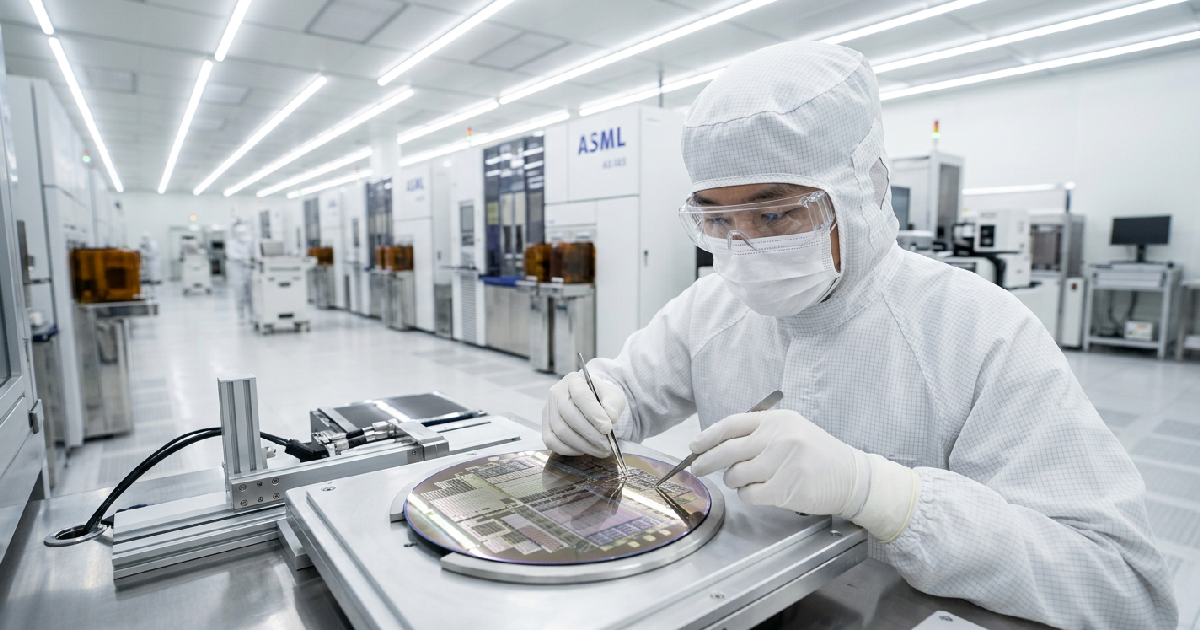
SK Hynix market value crosses $1.12 trillion on May 27, 2026
Major global technology companies are reportedly offering unprecedented financial backing to SK Hynix to secure critical memory chip supplies as an intensifying AI boom exhausts global production capacity. These proposals, reported around May 7, 2026, include direct investments in dedicated production lines and help with financing advanced lithography equipment from ASML Holding NV. The scramble for supply comes as SK Hynix, a key provider for Nvidia, dominates a market where available capacity for specific customers has effectively dropped to zero.
The South Korean chipmaker saw its market value surge on May 27, 2026, crossing the $1 trillion mark for the first time as shares jumped nearly 15% during intraday trading. By the close of that session, the company’s valuation surpassed 1,600 trillion won, which is approximately $1.12 trillion. This milestone reflects a broader trend where AI and quantum tech divert capital toward semiconductor infrastructure, driving SK Hynix’s stock price to a more than threefold increase over the course of 2026.
While the specific firms making these financing offers were not named in initial reports, industry leaders such as Alphabet, Meta, and Microsoft have recently signaled major increases in AI infrastructure spending. For SK Hynix, which is currently building a massive fabrication plant in its Yongin complex in South Korea, the offers represent a double-edged sword. Accepting customer capital could guarantee revenue but may also lock the manufacturer into supplying chips at lower prices over the long term.
The rise of memflation and its impact on hardware
The semiconductor industry is currently grappling with “memflation,” a term analysts use to describe profound spikes in memory costs. Gartner projections suggest that by the end of 2026, DRAM and NAND flash annual prices will have increased by 125% and 234%, respectively. High-Bandwidth Memory (HBM) is at the center of this crisis, as its complex production effectively “cannibalizes” standard capacity; one HBM wafer displaces two or more conventional DRAM wafers.
This supply-side pressure is already being felt in the consumer market. PC prices are expected to rise between 15% and 20% in 2026, while memory components now account for up to 20% of the bill of materials for mid-range hardware. Rajeev Rajput, Senior Principal Analyst at Gartner, warned that this inflation could destroy or delay demand for non-AI hardware into 2028 depending on the specific application.
The shift in manufacturing priorities towards AI data centers, which are expected to consume 70% of high-end memory this year, has significant global consequences. Analysts forecast that the PC and smartphone markets will shrink by up to 9% and 5%, respectively, during 2026. This contraction happens even as global stocks rise across other sectors, illustrating a sharp divide between AI-driven industrial growth and consumer electronics stability.
Strategic investments in the AI ecosystem
Beyond hardware production, SK Hynix is moving to secure its position within the broader software landscape. On May 31, 2026, Samsung Electronics and SK Hynix both acquired strategic stakes in Anthropic. The deal was part of a Series H funding round that valued the Claude AI model developer at approximately $965 billion. This move aligns with a record-setting year where global semiconductor revenue is projected to exceed $1.3 trillion.
Securing the future of AI processing requires more than just capital; it requires advanced machinery. Some of the offers to SK Hynix specifically involve financing extreme ultraviolet lithography tools from ASML Holding NV, machines that cost hundreds of millions of dollars each. By helping fund these purchases, tech giants hope to bypass the fact that current HBM production is effectively sold out through the end of 2026.
However, the caution displayed by SK Hynix executives highlights the shifting power dynamics in the tech world. With zero available capacity to designate for specific buyers, the manufacturer holds significant leverage. Just as new federal rules are reshaping the digital asset space, the semiconductor market is seeing a complete overhaul of traditional vendor-customer relationships based on extreme scarcity.
Future outlook for memory manufacturers and buyers
Relief for the conventional memory market is unlikely to arrive until well into 2027. While leading manufacturers are in the middle of multi-billion-dollar capital expenditure cycles, new production lines won’t come online fast enough to alleviate the shortages expected through the remainder of 2026. Computing and data storage segments are projected to lead the industry with 90% year-on-year revenue growth.
For now, analysts like Rajput are advising caution for corporate IT leaders. CIOs are being warned to avoid signing long-term supply agreements with unfavorable pricing terms that extend beyond 2027, as current peak prices may eventually moderate. Whether SK Hynix maintains its cautious stance or accepts the financial backing of its largest customers will be one of the defining corporate narratives of the coming year.