

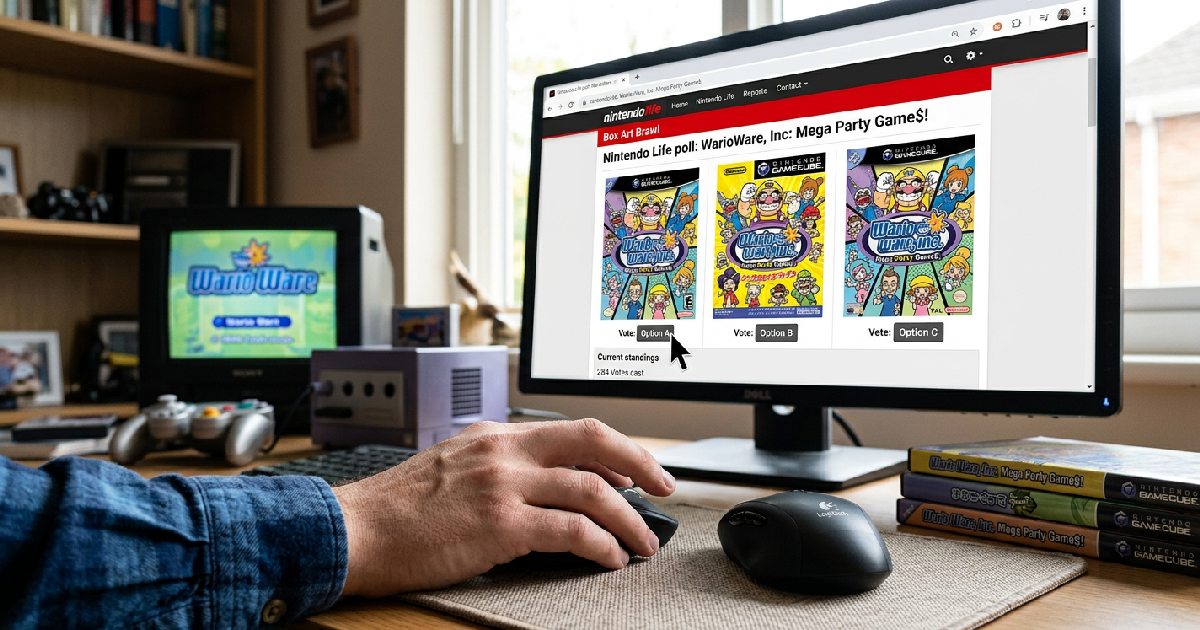
Nintendo Life launches GameCube cover art vote with 284 votes
Gaming publication Nintendo Life launched its latest “Box Art Brawl” poll on May 31, 2026, centering on the GameCube title WarioWare, Inc: Mega Party Game$!. This community event invites readers to compare and vote on the three regional cover designs released for the action-party game in North America, Europe, and Japan. The poll currently has 284 recorded votes as fans evaluate the vastly different aesthetic choices made by Nintendo during the game’s original launch cycle in 2003 and 2004.
The decision to feature this specific title follows the release of Pictonico!, a new mobile game from Nintendo that the publication noted put its team in a “microgame mood.” WarioWare, Inc: Mega Party Game$! was developed by Nintendo R&D1 and Intelligent Systems as the local multiplayer-focused home console debut for the series. It effectively brought the entire library of microgames from the handheld original into a four-player environment.
Regional variations of the WarioWare GameCube covers
The poll highlights the distinct visual identities used across the three major markets. The North American box art features a blue background with the titular character, Wario, positioned at the top and his companions situated below a central logo. It follows a layout traditional for Western marketing at the time, grouping the cast together.
Europe’s version utilizes the same Wario character asset and logo placement seen in the North American release. However, it replaces the blue background and the bonus characters with a bright yellow design. This yellow color scheme is more expansive, extending all the way into the vertical GameCube banner on the left side of the case. While some online battle mode features have defined later console hardware, this specific title was built around eight special modes for up to four local players.
The Japanese variant, titled Atsumare!! Made in Wario, takes a more abstract approach compared to its Western counterparts. Instead of using a full character render, the design features only the key facial features of Wario against a pink polka-dot background. This minimalist look focuses on the character’s instantly recognizable mustache and nose, contrasting sharply with the character-filled compositions used in the US and Europe.
Multiplayer legacy and critical reception
WarioWare, Inc: Mega Party Game$! holds a unique place in the franchise history as the first entry to emphasize group play. By packing in all the microgames from WarioWare, Inc.: Mega Microgame$! on the Game Boy Advance, the developers focused on the social aspects of the GameCube hardware. The title received a 77% aggregated score on GameRankings based on 53 reviews from critics.
The game also received professional recognition shortly after its release cycle. It earned a nomination for “Console Family Game of the Year” at the 8th Annual Interactive Achievement Awards. Despite the competitive nature of Nintendo’s software library, the title remains a frequently cited example of the brand’s experimental approach to the party genre during the early 2000s.
Historical trends in previous Box Art Brawl polls
While the final winner of the current poll is not yet determined, previous results for Wario-related titles show strong support for Western designs. In a previous poll for the original Mega Microgame$! on Game Boy Advance, the combined North American and European design secured 91% of the vote. However, Japanese designs often perform better with more unconventional titles.
The Japanese variant for The Hobbit on GBA won its respective poll with 68% of the vote. Similarly, Yoshi’s Universal Gravitation saw the Japanese design take first place with 46% of the vote, narrowly beating the European cover’s 41%. These historical results show that a stylized or abstract approach can frequently challenge the more literal character-based art found in Western territories.
Other recent polls have shown even tighter margins. In the comparison for Professor Layton and Pandora’s Box on the DS, Europe led with 41%, followed by Japan at 31% and North America at 28%. Fans continue to weigh in on the GameCube title as the vote count climbs, looking back at a release that hit Japan on October 17, 2003, followed by North America on April 5, 2004, and Europe on September 3, 2004.