

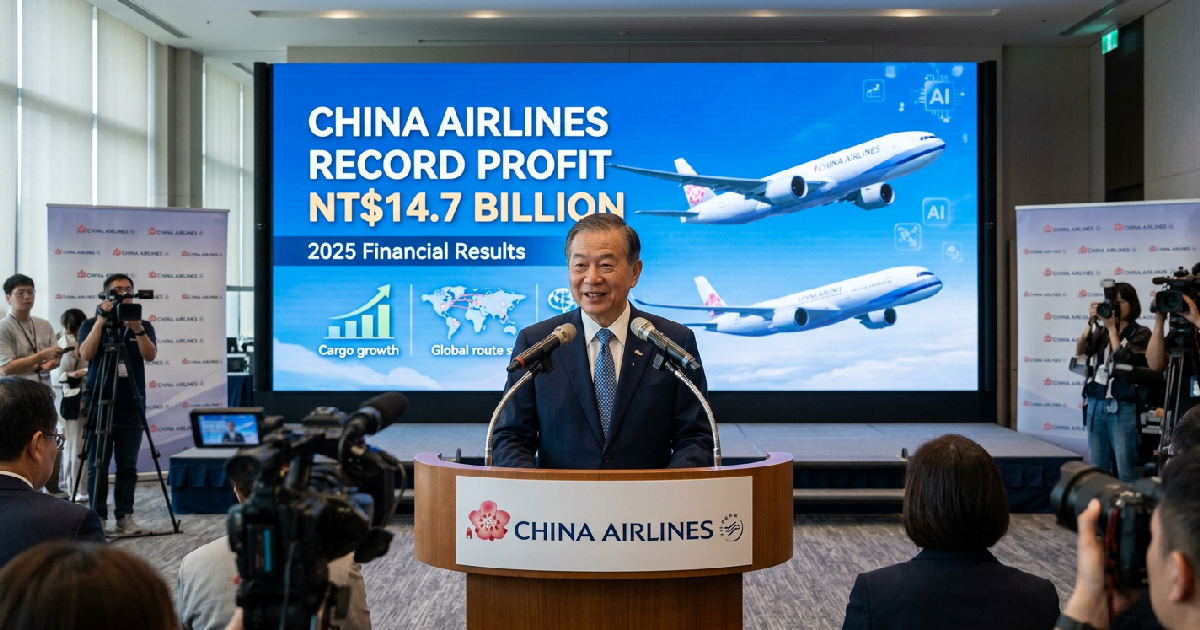
China Airlines Chairman Kao Shing-Hwang announces record NT$14.7 billion profit for 2025
China Airlines Chairman Kao Shing-Hwang expressed a bullish outlook for the carrier on May 27, 2026, as the board approved record-breaking financial results for the 2025 fiscal year. The airline’s 2025 annual results showed a net profit attributable to the parent company of NT$14.7 billion (approximately US$467 million), a new historical high for the company. This performance was driven by consolidated revenue reaching NT$209.14 billion, also a record high, as demand for AI infrastructure and semiconductor shipments continues to surge.
The 2025 results saw all three major indicators—consolidated revenue, net profit, and earnings per share (EPS)—set new historical highs. The EPS for the period reached NT$2.42, and the board subsequently approved a cash dividend distribution of NT$0.82 per share. This financial momentum comes as Taiwan remains a critical hub for high-value electronics, ensuring a steady flow of specialized cargo for the Taipei-based carrier.
Recent data indicates that the carrier’s growth is extending well into 2026. On May 11, 2026, the company reported Q1 results that set new records for any first quarter in its history. Consolidated revenue hit CNY 57 billion (US$8.4 billion), while net profit after tax reached CNY 5.17 billion. These figures represent the second-highest quarterly results ever recorded by the airline, supported by an 8% year-over-year increase in total revenue.
Taiwan AI surge fuels sustained cargo demand
The cargo business remains a vital pillar for China Airlines, with Q1 2026 cargo revenue hitting CNY 16.51 billion, a 5% increase compared to the previous year. Demand is primarily anchored by the global appetite for AI servers and semiconductor equipment. This trend follows a long-term shift for the airline; while cargo once accounted for roughly 30% of revenue pre-pandemic, it stood at 40% in 2023.
The airline’s strategic pivot toward heavy-lift capacity reached a milestone in 2021, when annual cargo revenue exceeded TWD 100 billion for the first time in its history. During 2021, at the height of the COVID-19 pandemic, the carrier utilized its fleet of 21 freighters to fly roughly 540 flights per month. This high-capacity utilization allowed the company to navigate global supply chain disruptions while maximizing returns on high-yield semiconductor logistics.
Financial analysts note that this operational strength mirrors broader market trends where specialized logistics firms outperformed expectations. For instance, the TFI International valuation recently climbed after its own earnings beat company guidance. China Airlines’ ability to maintain record revenue in the face of fluctuating global conditions highlights its entrenched role in the high-tech supply chain.
Freighter fleet transitions and route adjustments
To optimize its operations, China Airlines is moving away from the Boeing 747-400F due to high operating costs and the end of the aircraft’s production. The company plans to maintain a future fleet of 18 to 20 freighters, focusing on the more efficient Boeing 777F. As of mid-2023, the fleet consisted of 16 Boeing 747-400Fs and six Boeing 777Fs, with four additional 777Fs scheduled for delivery by the first quarter of 2024 to bring the total to ten.
Operational flexibility has also been necessary to navigate geopolitical challenges. In late February 2026, the carrier promptly adjusted several flight routes and schedules in response to escalating tensions in the Middle East. These tactical shifts were intended to minimize impacts on freighter capacity and maintain high flight frequencies despite regional instability. And while cargo remains a priority, passenger revenue grew 9% in Q1 2026, further diversifying the airline’s income streams.
This focus on technological excellence and logistical precision comes as other sectors face capital shifts. Some investors have observed how AI and quantum tech divert capital from traditional digital assets like Bitcoin. For China Airlines, the physical transport of the hardware required for these technologies is proving to be a highly lucrative niche that remains insulated from broader market volatility.
Advanced AI integration and sustainability goals
Beyond its cargo manifests, China Airlines is investing in generative AI to improve internal efficiency and customer service. President Chen Han-Ming recently outlined plans for deeper AI integration and a comprehensive upgrade of the cabin experience across the passenger fleet. The airline’s self-developed AI system has already improved quality inspection efficiency for its customer service center, earning industry recognition at the 2024 CSEA awards.
The new generative AI platform used by the airline moves away from traditional keyword matching in favor of enhanced language comprehension. This allows the system to offer multi-language support and smarter digital interactions. Such technological upgrades are part of a broader push to modernize the airline’s digital infrastructure alongside its physical fleet, which includes the phased delivery of 30 A321neo aircraft through 2027.
Environmental benchmarks and 2026 outlook
China Airlines is also pushing for regional leadership in sustainability. It was the first airline in Taiwan to use Sustainable Aviation Fuel (SAF) during ferry flights and has launched a dedicated carbon reduction program for corporate travelers. The carrier is currently the only one in the world recognized in the top 1% of the airline industry by the S&P Global Sustainability Yearbook, and it aims to meet a 2025 SAF procurement target of 0.5%.
Looking ahead, the airline is expanding its 2026 summer schedule to capture rising leisure and business travel demand. New flights are being added to several global destinations, including:
- Prague, Czech Republic
- Busan, South Korea
- Kumamoto, Japan
- New York, United States
The introduction of the new Boeing 787 Dreamliner fleet will further bolster these efforts as they enter service. Additionally, the airline is planning for the introduction of long-range aircraft models, specifically the A350-1000 and the Boeing 777-9. These fleet upgrades are intended to ensure the carrier remains competitive as global travel demand continues to heat up through the remainder of the 2026 fiscal year.