

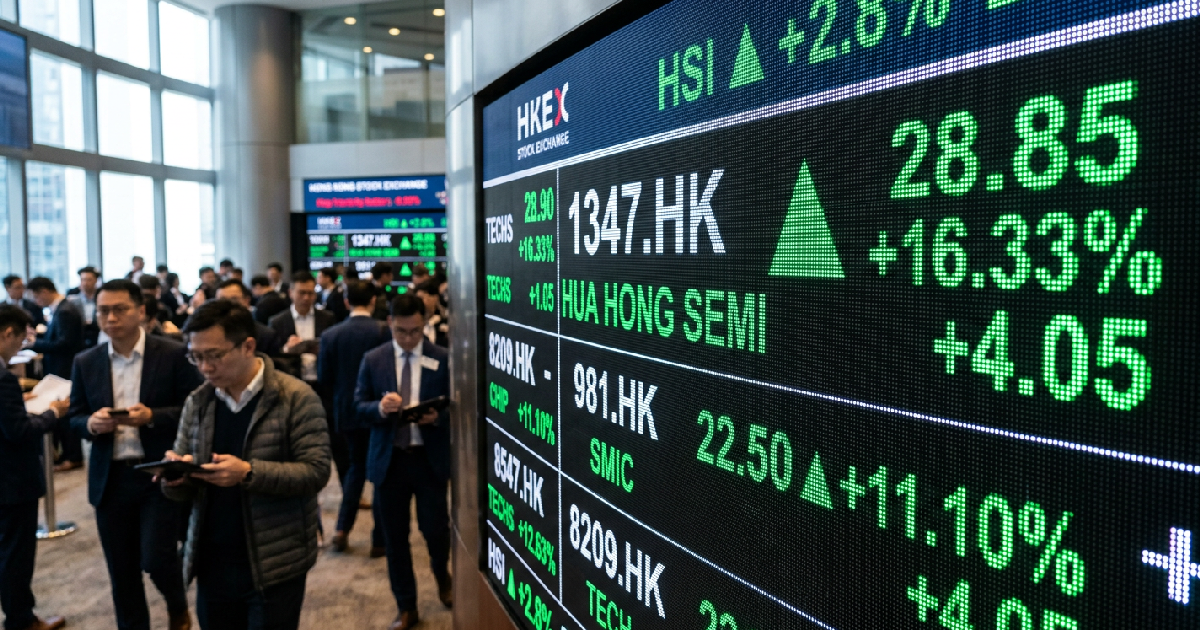
Chinese Chip Stocks Rally in Hong Kong Following Huawei Design Breakthrough
Hong Kong-listed Chinese chip stocks and artificial intelligence firms rallied on Tuesday, May 26, 2026, as investors reacted to a major semiconductor design breakthrough from Huawei Technologies Co. The surge followed a long weekend in Hong Kong, where markets had been closed on Monday for a public holiday, providing the first opportunity for local traders to price in Huawei’s announcement regarding its new architecture aimed at bypassing U.S. export restrictions.
The rally was led by semiconductor heavyweights as trading resumed. Hua Hong Semiconductor (HK:1347) closed nearly 13% higher at 149.6 HKD, after originally opening with a jump of 14.99%. Semiconductor Manufacturing International Corp (SMIC) (HK:0981) also saw substantial gains, opening nearly 15% higher before settling at 91.8 HKD, a rise of more than 10%. These moves reflect a growing confidence in China’s ability to foster a self-sufficient technology ecosystem despite a 2019 trade blacklist that continues to limit Huawei’s access to American software and hardware.
Huawei’s technological shift focuses on a new “Tau Scaling Law” and a design framework called “LogicFolding” architecture. Unlike traditional Moore’s Law scaling, which relies on physical transistor shrinkage, these innovations prioritize system-level efficiency and shortened internal chip wiring. President He Tingbo of HiSilicon, Huawei’s chip design arm, stated that the company has prepared a “major leap” for the industry and expressed confidence that its mobile and AI computing solutions will remain competitive for the next decade.
Understanding the Tau Scaling Law and LogicFolding debut
The “Tau Scaling Law” proposes a shift from node-driven scaling to what experts call system-level efficiency scaling. By focusing on “time scaling” rather than geometric scale, Huawei aims to extract higher performance from current manufacturing processes. The company expects that by applying this law, its high-end chips can achieve transistor density equivalent to 1.4-nanometer processes within the next five years. This is critical for Chinese firms that face barriers in acquiring advanced lithography equipment from overseas.
Support for this initiative comes from the “LogicFolding” architecture, which is designed to reduce latency and improve data movement. Huawei confirmed the technology will debut in its upcoming Kirin smartphone chips later in 2026 before being applied to its Ascend AI processors. This domestic progress is increasingly important as global markets remain sensitive to geopolitical shifts and trade barriers that affect high-tech supply chains.
Market performance across the semiconductor sector
Other technology and hardware stocks also profited from the bullish sentiment. ASMPT (HK:0552) saw its shares rise 11% to 212.2 HKD, while personal computer maker Lenovo Group (HK:0992) jumped 16%. GigaDevice (03986.HK) finished the day up 9.9% at 855 HKD. The broadness of the rally suggests that investors are betting on a systemic lift for the entire Chinese chip sector as Beijing intensifies its policy guidance for domestic firms.
A research report from CITIC Securities indicated that the “Tau Law” will bring profound changes across four levels: transistors, circuits, chips, and systems. The analysts believe China can use these technological strengths to compensate for short-term gaps in process node development. This technical optimism aligns with recent press briefings from the National Development and Reform Commission (NDRC), which has urged domestic AI models to adapt more quickly to home-grown computing chips.
Competing with Nvidia in the China AI market
The breakthrough carries significant weight in the AI sector, where Huawei’s Ascend processors are becoming the leading domestic alternative to restricted American products. U.S. export controls currently prevent Nvidia from selling its most advanced AI chips to Chinese customers. In fact, Nvidia CEO Jensen Huang noted in early May 2026 that the company had “largely conceded” the AI chip market in China to Huawei as domestic firms pivot to local suppliers.
He Hui, Director of Semiconductor Research at Omdia, stated that Huawei’s approach is a “credible way to extract more performance when leading-edge lithography is constrained.” By lowering latency and Improving interconnects, Huawei is effectively narrowing the gap with global leaders, even if a technology gap on the most advanced physical nodes remains. This strategy has been compared to a “second growth curve” for the industry in commentary published by the People’s Daily “People’s Sharp Review” platform.
But the broader market remains complex, as seen in other sectors where valuations have fluctuated during this period of high-tech transition. For example, TFI International’s valuation recently shifted following its first-quarter earnings report, illustrating how different sectors are navigating the current fiscal year. For now, the focus in Hong Kong remains firmly on whether Huawei can scale its architecture across its Kirin and Ascend product lines.
Future prospects for China’s self-sufficient chip ecosystem
Huawei’s recent momentum follows its 2023 comeback with the Mate 60 series, which utilized a 7-nm chip manufactured by SMIC. The latest “LogicFolding” announcement signals a move beyond simply responding to sanctions toward actively innovating new industry standards. If the Kirin chips launching later this year meet performance expectations, it could further decouple China’s consumer electronics and AI industries from foreign intellectual property.
For investors, the immediate outlook depends on the integration of these new chips with domestic large-scale AI models. With the NDRC providing clear policy guidance, the synergy between hardware designers like Huawei and the broader software ecosystem is expected to tighten. As the industry moves into the second half of 2026, the success of these system-level innovations will determine if China can effectively bypass the physical limits imposed by international trade barriers.