

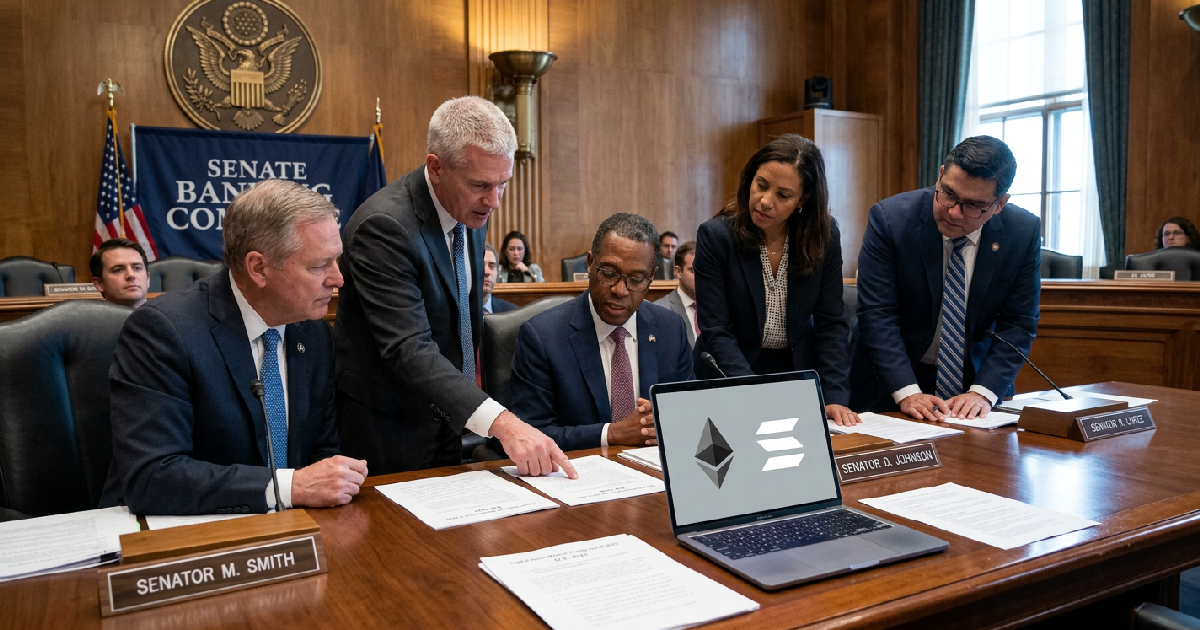
Clarity Act advances to Senate as Ethereum and Solana face new federal rules
R. 3633) on May 14, 2026, in a bipartisan 15-9 vote, moving a comprehensive federal regulatory framework for cryptocurrencies closer to becoming law. T.
Thompson, seeks to resolve jurisdictional friction between the Securities and Exchange Commission (SEC) and the Commodity Futures Trading Commission (CFTC). The bill’s progress has put a spotlight on Ethereum, Solana, and XRP as key assets that could benefit from clearer legal classifications.
The Clarity Act aims to divide the digital asset market into three distinct silos: digital commodities, investment contract assets, and payment stablecoins. Under the current draft, tokens on sufficiently decentralized networks would be classified as digital commodities under CFTC oversight. Assets that are centralized or in early-stage development would remain under the SEC’s purview. This structural shift is intended to replace the “regulation by enforcement” model with a statutory standard that provides long-term certainty for institutional investors.
This legislative movement comes as the broader market experiences a transition in capital flows. While certain digital assets have faced pressure—with Bitcoin prices retreating toward $75,406 recently due to shifts toward AI and quantum tech—the Clarity Act offers a potential stabilizing force. By codifying which assets fall under the lighter-touch CFTC, the bill could invite fresh liquidity into networks like Ethereum and Solana that have long operated in a legal gray area.
Establishing clear boundaries for Ethereum and Solana
The revised 309-page draft of the bill establishes a framework to determine when a network is “sufficiently decentralized.” For Ethereum (ETH), which is already often treated as a commodity by the CFTC, the act would provide a permanent federal shield against reclassification as a security. This removes a significant layer of regulatory risk for developers building on the network, potentially accelerating the deployment of Ethereum-based financial products.
Solana (SOL) is also positioned as a primary beneficiary of the new classification system. Frequently mentioned in SEC exchange complaints, Solana’s path to broader institutional adoption would be simplified if it is formally designated as a digital commodity. The bill also establishes a micro-innovation sandbox, allowing firms to test new products for up to two years under joint SEC and CFTC supervision. This provides a controlled environment for Solana developers to iterate on decentralized finance (DeFi) protocols without immediate fear of litigation.
Infrastructure improvements are also embedded in the Senate’s version of the legislation. The committee adopted amendments regarding portfolio margining, enabling firms to manage risk across different asset classes more efficiently. This technical change is expected to improve the depth of liquidity pools for ETH and SOL, making them more attractive to professional trading desks. As the market matures, Grayscale’s recent filings for new fund products suggest that institutional players are already preparing for this more transparent regulatory environment.
The impact on XRP and stablecoin yield limits
XRP remains a central figure in the push for federal clarity due to its history of litigation with the SEC. The Clarity Act provides a potential statutory exit for the token by defining digital commodities in a way that aligns with court rulings favoring decentralized network assets. By establishing a nationwide standard, the bill aims to prevent future legal challenges from disrupting the asset’s utility in the market.
A critical component of the legislation involves the regulation of payment stablecoins, building upon the Guiding and Establishing National Innovation for US Stablecoins (GENIUS) Act signed in July 2025. The Clarity Act prohibits digital asset service providers from paying U.S. customers passive, deposit-like interest or yield on payment stablecoin balances. This provision is designed to prevent a “yield pass-through arms race” that could potentially destabilize the traditional banking sector.
Analysts at Bernstein suggest this compromise structurally favors entities like Circle Internet Group. By protecting activity-based and distribution-linked incentives while banning passive yield, the bill supports the growth of stablecoins like USDC without turning them into direct competitors for bank deposits. Importantly, the bill clarifies that digital commodities are not considered “securities” under the Securities Investor Protection Act (SIPA), further insulating the broader market from SEC overreach.
Stricter oversight for illicit finance and DeFi
The Senate’s version of the bill places significant weight on national security and anti-money laundering (AML) protocols. Mirroring traditional banking rules, digital commodity brokers, dealers, and exchanges must now operate as financial institutions under the Bank Secrecy Act. This necessitates the implementation of rigorous customer identification and due diligence programs to track and report suspicious activity.
To balance innovation with security, the act includes a safe harbor for DeFi protocols. This allow stablecoin issuers and service providers to place temporary holds on suspicious transactions, providing a mechanism to combat illicit finance without requiring a centralized intermediary for every transaction. Senator Ruben Gallego and Senator Angela Alsobrooks were notably among the Democrats who voted for the bill, signaling a bipartisan consensus on the need for these safeguards.
Regulatory agencies will also be forced to cooperate more closely. The SEC and CFTC are required to sign a memorandum of understanding to share information and coordinate enforcement actions. This is intended to stop conflicting agency demends that have previously plagued the industry. The bill also takes a hard stance on central bank digital currencies (CBDCs), explicitly prohibiting the Federal Reserve from offering a digital currency directly to individual citizens.
Market outlook as the bill heads to the full Senate
The legislative path remains steep as the bill moves out of committee. The Banking Committee’s version must now be merged with a parallel bill from the Senate Agriculture Committee. Once a unified text is established, it will require 60 votes to clear the full Senate floor. Polymarket currently places the odds of the bill passing into law in 2026 at 62%, reflecting cautious optimism among market participants.
As of May 24, 2026, the market reaction has been largely positive. Ethereum is trading at $2,117.91, marking a daily gain of 2.60%. Solana is currently priced at $85, with investors closely watching the September 30 deadline previously mentioned by Senator Tim Scott for advancing market structure legislation. Scott has consistently referred to the House version of the Clarity Act as a “strong template” for the final law.
Failure to pass the bill this year would likely push the effort into 2027, potentially extending the period of regulatory uncertainty. However, the bipartisan majority in the Senate Banking Committee suggests a genuine appetite for finalizing the rules. If enacted, the Clarity Act would represent the first comprehensive federal effort to govern the $2 trillion digital asset market, moving it into a more rigid but predictable legal framework.