


Ubisoft doubles down on Far Cry as release drought stretches beyond expectations
Ubisoft has publicly reaffirmed its commitment to the Far Cry franchise — even as the series enters the longest content gap in its modern history.
The publisher confirmed that multiple new Far Cry games remain in active development, signaling that the open-world shooter brand continues to be a central pillar of its long-term strategy. The announcement arrives during an unusually quiet period for the franchise, one that highlights how dramatically AAA development timelines have expanded across the industry.
Franchise cadence breaks after years of predictable releases
For over a decade, Far Cry operated on a relatively steady release rhythm. Major installments were typically separated by only a few years, often supported by experimental spin-offs between flagship entries.
That pattern has now fractured.
The time since the last mainline release has already surpassed previous gaps, marking a structural shift rather than a temporary delay. The slowdown reflects broader changes affecting large-scale game production — rising development costs, expanding world design complexity, and increasingly demanding quality benchmarks.
Ubisoft is no longer shipping Far Cry on a predictable cycle.
It is rebuilding the pipeline.
Parallel projects signal multi-format future for the series
Instead of focusing on a single sequel, Ubisoft appears to be advancing multiple Far Cry initiatives simultaneously. One project continues the traditional open-world formula, while another explores a different gameplay framework designed around multiplayer interaction.
Developing parallel entries suggests a strategic repositioning of the brand. Rather than functioning solely as a single-player franchise with occasional experimentation, Far Cry is being shaped into a broader ecosystem capable of supporting different play models.
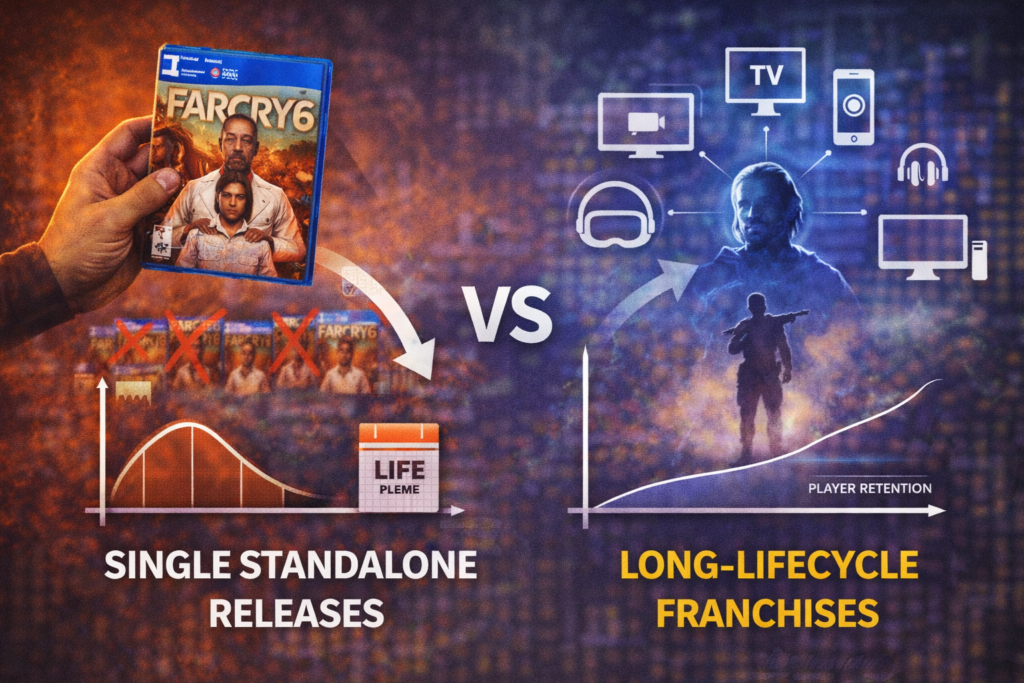
That shift mirrors how major publishers increasingly manage their flagship intellectual property — not as individual releases, but as expandable platforms.
Multiplayer remains Ubisoft’s most unpredictable battleground
While Ubisoft has delivered consistent large-scale single-player experiences, its record in competitive multiplayer development has been uneven.
Attempts to establish new long-term live-service hits have repeatedly struggled to gain traction. This history raises questions about how effectively the company can translate Far Cry’s design identity into a persistent multiplayer environment.
Creating shared-world systems, progression economies, and player retention loops requires a different development philosophy than building narrative-driven open worlds. The challenge is not technical scale, but systemic balance.
That distinction may explain why certain projects have evolved significantly during development.
Assassin’s Creed pipeline remains comparatively stable
While Far Cry’s release structure is being reworked, Ubisoft’s other flagship franchise shows clearer forward momentum.
Multiple Assassin’s Creed titles remain in production across different formats, including traditional single-player experiences and multiplayer expansions. The brand’s long-term roadmap appears more defined, even as individual projects shift schedules.
The contrast between the two franchises illustrates how differently major series can behave under modern production pressure. Some pipelines stabilize through iteration. Others require structural redesign.
AAA development economics are reshaping franchise management
The extended Far Cry gap reflects more than internal delays. It signals a wider industry transition.
Large open-world games now demand longer production cycles, larger teams, and higher financial risk. Publishers increasingly prioritize durability and scalability over release frequency. Launches must sustain engagement for years rather than months.
In this environment, fewer releases may represent a deliberate strategy rather than a setback.
Ubisoft’s focus appears to be shifting from regular franchise output to long-lifecycle franchise ecosystems.
Transmedia expansion keeps brands active between releases
Even without a new game on shelves, Far Cry and Assassin’s Creed continue to expand into other media formats.
Film and television adaptations are in development, extending brand visibility beyond interactive releases. These initiatives help maintain audience engagement while game production stretches across longer timelines.
For major publishers, intellectual property no longer depends solely on game launches to remain relevant.
What Ubisoft must deliver next
Public confirmation of multiple projects raises expectations that tangible results will follow.
Players and industry observers alike will be watching for concrete demonstrations of progress — gameplay reveals, release windows, and clearer definitions of how each project fits within the broader franchise strategy.
After such an extended hiatus, the next Far Cry release will carry more weight than usual. It will not only introduce a new entry, but signal whether Ubisoft’s restructured development approach can restore momentum to one of its most recognizable series.
The franchise isn’t disappearing — it’s being recalibrated
The absence of new releases might suggest stagnation, but Ubisoft’s messaging indicates the opposite. The company is repositioning Far Cry for a different era of game production — one defined by longer timelines, broader formats, and higher expectations.
If that recalibration succeeds, the current silence may ultimately be remembered as a transition period rather than a decline.
For now, the future of Far Cry is not uncertain — only delayed.
Source: https://kotaku.com/far-cry-7-extraction-shooter-assassins-creed-hexe-ubisoft-2000672574